
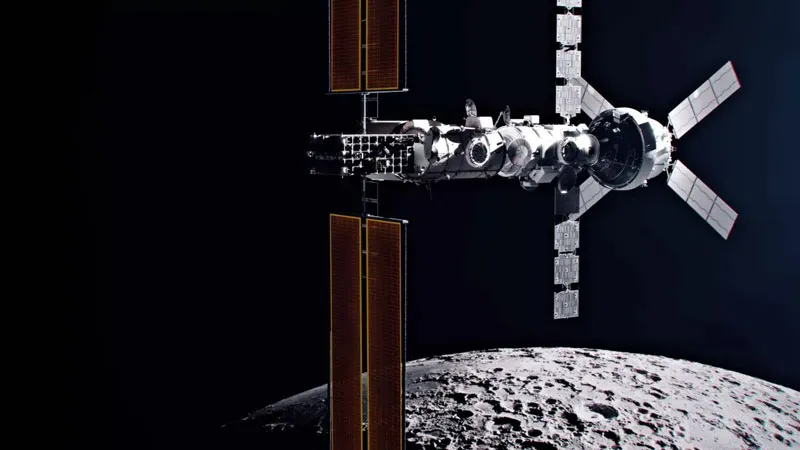
The future NASA Gateway lunar station has been canceled and will even be dismantled, but the idea of a transfer point may live on. As traffic increases between Earth and the Moon, another station could appear in lunar orbit through which cargo and crew would travel to the satellite’s surface. If flight is to become truly regular, the spacecraft’s motion must be regulated and optimized in some way. Scientists have carefully calculated suggestion on this matter.
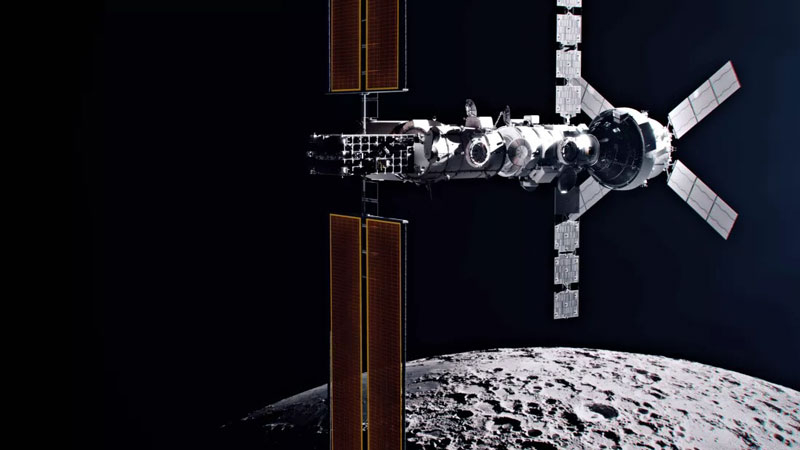
Image source: NASA
The research was conducted by experts at Texas A&M University, NASA’s Johnson Space Center and Purdue University. They developed a mathematical model for controlling spacecraft flow, designed to prevent chaos when multiple spacecraft arrive at a lunar station at the same time. In fact, we are talking about the first traffic rules of the future “lunar airport”, whose role is initially assigned to the gateway and may in the future go to another station.
The researchers hypothesized that such a space station would operate in an NRHO (near rectilinear halo orbit) orbit, which was previously selected as the gateway. It is a highly elongated orbit around the moon, with the space station passing about 1,600 kilometers above the satellite’s north pole before moving to nearly 64,000 kilometers above the satellite’s south pole. The orbit provides constant communication with Earth and requires relatively little fuel to maintain, but the complex interaction of the Earth and Moon’s gravity makes it difficult to control multiple spacecraft approaching the space station simultaneously.
Unlike airplanes at airports on Earth, spacecraft cannot simply stop and wait for a free space in the terminal. They are constantly moving in orbit, waiting for docking that can last hours, days or even weeks. The researchers ran thousands of computer simulations, taking into account the effects of navigation errors, engine errors and celestial gravity. Therefore, they proposed the concept of a “string of pearls”: ships waiting for docking are placed in front or behind the space station in the same orbit at calculated intervals.
To support this structure, scientists propose using relative orbit control algorithms to track each vehicle’s position relative to the space station, rather than the moon or Earth. Smaller, more frequent trajectory corrections keep the ship in a predictable position while minimizing fuel consumption while reducing the risk of collision.
The proposed system is not yet an official set of rules for lunar orbital motion, especially considering that the Gateway itself has been cancelled. However, the principles developed could form the basis of a future lunar traffic control system – a scheduling service in the era of scheduled flights between Earth and the Moon.
If you find an error, select it with your mouse and press CTRL+ENTER.