
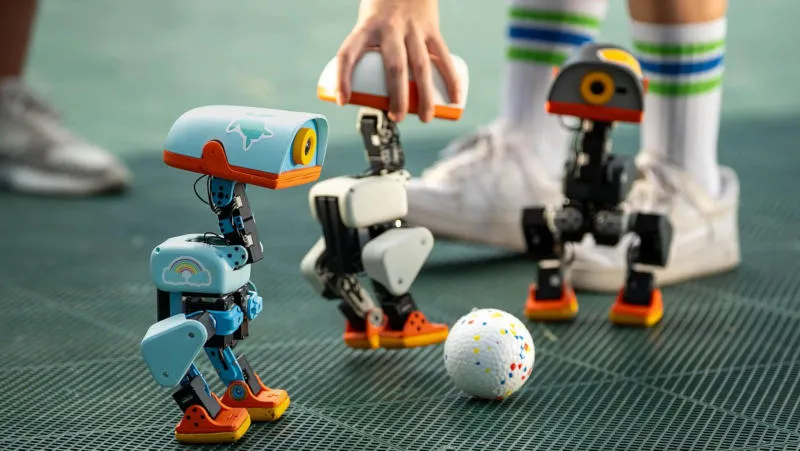
Artificial intelligence platform Hugging Face has launched Microduck, a $399 bipedal robot that can be independently programmed and teach new skills. Developers hope to use it to make experiments in artificial intelligence and robotics more accessible to a wider audience.
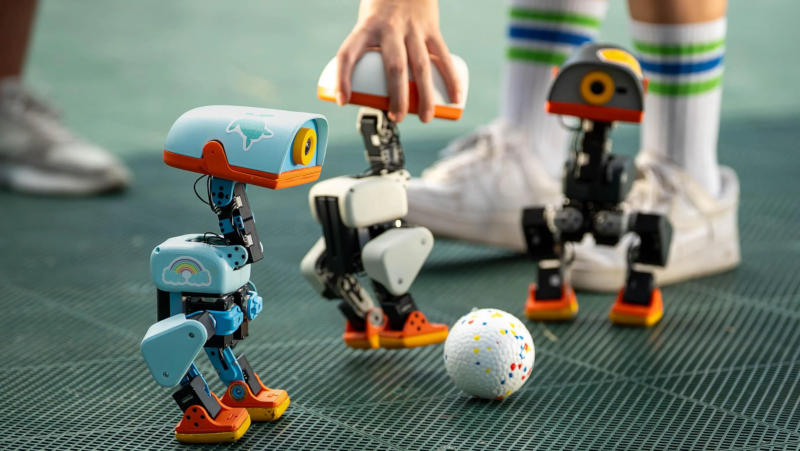
Image source: Huofian
Microduck does look a lot like a duck, even though the robot only has one eye and no wings or arms. Part of their function is performed by a movable beak, which can be used to grasp small objects. The Microduck is approximately 25cm tall and weighs less than 800g. Fifteen electric motors are installed inside to provide movement of the legs, head, neck and beak.
Both beginners and experienced developers can be taught new skills with Microduck. Reinforcement learning, modeling, and open source software can be used for this purpose, and can be programmed in Python and JavaScript. New behaviors can be trained in the MuJoCo simulator first and then transferred to the real robot. The Microduck software stack is open source. French companies participate in equipment research and development pollen robotHugging Face acquired the company last year.

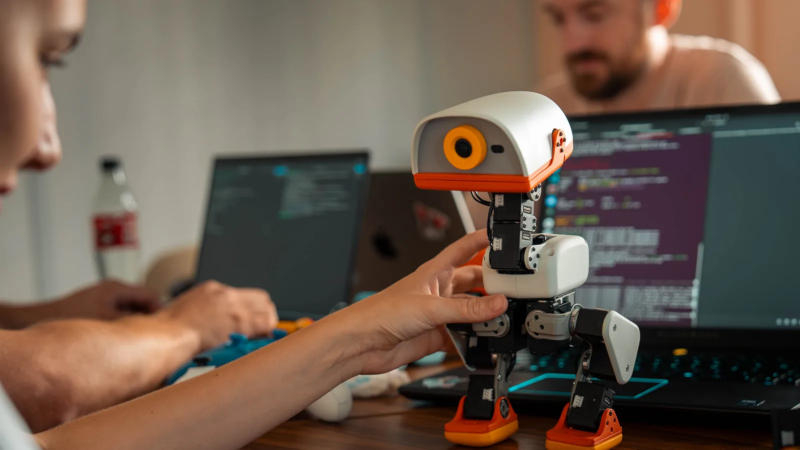
At the same time, Microduck knows how to entertain its host immediately after opening the package. Seven behavioral modes have been prepared for it: the robot can walk, squat and stand up, kick a ball, grab small objects with its beak, roller skate, and get up independently after falling. You can control it with a full game controller or even a laser pointer, and the robot can follow it.
Microduck can also “speak,” although the developers deliberately avoid using human language. Instead, the robot emits special sounds designed to make it more like a living creature than a voice assistant. Each instance receives its own sound “personality” when first turned on and retains the same sound throughout its lifetime.
In order to interact with the outside world, Microduck is equipped with a camera, microphone, speaker, lidar and motion sensor, and also supports Wi-Fi and Bluetooth. There are also two NFC readers available for use with other accessories. For developers who find the basic functionality insufficient, a separate expansion kit will be available.

In the demonstration, several miniature ducks roller-skated and sang together, while a single robot carried socks, markers and other small objects in its beak. The developers also suggest experimenting with the collective behavior of multiple robots, such as organizing games or playing football with them.
Hugging Face expects to sell more than 20,000 Microducks. Company head Clément Delangue said selling 50,000 copies would be a huge success. Pre-orders are currently available for $399 (excluding tax and shipping), and the first customers should receive their robots before Christmas. Available in four colors: cream, graphite, lilac and blue. Microduck is produced in China in collaboration with Shenzhen Seeed Studio.
If you find an error, select it with your mouse and press CTRL+ENTER.