Scientists from the University of Witwatersrand (Wits, South Africa) and the University of Bordeaux (France) show A new method of transmitting information using laser beams can preserve data even after it is severely distorted by atmospheric turbulence. Unlike traditional optical communication systems, which must use complex adaptive optics algorithms to compensate for jitter and distortion in light beams, researchers encode data using the topology of light.
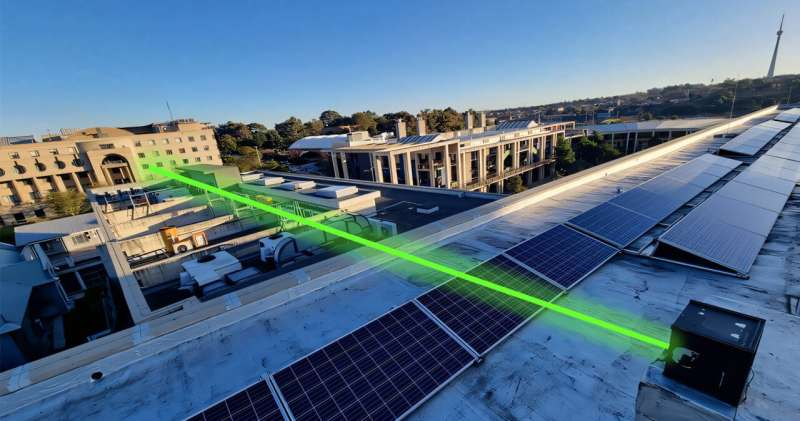
Image source: Wisdom
The technology is based on the use of lightweight structures, e.g. Skyrim – Vortex structures of electromagnetic fields, in which information is recorded not in the precise form of light pulses, but in its topological state. Topology remains unchanged nature of space For example, with continuous deformation, a circle turns into an ellipse and vice versa, making them topologically identical. Therefore, atmospheric flows can drastically change the appearance of a laser beam, but its topological characteristics remain the same and can be read by the receiver.
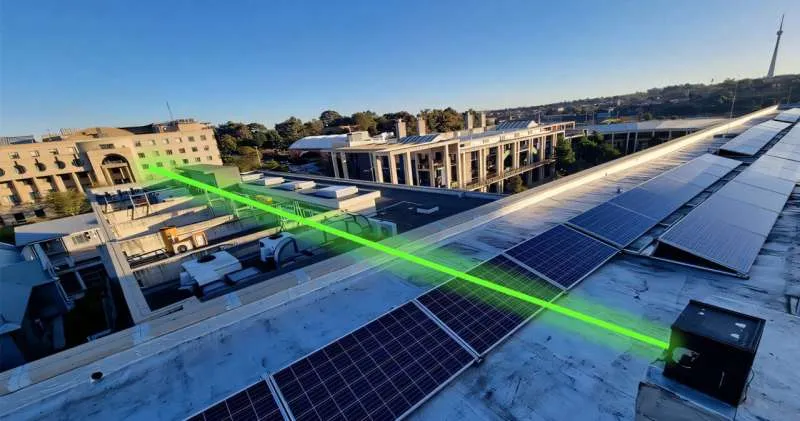
To test the method, the researchers transmitted laser beams hundreds of meters between buildings on the Wits Johannesburg campus. The beam passes through natural atmospheric turbulence caused by uneven air heating, flow, and random changes in refractive index. Although the shape of the received light spot is significantly different from the original light spot, the topological information encoded in it is preserved. This experiment therefore demonstrates the possibility of optical communication without the need for forced preliminary correction of distortion, which is usually done by adaptive optics.
The development could form the basis for more powerful laser communication systems between ground stations, drones, aircraft and spacecraft. Atmospheric turbulence remains one of the major challenges in transmitting data using light in open space, especially for high-speed quantum and optical links. The researchers believe that exploiting the topological properties of light could improve the reliability of future optical networks, as the data will not be affected by deformation of the beam itself, but by loss of the underlying structure, which does not occur in practice.
If you find an error, select it with your mouse and press CTRL+ENTER.