


In the semiconductor component market, many companies have long acquired specialization, which allows them to produce according to orders from third-party developers. Since they have more and more customers as artificial intelligence booms, and the demand for chips in general continues to grow, it’s no surprise that these market players’ revenue grew by 29% in the second quarter of 2026.

Image source: Samsung Electronics
This statistic comes from counterpoint study The exact amount of revenue was not specified. The leader in the chip foundry services market remains Taiwan Semiconductor Manufacturing Co., Ltd., whose share increased from 71% to 73% in the past 12 months. South Korea’s Samsung, which also produces its own chips, has maintained a 7% share for four consecutive quarters, despite taking an 8% share in the second quarter last year, compared with 9% in the previous quarters. As TSMC strengthens its position mainly by increasing production of advanced 3nm and 2nm chips, Samsung is trying to follow its lead. However, in the second half of the year, due to the increase in the supply of 5-nanometer and 4-nanometer products and the increase in service prices, the latter’s revenue grew even more.
China’s SMIC held 5% of the global contract chip manufacturing market over the past 12 months, ranking third despite itself generating record revenue in the second quarter and showing good financial results. The company also benefits from foreign orders and therefore serves not only the domestic Chinese market.
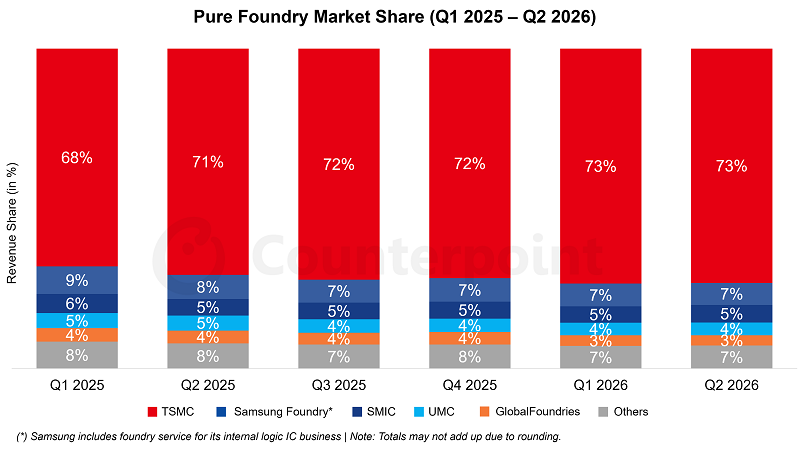
Image source: Counterpoint Research
Although Taiwan UMC has retained its position as the island’s second-largest contract chip manufacturer, it not only lags far behind TSMC, but also lags behind China’s SMIC in the global rankings, with only a 4% market share. By the way, it was on par with SMIC a year ago, but now it is inferior.
U.S. firm GlobalFoundries shuts down five of its largest contract manufacturers, fueled by money from Arab investors. Its position fell from 4% to 3% in one year. Overall, the top five players control 93% of revenue, with other players accounting for the remaining 7%. Consolidation continues, with them sharing 8% of global revenue in this segment in the second quarter last year.
If you find an error, select it with your mouse and press CTRL+ENTER.