
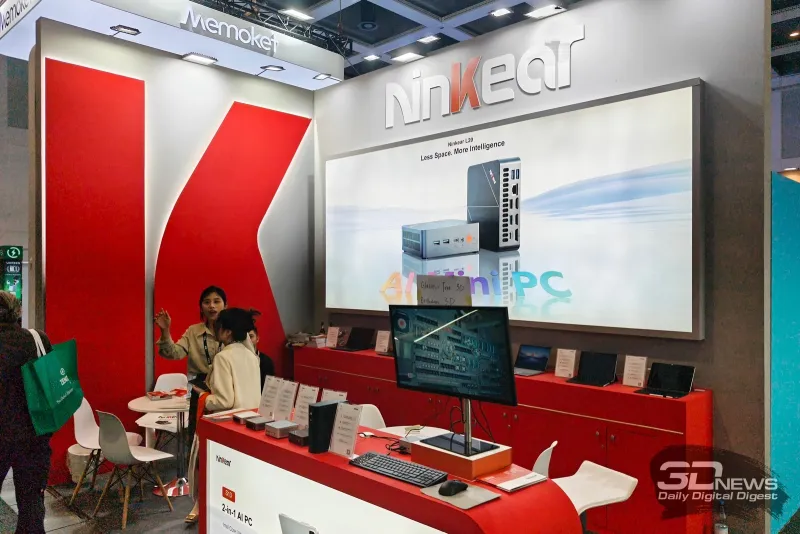
Ninkear brings a fairly compact but diverse selection of devices to IFA 2026. These include Windows tablets that can be turned into laptops, classic laptops with different hardware, and a whole range of mini PCs. The general idea is simple: provide computers for work, school and home – from budget models to machines that can handle serious work and creative tasks.
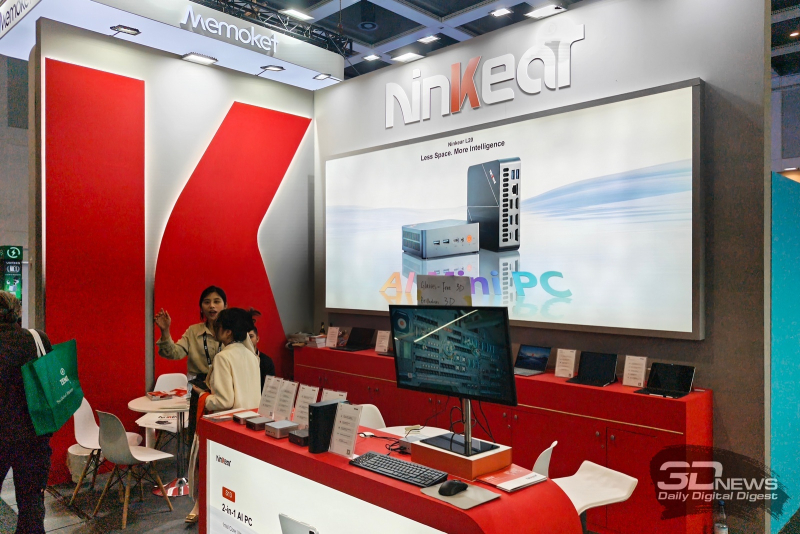
Ninkear is a Chinese computer brand founded in 2020, focusing on notebook computers, mini computers and other compact computing devices. The company mainly focuses on users who need a computer that is powerful enough and affordable enough to complete work, study, and daily tasks. Ninkear products are now sold to more than 25 countries and regions, including Europe, Russia and CIS countries. Recently, the company has also been developing devices with local acceleration of AI algorithms.
Ninkear S13 and S13 Neo convertible tablets on Windows 11
The Ninkear S13 and S13 Neo are built in a 2-in-1 format: these are Windows tablets with a keyboard attached. Visually, the two devices resemble Microsoft Surface Pro-class solutions – tablets that can be used as standalone devices and, if necessary, transformed into compact laptops. This format is great for traveling, meetings, working on documents, taking notes and reviewing content using handwritten notes.
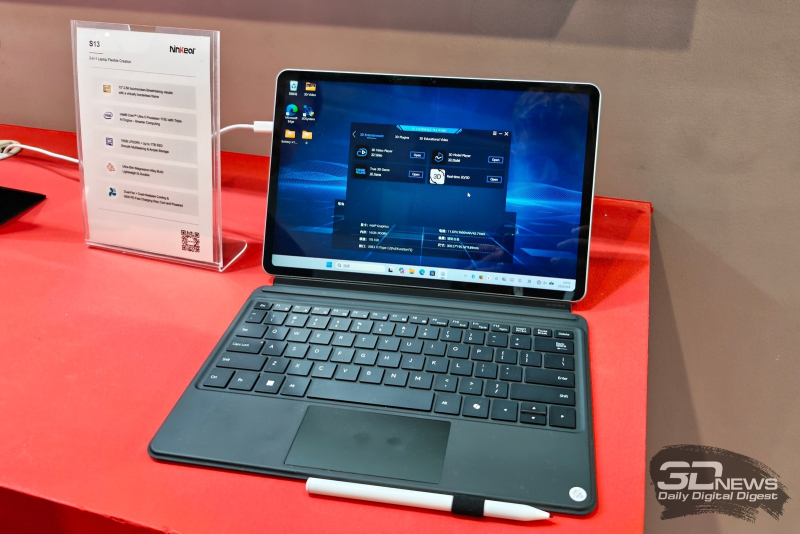
The old S13 is equipped with a 13-inch IPS display with a resolution of 2.5K (2560×1600 pixels). An interesting feature of this model is support for outputting 3D content without the need for special glasses, as well as support for converting regular 2D video to 3D.
There’s an Intel Core Ultra 5 115U inside – an eight-core, 10-thread processor with a top frequency of 4.2 GHz. Configurations include 16 GB LPDDR5 and 1 TB SSD. Integrated Intel Graphics is responsible for graphics processing, and the processor is equipped with an NPU to accelerate AI tasks.
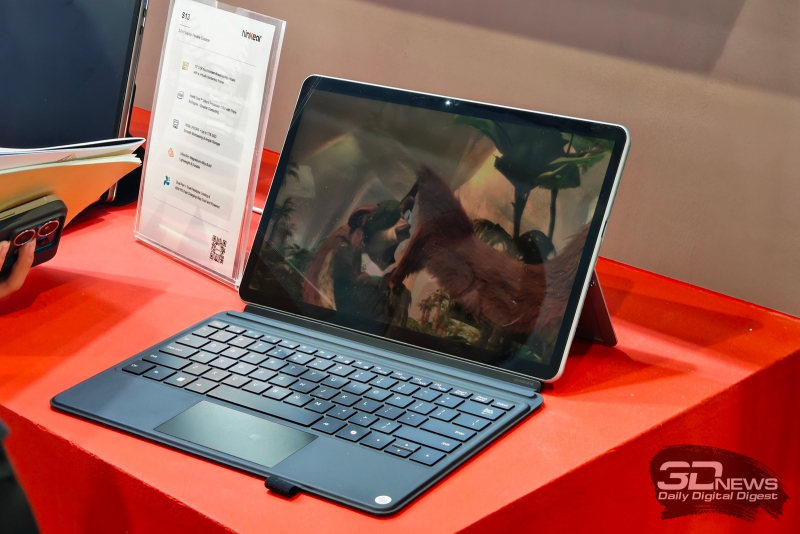
At the same time, the S13 is also truly compact: the magnesium alloy body measures 300 × 195 × 10 mm and weighs only about 850 grams. The 46.2 Wh battery supports charging via USB Type-C with power up to 65 W. There is also a cooling system with two fans and two heat pipes, and 5-megapixel cameras are installed on the front and back.
The S13 Neo is a more affordable version. It uses Intel processor N150, installs 12GB LPDDR5, has a screen diagonal of 13.2 inches and a resolution of 3K. At first glance, the resolution is even higher than the older model, but the differences between the units lie mainly in the platform: the N150 is designed for basic day-to-day tasks, while the Core Ultra 5 offers significantly higher performance margins.
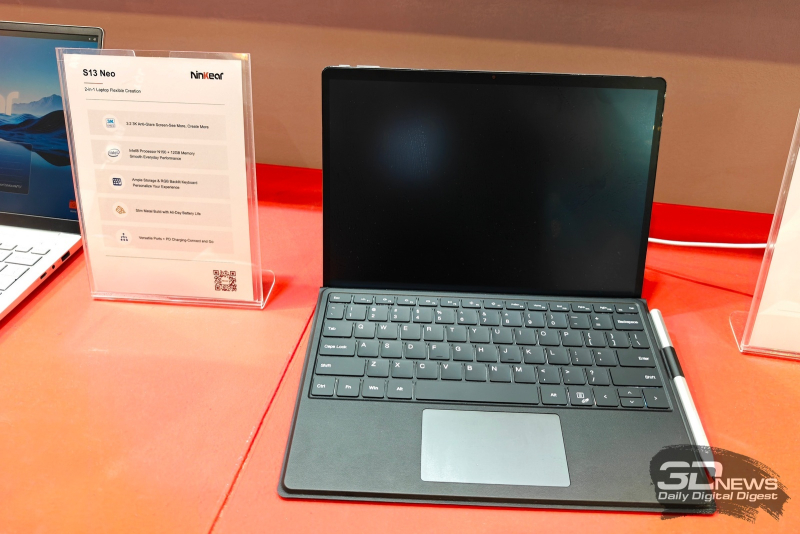
Neo also supports stylus and comes with a detachable keyboard with RGB backlight. Therefore, it is a fun choice for studying, note-taking, web services, video calls and watching movies. However, for heavy multitasking or resource-intensive work, it’s better to focus on the regular S13.
Ninkear S14, Ybook 15 and A15 Pro laptops
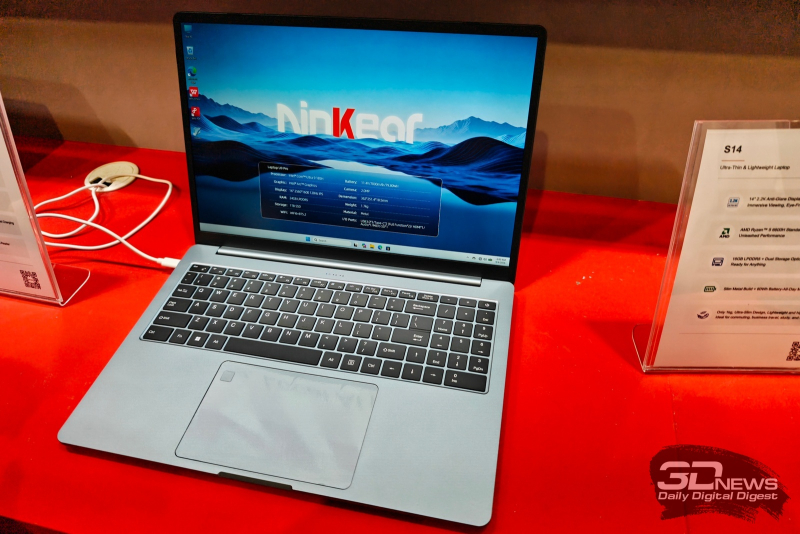
The Ninkear S14 is already a classic laptop without a distorted design. The company has made it as light as possible: the device weighs about 1 kg, the body is made of metal and is about 15 mm thick. But at the same time, the device provides very efficient filling.
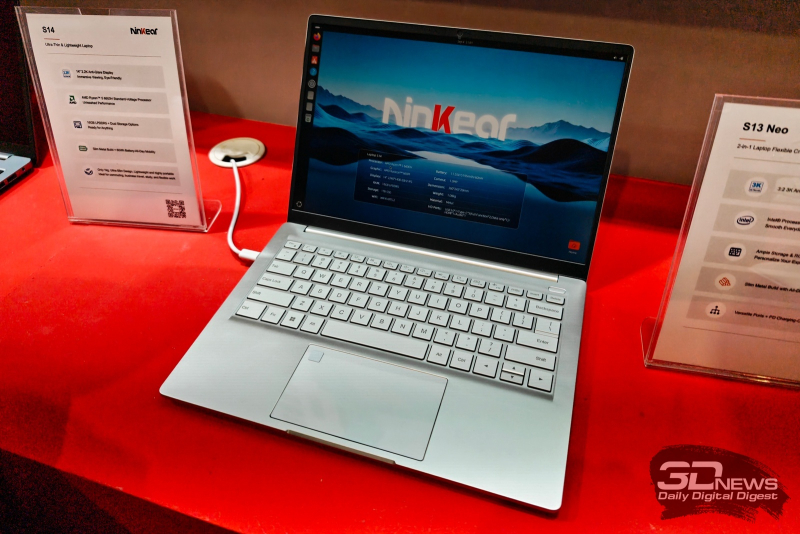
A version equipped with AMD Ryzen 5 6600H was shown at the exhibition. It’s a six-core, 12-thread H-series processor that’s significantly more powerful than typical power-saving laptop chips, especially when running multiple applications, files, code, photos or light video editing. The chip comes with 16 GB LPDDR5 RAM and 1 TB storage space.
The 60 Wh battery ensures autonomy and supports 65 W charging via USB Type-C. For connecting peripherals, there are two full-featured USB-C, an additional USB-C, USB-A, HDMI and an audio jack. Wi-Fi 6 and Bluetooth 5.3 are also supported. As a result, the S14 looks like one of the most balanced laptops in the series: compact enough to be carried around often, but with reasonably powerful hardware.
The Ybook 15, on the other hand, relies not on performance but on a convertible design. This is a 15.6-inch laptop with a touch screen and a hinge that allows you to open the device 360 degrees. It can be used as a regular laptop, placed as a “house” for watching movies, or folded into a large Windows tablet. Since the diagonal is 15.6 inches, the latter case won’t suit everyone, but the touchscreen is fine for presentations, interface work, and home use.
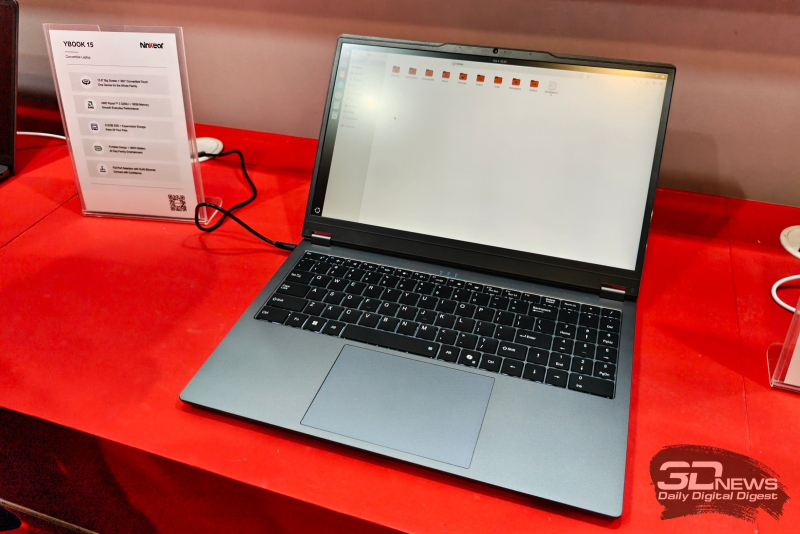
The Ybook 15 runs on an AMD Ryzen 3 3200U, a middle-aged quad-threaded dual-core processor. The device comes with 16GB DDR4 and 512GB SSD. The suite shouldn’t be considered a heavy-duty platform, but it should be enough for training, remote working, web services, and watching videos. The screen resolution is 1920×1080 pixels. The battery is rated at 38 Wh.
The Ninkear A15 Pro is a traditional 15.6-inch laptop from the affordable segment. The booth showed off a modded version powered by an AMD Ryzen 5 5500U, 16 GB DDR4 RAM, and a 1 TB SSD. The integrated Radeon core is responsible for graphics processing, and the battery capacity is 54.29 Wh.

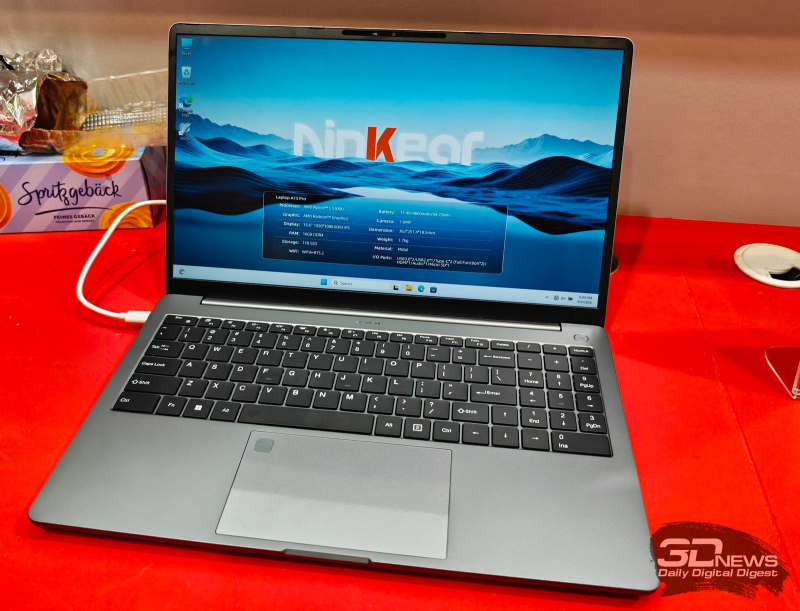
The A15 Pro body size is 361 x 237 x 18.5 mm and weighs about 1.7 kg. This isn’t the lightest laptop on display, but it should be thought of more as a primary home or work computer rather than a device that’s always in your backpack. The proposed feature set is suitable for office programs, working with documents and spreadsheets, web development, remote working and multimedia. You can also play games on integrated graphics, but you should rely on less demanding projects or lower settings.
Ninkear U9 Pro: The most powerful laptop in the series
The Ninkear U9 Pro can confidently be called the flagship product of Ninkear laptops. It is built on the Intel Core Ultra 9 185H, a 16-core, 22-thread mobile processor clocked at up to 5.1 GHz. It contains various types of computing cores, integrated Intel Arc graphics cards and neural accelerators. For the AI unit, the company claims performance up to 35 TOPS. In practice, NPUs are useful for video calls, local speech recognition, image processing, certain editing functions, and some scenarios using compact AI models.
U9 Pro is equipped with a 16-inch screen with a resolution of 2.5K (2560×1600 pixels) and a refresh rate of 120Hz. It is equipped with 24GB LPDDR5 RAM and 1TB SSD. The large display and increased memory make it better suited for handling graphics, multiple heavy-duty applications, virtual machines, and larger projects than traditional office models.
At the same time, the U9 Pro shouldn’t automatically be classified as a gaming laptop. It does not have a discrete graphics card, so the performance of modern heavy-duty games and professional 3D programs will depend on the capabilities of the integrated Intel Arc graphics card. But as an efficient mobile machine suitable for work, school, programming, photo editing, and multimedia tasks, it looks like Ninkear’s most serious laptop at IFA 2026.
Mini PCs: From small office machines to artificial intelligence stations
The second half of the Ninkear show was dominated by mini PCs. Here, the company showed off multiple models at the same time, and the performance gap between them was quite obvious.
MBOX 18 is a microcomputer weighing only 478 grams and measuring 116 x 107 x 36 mm. It is equipped with the new Intel Core 3 304 – a five-core chip with a maximum frequency of 4.3 GHz, built using Intel 18A process technology. The computer comes with 12 GB LPDDR5X and 512 GB SSD. Interestingly, despite its small size, it has two SSD slots, so storage can be easily expanded.
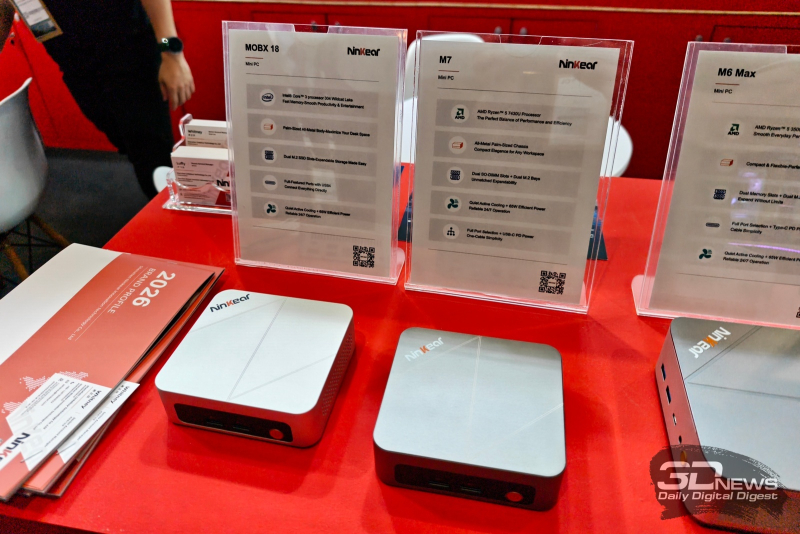
MBOX 18 is based on Intel Core 3 304. It’s a compact mini PC with an aluminum casing, designed for everyday work. The manufacturer provides two M.2 slots for storage devices, full-featured USB4 and active cooling. This model is suitable for browsers, documents, accounting applications, media players, remote access to work PCs and home offices. For those for whom 1 SSD is not enough, the two M.2 slots are particularly useful: you can store system and work files separately without resorting to external drives.
Ninkear pays special attention to AI: the built-in Intel AI Boost unit provides up to 15 TOPS. The company cited features such as background blur, automatic framing, gaze correction and noise reduction during video conferencing as examples of its use.
The M7 looks like a version of the MBOX 18, but is based on the AMD Ryzen 5 7430U. This is a six-core processor with 12 threads and a frequency of up to 4.3 GHz. It has built-in Radeon Vega 7 and has good multi-tasking capabilities. This mini PC has two SO-DIMM slots for RAM and two M.2 slots for SSD, which means the upgrade options are significantly better than most compact laptops. The device also includes USB-C support for power delivery.
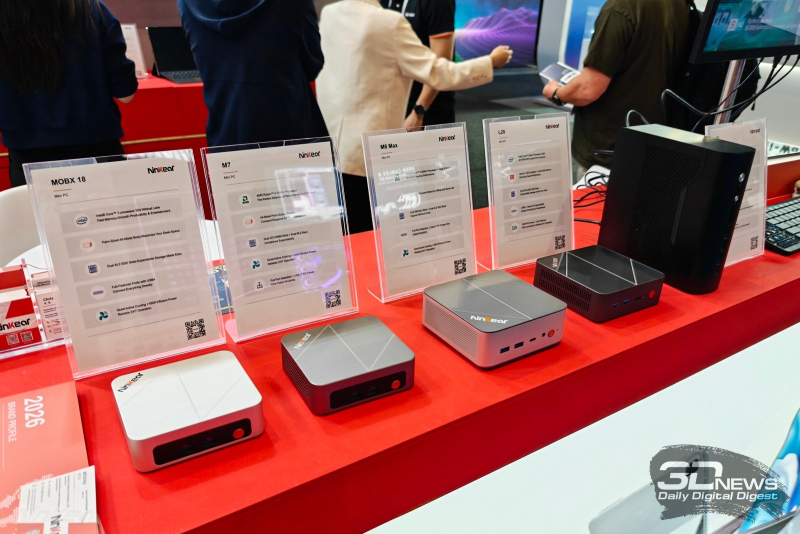
This kit allows you to use the M7 not only as an office device, but also as a compact home system unit, a computer that can be used with multiple monitors (up to three 4K resolutions), or as the basis for a workplace where you don’t want to take up a big box desk. The integrated graphics card here still doesn’t replace a discrete accelerator, but it’s more than enough for multimedia, less demanding gaming, and everyday work.
The M6 Max is a simpler, more affordable mini PC based on the AMD Ryzen 5 3500U with integrated Radeon Vega 8 graphics. This configuration is designed for everyday tasks – office work, multimedia and home use.
Meanwhile, the case retains its compact dimensions, with two memory slots and two M.2 slots for drives inside. At the booth, Ninkear also highlighted a full range of connection ports, support for USB-C power supply, and an active cooling system with 65W power.
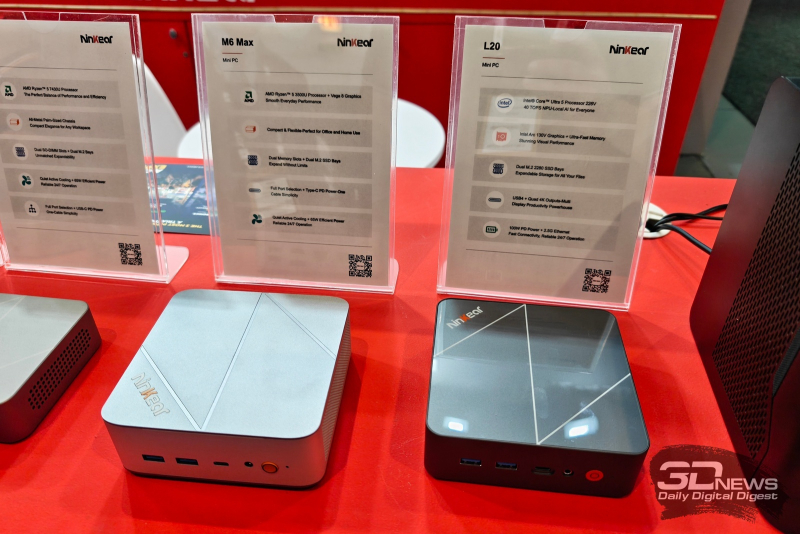
For those looking for a more powerful yet still compact work system, Ninkear offers the L20 Mini PC. It uses the Intel Core Ultra 5 226V Lunar Lake generation processor with built-in NPU, performance up to 40 TOPS, and integrates a very powerful Intel Arc 130V graphics card.
The L20 is interesting mainly because it combines compactness with the latest platform. The integrated Arc 130V graphics card should be noticeably more fun than the old Radeon Vega in graphics tasks and modern multimedia scenarios, and the NPU will be useful in programs that use native AI acceleration.
In terms of volume, L20 only occupies about 0.66 liters. This set of interfaces includes USB4, several USB 3.x, two HDMIs, DisplayPort, 2.5 Gigabit Ethernet, Wi-Fi 6 and Bluetooth 5.3. Supports multiple monitor connections, including 8K image output. In addition, the L20 has two M.2 2280 slots.
Ninkear Z1 – Workstation-grade mini computer
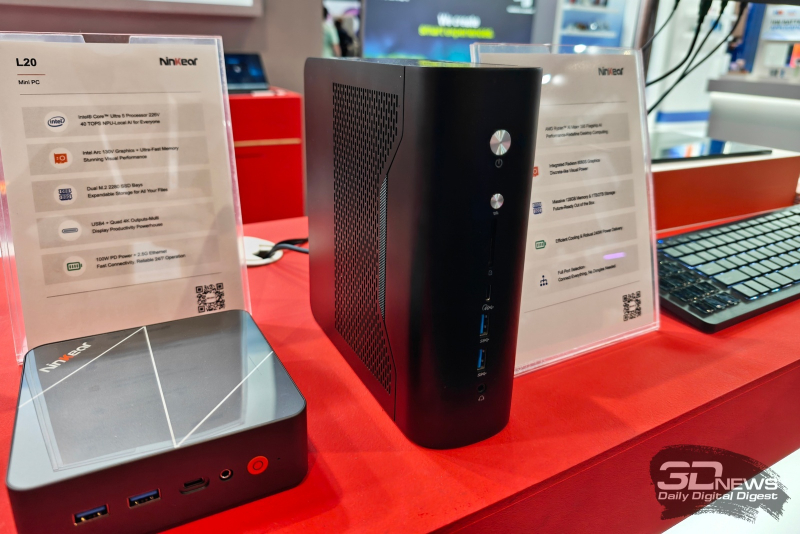
Ultimately, the Z1 is the most powerful mini PC Ninkear has ever shown. It is based on the powerful AMD Ryzen AI Max+ 395 chip, which combines 16 processor cores with powerful integrated Radeon 8060S graphics. The platform is designed not only for traditional computing, but also for native artificial intelligence workloads and graphics processing.
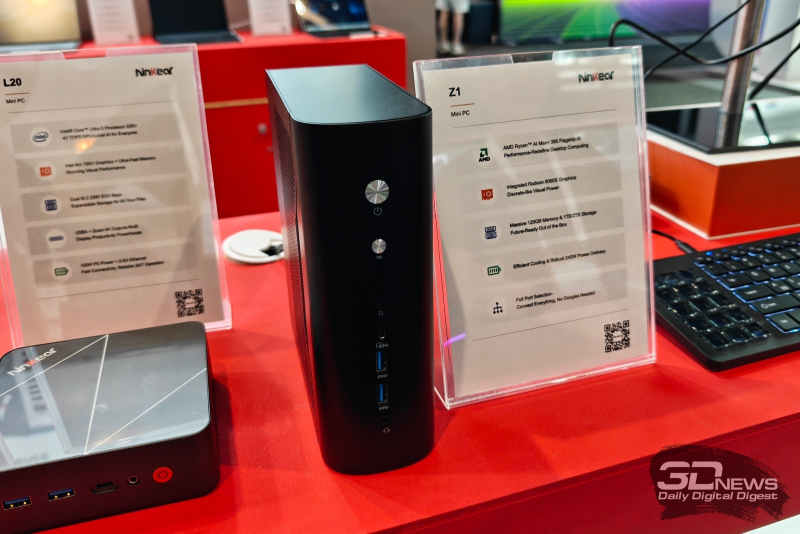
The memory configuration is particularly impressive: the new product offers up to 128 GB of RAM. Hard drives with capacities up to 1 or 2 TB can also be installed. A rather rigorous system is responsible for cooling, powered by a 240 W unit.
In fact, the Z1 is no longer just a mini computer for offices. Ryzen AI Max+ 395 is designed to be a compact workstation for content creation, development and local AI models. Additionally, all the hardware is housed in a chassis that is much smaller than a typical desktop computer.
Ninkear’s exhibit at IFA 2026 suggests that the company is trying to shut down multiple popular scripts at the same time. The S13 and S13 Neo are designed for users who want to convert a small Windows tablet into a laptop. The S14 is suitable for mobile work without sacrificing performance; the A15 Pro and Ybook 15 are targeted at home use, study, and office tasks respectively; and the U9 Pro offers a more serious laptop platform.
In the world of mini PCs, the choice is wide as well. MBOX 18, M6 Max and M7 are designed for easy daily use and allow for expandable storage and memory. The L20 offers a more powerful Intel platform with USB4, 2.5GbE and an NPU, while the Z1 attempts to transcend the usual mini PC category and become a full-featured desktop alternative.
If you find an error, select it with your mouse and press CTRL+ENTER.