
Chinese artificial intelligence laboratory DeepSeek has launched an updated version of its compact model that supports visual perception capabilities. DeepSeek V4.1-Flash Memory Designed to process and generate tokens quickly, i.e. work at high throughput.
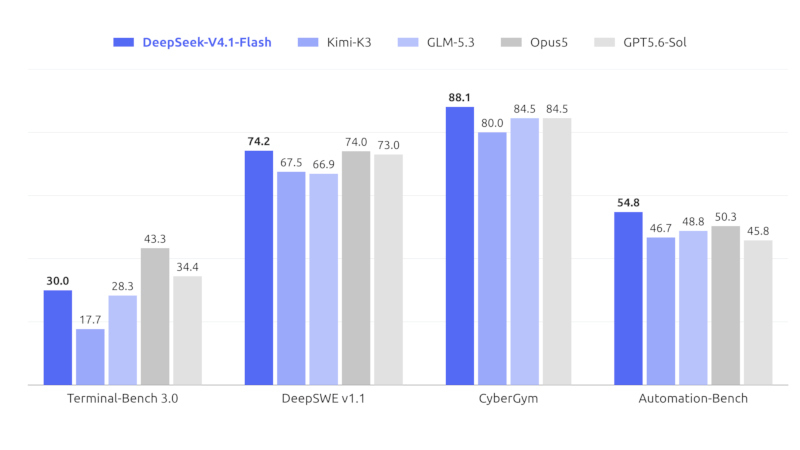
Image source: deepseek.com
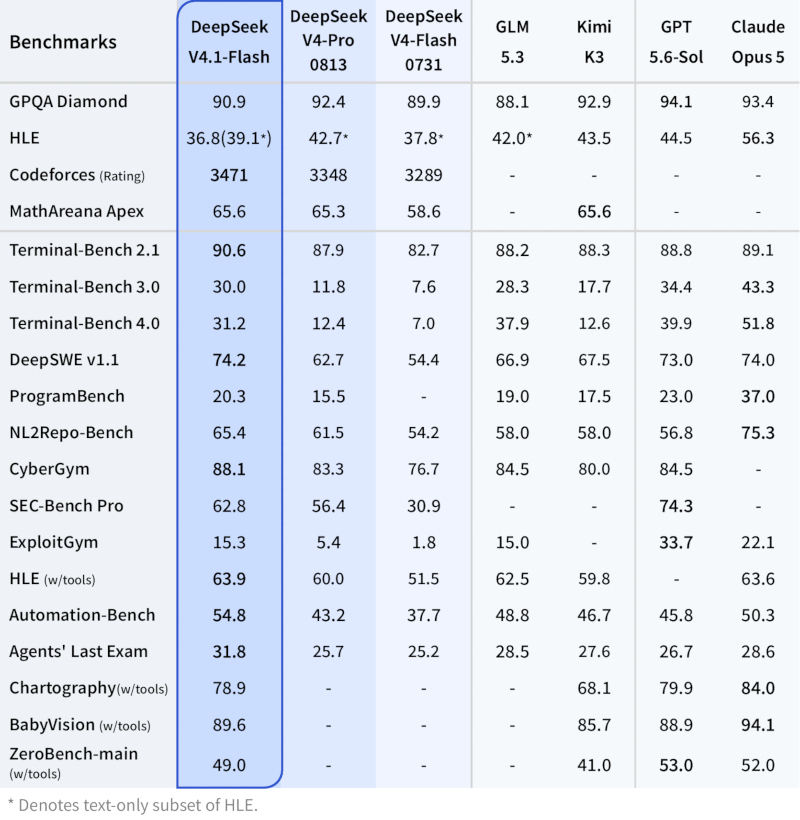
The model has 552 billion parameters, uses the MoE (Mixture-of-Experts) mechanism and an updated causal encoder-decoder architecture, with 8 billion input parameters and 16 billion output parameters. New pre-training methods and extensive post-reinforcement learning stages deliver results superior to flagship models, including the powerful DeepSeek V4-Pro.
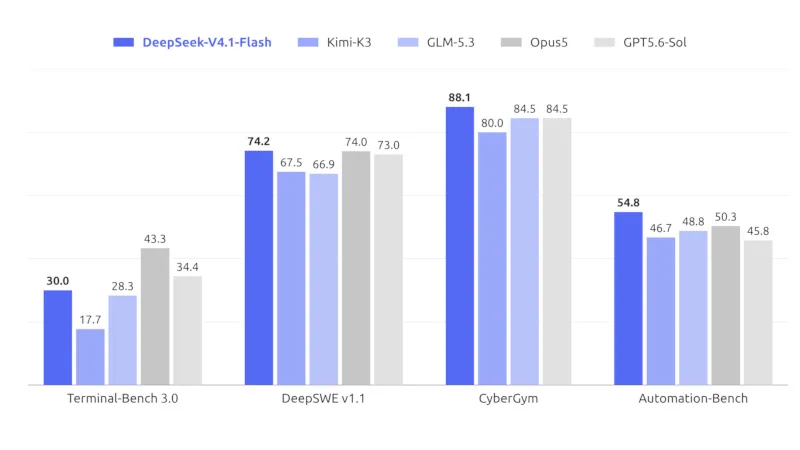
For example, in the DeepSWE v1.1 test, the new model scored 74.2 points, slightly ahead of GPT-5.6-Sol (73) and Claude Opus 5 (74). On CyberGym, V4.1-Flash scored 88.1 points, higher than GPT-5.6-Sol and GLM-5.3 (84.5 each) and Kimi K3 (80). In the Terminal-Bench 3.0 test, the model scored 30 points, beating GLM-5.3 (28.3) and Kimi K3 (17.7), but losing to GPT-5.6-Sol (34.4) and Claude Opus 5 (43.3).

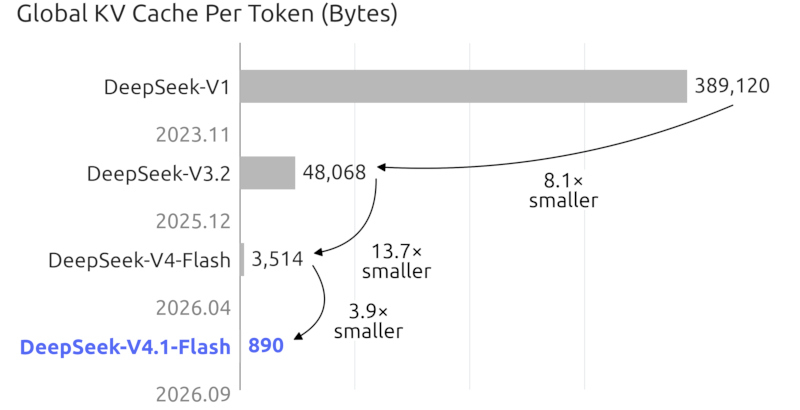
Developers have reduced KV cache usage – the DeepSeek-V4.1-Flash model consumes four times less HBM memory and eight times less SSD space. The cost of handling cache hit requests often accounts for a large portion of the cost of running an AI agent, so cache compression can significantly reduce costs.

With the release of DeepSeek-V4.1-Flash, support for the V4-Flash and V4-Flash-Vision-Exp models ends – all calls to them are temporarily redirected to the new model. Considering that V4.1-Flash is superior to V4-Pro in terms of performance, speed and overall task execution time, the latter will also be phased out – starting from September 14, requests to V4-Pro will be completely redirected to V4.1-Flash at the latter’s rate. Official partners WorkBuddy, CodeBuddy and OpenCode have announced support for V4.1-Flash.

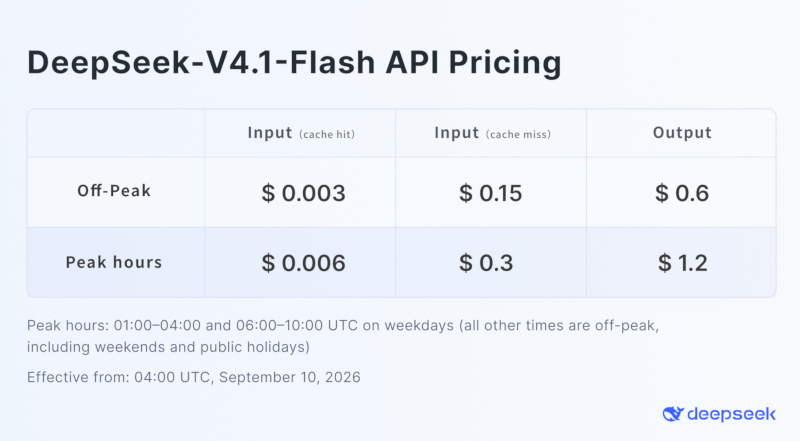
This model is already available through the DeepSeek API and has native multimodal support; to use it, you must select the deepseek-flash model. When accessing DeepSeek V4.1-Flash via the API, flexible pricing is used, divided into peak and off-peak hours – in the second case, the price is 50% lower. During off-peak hours, the cost of processing input data with a cache hit is $0.003 per 1 million tokens, the cost of a cache miss is $0.15, and the cost of processing output data is $0.60. During peak periods, these rates are $0.006, $0.30, and $1.20 per 1 million tokens respectively.
If you find an error, select it with your mouse and press CTRL+ENTER.