
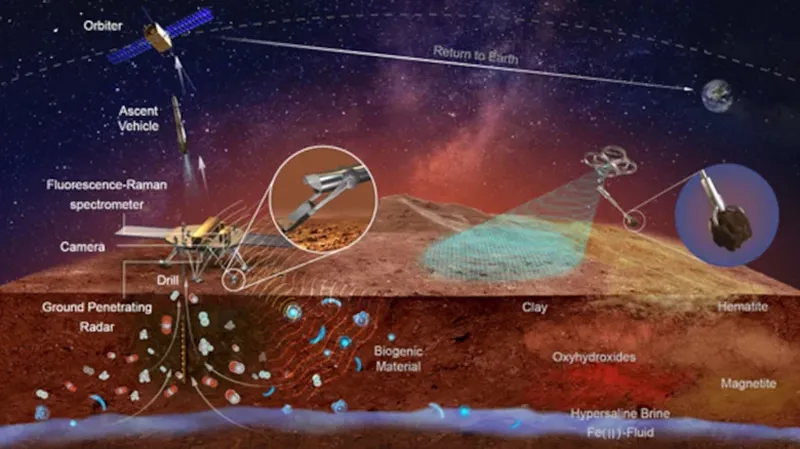
China has confirmed plans to deliver Martian soil samples to Earth in 2031 as part of the Tianwen-3 mission. According to news JalopnikThe launch of the vehicle to the Red Planet, scheduled for 2028, contrasts with the U.S. Mars sample return program, which faces a funding crisis after Donald Trump’s administration proposed cuts to NASA’s budget.
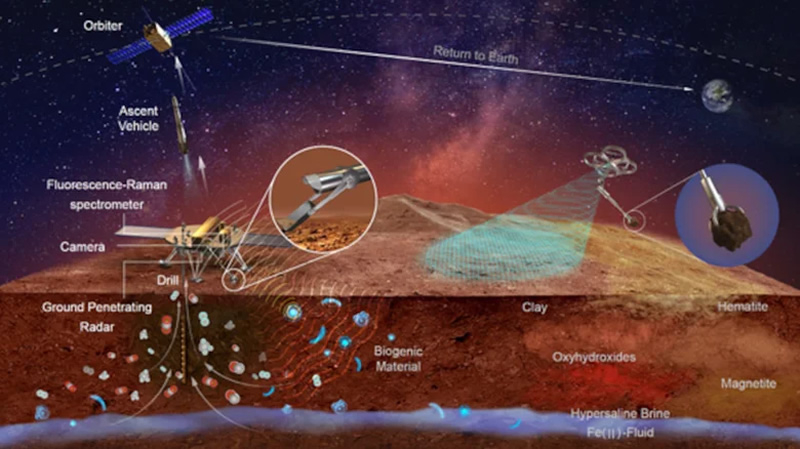
Image source: University of Hong Kong
Hou Zengqian, the project’s chief scientist, told state media that preparations were proceeding as planned. After a three-year flight, the lander will descend to the Martian surface, drill a hole about two meters deep, remove about 500 grams of rock, and send the container into orbit. The entire active phase of the ground work is expected to take approximately two months.
The main difference between Tianwen-3 and the American Mars Sample Returner (MSR) is its simpler mission architecture. NASA plans to use the rover to drill and collect samples, and then another vehicle will arrive at Mars, pick up the container and launch it into orbit. The Chinese mission will be conducted without a rover: a stationary landing module will independently drill, collect samples and launch them into space, where they will be intercepted by an orbiter for return to Earth. China plans to use two Long March 5 missiles to carry out this mission.
Meanwhile, China’s plans are still a long way from getting off the ground. Zeng Qian said that work has entered the prototype design stage, but even the simpler Tianwen-3 design is still a complex space mission, and one of its main problems still is the need to not only reach Mars, but also need to successfully launch from the Martian surface, enter orbit, and then return the sample to Earth.
U.S. Mars sample return finds itself in a more difficult position due to rising costs. NASA’s latest estimate is between $7 billion and $11 billion, while U.S. defense industry company Lockheed Martin has proposed the mission cost about $3 billion. Meanwhile, the Perseverance rover, which is due to arrive at Mars in 2021, has collected some samples that will be transported to Earth as part of subsequent phases of the program, but now their return time remains uncertain. If passed, NASA’s 2026 authorization bill would provide $8 billion for the mission.
In the context of problems with the U.S. program, the success of Tianwen-3 also has geopolitical significance. China is keen to demonstrate its capabilities in the aerospace industry, having already achieved notable success in lunar exploration, and transporting Mars samples to Earth ahead of NASA would be another such achievement. At the same time, the mission’s main scientific goal remains to search for signs of life on Mars. Zeng Qian also said that Tianwen-3 will adhere to the principle of open cooperation and work with scientists from various countries to explore Mars and develop planetary science.
If you find an error, select it with your mouse and press CTRL+ENTER.