
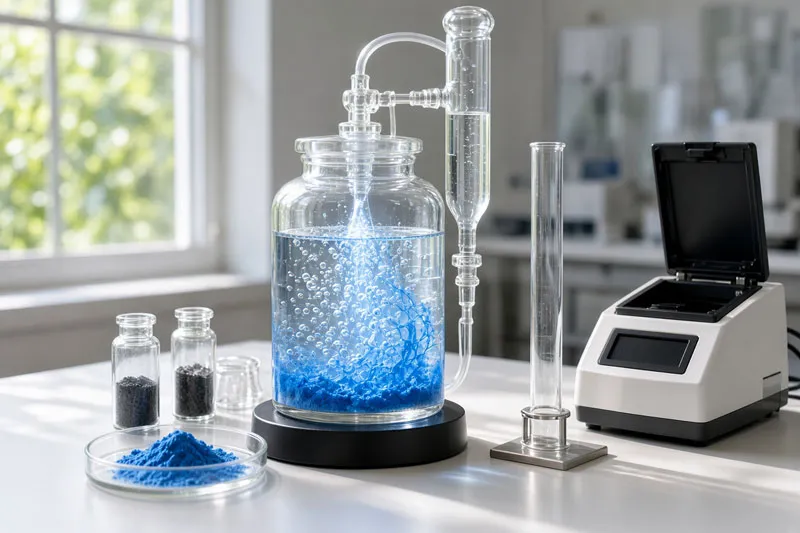
Researchers at Ningbo Institute of Materials Science and Engineering (NIMTE), Chinese Academy of Sciences developed A breakthrough photoorganic catalyst that dramatically accelerates the production of hydrogen from ordinary water using sunlight. Hydrogen is an energy-dense and environmentally friendly fuel that can heat and power anything without harming the environment.
Image source: AI Generation Grok/3DNews
A big problem with all catalytic reactions involving the splitting of water into oxygen and hydrogen under the influence of sunlight remains the short lifetime of the charge carriers (electrons and holes), which quickly recombine and no longer participate in further hydrogen production reactions. Chinese scientists have found a way to increase the lifetime of carriers in solution by 1,000 times, allowing as many carriers as possible to participate in the hydrogen synthesis reaction.
It turned out that traditional chemical bonds were insufficient for long-term active reactions, so the researchers replaced them with more stable bonds. Coumarins Connect and use in parallel so called Covalent Organic Framework (COF). Compared with traditional imine-bonded COF, the maintenance time of the separated charge state under the new conditions is extended by about 1000 times, which can be said to be a real breakthrough.
In fact, in conventional COFs, flexible compounds can rotate out of plane, causing structural fluctuations and additional energy loss. Coumarin fragments inhibit this movement. This facilitates long-distance charge transfer within the organic framework and can reduce the band gap and improve the efficiency of visible light energy use.
In addition, to speed up the hydrogen evolution reaction, the researchers used platinum nanoparticles as additional catalysts. Under 440 nm irradiation, the new material exhibits a hydrogen evolution rate of 531 mmol per gram of catalyst per hour. When irradiated with visible light with a wavelength greater than 420 nm, the rate is 166 mmol/g·h.
This work shows that the efficiency of organic photocatalysts can be improved not only by changing their chemical composition, but also by targeted control of charge dynamics within the molecular framework. In this case, the longer the electrons and holes are separated, the greater the chance that they can participate in useful chemical reactions before recombination, which can be successfully used to increase the production of truly “green” hydrogen.
If you find an error, select it with your mouse and press CTRL+ENTER.