
| type | Adventure, farmer simulator |
| Publisher | logo game |
| Developer | redsaw game studio |
| Minimum requirements | Intel Core i3-6100 3.7 GHz processor or AMD equivalent, 8 GB RAM, DirectX 11 compatible graphics card and 1 GB memory such as NVIDIA GeForce GTX 460 or AMD equivalent, 2 GB hard drive |
| Recommended requirements | Intel Core i7-10700K 3.8 GHz / AMD Ryzen 7 3700X 3.6 GHz processor, 16 GB RAM, DirectX 12 graphics card and 8 GB memory, such as NVIDIA GeForce RTX 3060 / AMD Radeon RX 6600 XT |
| Release date | August 6, 2026 |
| age limit | From 3 years old |
| localization | text |
| platform | personal computer |
| Official website | |
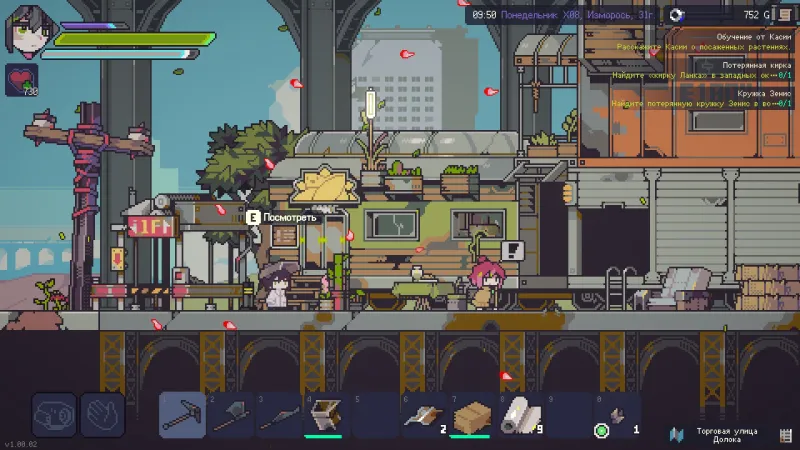
In the decade since Stardew Valley was released, there have been many clones of it—quiet farming simulators in which you could lose yourself for dozens or hundreds of hours. Almost always, their authors try to bring something of their own into the genre: they change the rural setting to something else, add character upgrades through extensive skill trees, try to make daily activities less boring, etc. The authors of Dorok Town also tried to make a big change to the familiar formula: here the view is from the side rather than from above, so the buildings on the farm can be very tall and the world is on the edge of survival (but still looks very good).
⇡#we will survive
In the game’s universe, the world is ravaged by war, and acid rain finally puts an end to everything. Once upon a time, people were trying to escape robot attacks on a moving train, but at some point the fuel ran out and everyone fled in all directions. Those who decided to stay on the bridge where the train stopped founded the town of Dorok there, which had shops, a forge, saloons, a small port, and several research laboratories. In the latter, they studied new technologies and plants in the hope that this knowledge would help people survive in the new conditions.
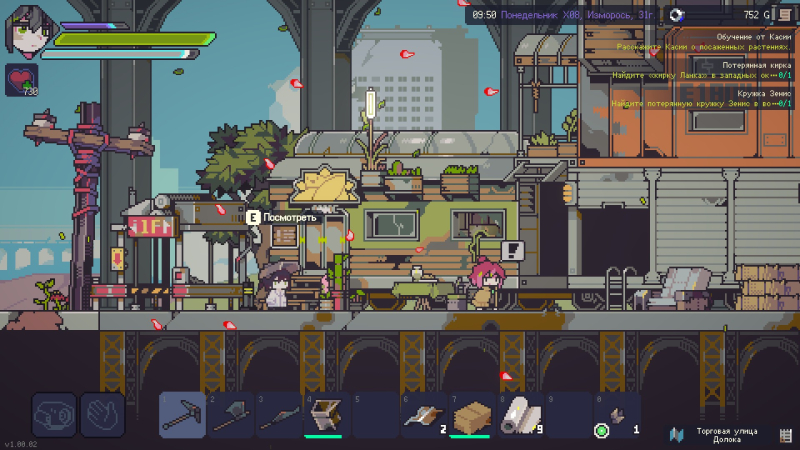
Quest-related characters are easy to find – they have exclamation points above their heads and they’re always marked on the map
It’s not often that you play a farming simulator for the story, but Dorok Town is perfect for this type of game. Since this is a post-apocalyptic world, the narrative is very much based on learning the details of life before the war – it’s fun to gather them bit by bit in the optional dialogue and notes. The main goal of the heroine is to find the mysterious and legendary legacy of Eden, a pre-war company engaged in environmental restoration. Now its buildings have been ransacked and the disks containing the information have been lost, but no one has been able to find anything of value yet, so we still have a chance to help the world.
This won’t happen anytime soon – before we get any closer to that legacy, the protagonist (a name we choose at the beginning of the game) will have to meet dozens of characters, full of interesting personalities. The mayor with several skeletons in the closet, the kind-hearted scavenger, Alkemia, the plant lover who helps us check the seeds – after the war, many crops can no longer grow naturally, and with the help of Alkemia and her analytical equipment we will prepare seeds for the new conditions. In the company of these characters you will spend pleasant hours, reading dialogues and sometimes complaining that all heroes have their own daily life and you do not always find them where you expect.
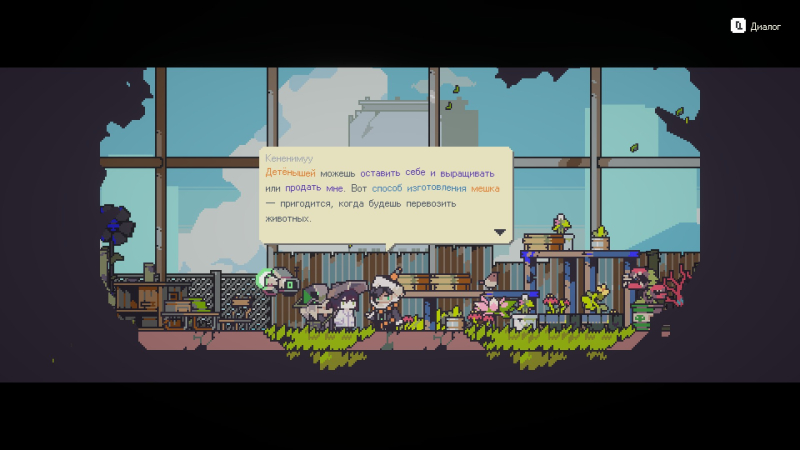
You can give gifts to city residents – sometimes you’ll get unique recipes
But the most important thing in Dorok Town is of course farming. We were immediately given a fairly large area littered with trash and other trash, where our tent and bed stood, with a storage bin next to it. Starting items include an axe, a pickaxe, and a scythe—luckily, these tools don’t break, so you can chop down trees, chop cobbles, and slash bushes at will, worrying only about your character’s stamina. So the first thing you have to do is clean up the farm, collect everything around, fill your pockets quickly and go explore the surroundings.
⇡#Growth potential
In the first hour, you expected that by now they would either start bombarding you with seeds, or that you would be buying and growing them every day, but the store selling them was surprisingly late. The developers will not reveal all the mechanics at once, but will discuss everything gradually. After a few hours, it becomes clear that Dolok Town is less a game about farming than it is about mass production, and the road to that production will stretch to dozens of hours. You need to mine ores, you need to engage in animal husbandry, you need to create mechanisms and automated processes, and so on.
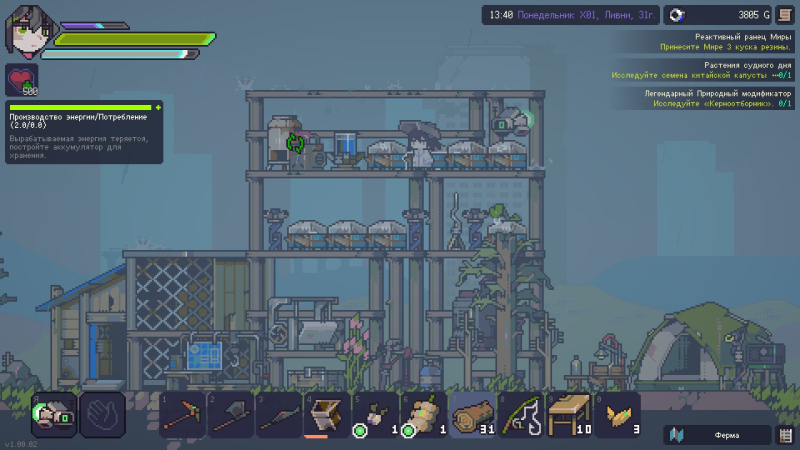
You always need to make sure that cloudy weather does not threaten the harvest – damaged seeds will not be returned
First, the rare seeds required for the mission are manually planted in fragile pots that last for several days. After that you will start building automatic sprinklers, connecting generators to them, making auxiliary robots involved in sowing, harvesting and transporting… If you place the first structure on the ground, then later you will build tall wooden superstructures, one on top of the other, and then you place trampolines to make it easier to reach the mechanisms located on the upper floors. Well, if you need to sell something, this can be done without leaving the farm, just throw the unwanted stuff into the cargo drone not far from the tent – it will fly away, sell everything on its own, and “spit out” the money for the goods sold when it returns.
However, the farm doesn’t grow quickly – time and time again you’re faced with the fact that you don’t have enough resources to create things. Here, you need to actively chop down trees, “pound” stones with a pickaxe, mine ore, and so on, while you turn in quests or accept new ones – otherwise you risk wasting time. Even trash cans contain useful items such as plastic bottles, wires, or debris – the latter being especially hard to find early in the game and required for certain buildings. I recommend not selling anything you find in the world within the first few hours – you may stumble upon a rare item that may be difficult to rediscover later. To purchase rare resources, you need a considerable amount of money, which is best spent on improving tools or increasing your backpack – the longer you travel, the faster your backpack fills up.
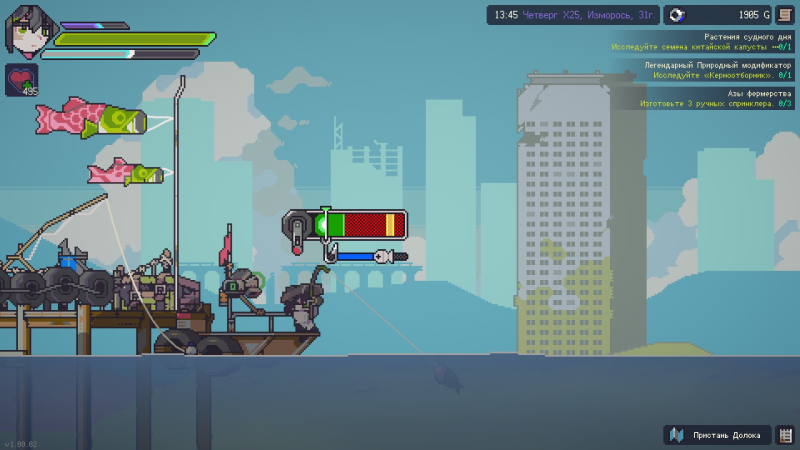
Of course, a game like this wouldn’t be complete without fishing.
As you progress through the town of Dorok, you’ll begin to see some elements that may seem inconvenient or even annoying at first. Especially for weather events. Acid rain ruined our pots, along with the seeds that were planted. Not only did you untie the pot’s protective covering, but you also learned that the plants were much more comfortable under a canopy and it was better to move the seedlings indoors. You may also lose potential harvests during thunderstorms, but using lightning rods makes it easier to accumulate energy for your generator, while raindrops allow you to avoid wasting electricity on your watering system. A lot depends on the weather – some crops can’t be planted in certain seasons, others need to be planted in a hurry before the sunny weather in the forecast ends, and so on.
By automating some processes, you’ll free up time to wander outside the city, where you can find particularly valuable resources, trophy boxes, and even new characters with their own quests. At the same time, there are enemies there – mostly insect robots, which can not only cause damage in melee combat, but can also actively shoot in the direction of the heroine. You can use tools to fight them off, but this is dangerous and inconvenient – it’s better to use the services of an auxiliary drone, on which you can mount a new gun and aim it manually, or leave the shooting to the game by turning on automatic mode. There isn’t much variety in enemies, and the designs that exist aren’t the most creative, but for the sake of being useful, I’m prepared to fight these monsters again so I can go back to the farm and fill boxes with wires, chips, and other junk that will come in handy one day.
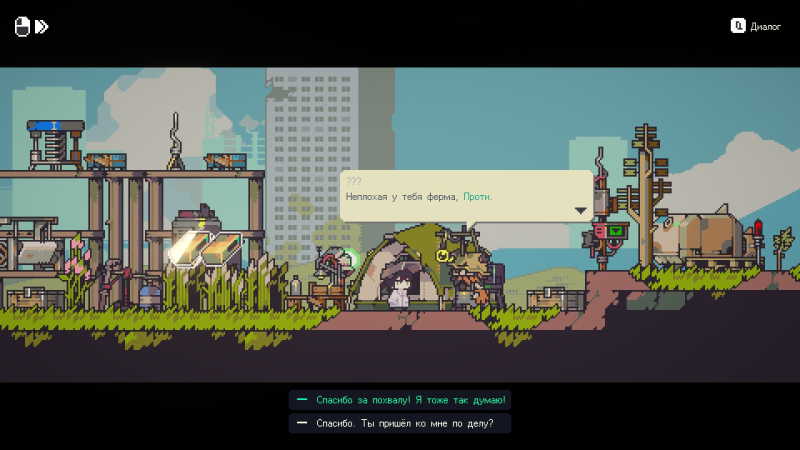
The choice of lines in dialogue does not affect anything
The best thing about Doroktown is the close relationship between the mechanics. We grow a crop and then either sell it or cook a few dishes. You will take these dishes with you when you go out for an outing, so that when night falls and your character’s energy is exhausted, you can have a quick snack to restore your energy. During your outing, you defeat multiple robots – use these resources to improve your farm’s drones. In addition, each action provides experience to improve different categories of skills. The more you plant and harvest, the sooner you’ll unlock new watering systems and bed types. The more you build things, the faster you’ll gain access to various types of mechanics and generators.
***
The town of Dorok is unlikely to be someone’s “forever” game, much like Stardew Valley – when processes are automated, production is set up, and all tasks are completed, there’s not much to do here. However, all this only happens after a few dozen hours, and there is always something to do during the journey: either optimize the farm, restore the bus station to move around the world, complete the orders on the bulletin board, or just explore and fight monsters. There is a lack of resources at times, which kind of ruins the impression. On the other hand, there’s no place to rush here – sooner or later you’ll unlock and build everything, even if at some point you’re too lazy to cut down a few trees and don’t have anything to recharge the generator.
advantage:
- Charming pixel art;
- A very interesting story with lovable characters;
- All game mechanics are closely related to each other, so by doing one thing, you help yourself do another;
- The verticality of the farm is unusual for this type of game, breaking the genre template and forcing new approaches to site planning.
defect:
- Often without enough resources (and money) you’ll actually be penalized for being too lazy to “farm” something;
- Boring enemy designs, not the most exciting combat.
|
graphics |
Very cute pixel art that makes Dorok City a cozy place where you’ll happily spend dozens of hours. This is very important in a farming simulator like this, and the creators clearly understand this. |
|
sound |
Quite a few musical pieces, and their number increases as you progress. They’re all good, but given the length of the game, sooner or later you’ll turn off the music and put on your own stuff. |
|
single player game |
The story campaign is filled with missions that gradually open up new options, mechanics, and techniques, so your head won’t be spinning with the sheer number of possibilities within the first few hours. |
|
Estimated completion time |
In theory, the game can be completed in 35 hours if you just focus on the story missions, but in reality it’ll probably cost you much more. It will take about a hundred hours to complete everything possible (upgrade all technology trees, research all seeds, etc.). |
|
group games |
Not provided. |
|
overall impression |
In many ways, this unusual farming simulator has become one of the best attempts at making a game as exciting as Stardew Valley. |
Rating: 8,0/10
More information about the rating system
video:

If you find an error, select it with your mouse and press CTRL+ENTER.