
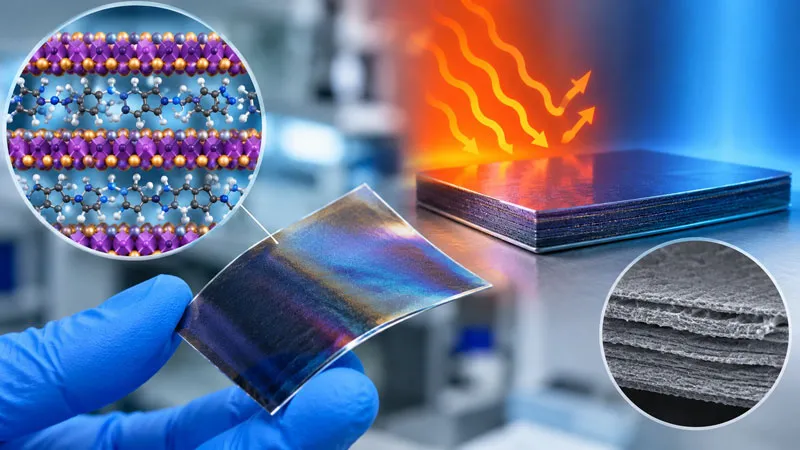
Scientist at North Carolina State University Created A dense, non-porous material with both extremely low thermal conductivity and high mechanical stiffness. Typically these are incompatible properties, but this discovery is a real breakthrough, getting as close as possible to the theoretical limits of a material’s thermal insulation properties.
Image source: AI Generation ChatGPT/3DNews
The new work involves thin films of two-dimensional hybrid organic-inorganic perovskite-azobenzene-ethylammonium iodide and lead. At room temperature, its thermal conductivity reaches about 0.04 W/(m·K), which is close to the theoretical limit of dense solid materials. At the same time, the material has an elastic modulus of 7.7 GPa – significantly higher than most polymers, foams and aerogels commonly used to achieve low thermal conductivity.
An unusual combination of properties is achieved through molecular design of the perovskite structure. Such materials consist of alternating organic and inorganic layers and have an ordered crystal structure. The researchers modified the organic layer by replacing some of the carbon chains with specially selected benzene fragments. As a result, it is possible to simultaneously change the rigidity of the lattice and reduce the transfer of thermal energy through the lattice. In other words, mechanical loads are efficiently transmitted through the rather rigid structure, while the propagation of thermal vibrations (phonons) is greatly suppressed.
In terms of thermal conductivity, the new material is approximately five times higher than silicone insulation: silicone has a thermal conductivity of approximately 0.2 W/(m·K). Furthermore, according to the authors, the film developed is 700-10,000 times harder than silicone. It is especially important that we are not talking about porous aerogels or foams, which achieve low thermal conductivity due to the presence of large amounts of air in the pores, but rather dense solid materials.
A practical advantage of this development is the manufacturing technology: the film is produced by rolling and applying the material, i.e. applying a solution, which is then formed into a thin layer by rotating the substrate. The researchers say the method is relatively easy to scale up, and the material itself can be used as a thin thermal barrier coating. Potential applications therefore include electronics, thermal insulation coatings, kitchen and aerospace applications, for which traditional soft insulation is simply not suitable due to insufficient mechanical strength.
If you find an error, select it with your mouse and press CTRL+ENTER.