

By 2030, the smartphone market is likely to return to sales close to 2025 levels, but the cheaper segment will not follow the same trajectory. More than 230 million smartphones cost less than $200, according to latest forecast from Counterpoint Research They may disappear from the market by the end of the century.
This contraction is first related to the increase in the cost of memory, chipsets and other components, which has a greater impact on cheaper devices. At the same time, increases in the minimum specifications required to offer a competitive smartphone make it increasingly difficult to maintain extremely low prices.
Are smartphones getting more expensive?
Counterpoint estimates that overall global shipments will reach about 1.2 billion units in 2030, only slightly lower than in 2025. However, smartphones priced under $200 are expected to shrink by about 40% during the same period, while smartphones priced at $200 and above are expected to grow 26%. This phenomenon is not simply equivalent to consumers switching to more expensive car models. Some users may actually purchase higher-end devices, but others may delay smartphone replacement, thereby extending the life of the models they already own. The used and refurbished equipment market may also intercept some demand.

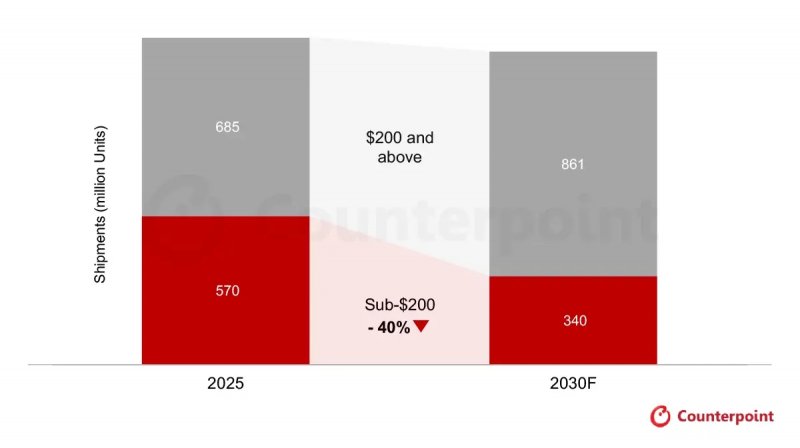
This disparity is particularly important in low- and middle-income countries, where device prices remain a barrier to accessing mobile internet. The reduced supply of cheap smartphones could slow the transition from traditional phones to smartphones and make it harder for new users to enter the mobile ecosystem.
Smartphones, from peak in 2018 to crisis in 2026: 8 years of digital and mid-range collapse


Therefore, the mid-range may become the main competitive field. Counterpoint provides a High-end models are experiencing particularly strong growththe compound annual growth rate is about 7%, while the mid-to-high range should remain basically stable. As a result, manufacturers will focus on devices with more memory and storage, 5G, better cameras, longer battery life, longer software support, and artificial intelligence capabilities that run directly on the device.
In short, the predictions suggest changes in market structure. The high-end segment is expected to increase its economic impact, supported by foldable devices, more advanced camera systems, larger storage capacities, and new AI-based features. The recovery in shipments is expected to be more pronounced from 2028 onwards, when parts supply and retail prices stabilize.

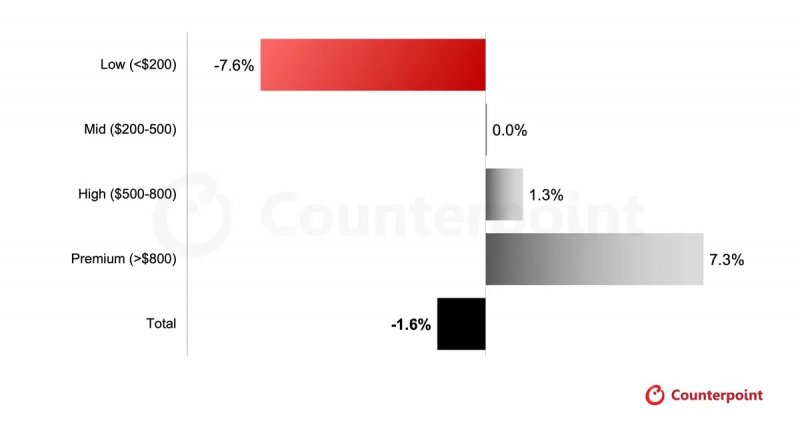
The result would therefore be an overall smartphone market similar in size to the current market, but with a different distribution. Very cheap devices are becoming increasingly raremore mid-range models and an increasing number of high-end products. For manufacturers, the ability to cover multiple price ranges may become more important, while for consumers with fewer financial resources, the problem starts with finding new devices that are still available.