
The situation in the AI systems market is complex. US market leaders preparing for IPOs are interested in showing positive revenue dynamics, but Chinese competitors do not allow them to raise prices. In the United States, enterprise users are increasingly relying on open artificial intelligence models to save money without significantly affecting their business progress.
Image source: Unsplash, Aerps.com
according to financial timesJudging from the annual comparison from August to September this year, the number of mentions of these terms by American business managers in public speeches has increased six times compared with last year, which is enough to prove the tendency of the American business community towards open source code or open scale models. It is worth noting that even companies far from the IT sector are increasingly interested in implementing open artificial intelligence models: representatives from the financial services, logistics and heavy engineering sectors have already noticed this behavior.
Chinese companies have begun to dominate the field of open artificial intelligence models, but some Western developers have taken a similar approach, including US Nvidia, French Mistral, startup Reflection AI and Thinking Machines Lab. According to Vercel data, as of August, the share of open models in token usage statistics reached 56%, compared with only 7% in December last year. According to OpenRouter statistics, China Artificial Intelligence Laboratory is currently among the top ten token users in terms of token usage intensity.

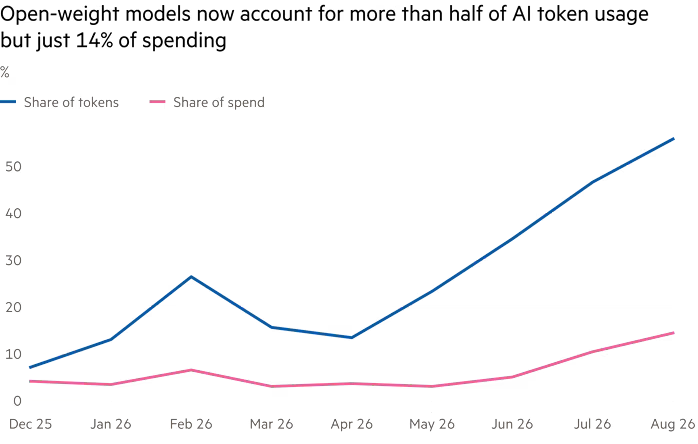
Image source: Financial Times, Vercel
Technical director Vinay Kuruvila said the developers of the Tinder app have started redirecting some minor internal requests to AI models with open scale. The reality is that if a company’s annual spending hits $1 million in January, spending will grow tenfold by July, and Tinder wants to prevent this dynamic from continuing. As the representative of the Match Group company emphasized, the advanced Astra and Claude models in the United States can meet 90% of its needs. If the open models reach this level, there will be no need to use the former in the same volume. OpenAI and Anthropic were forced last week to offer more affordable versions of their models to somehow protect themselves from the expansion of their “open” competitors.
Andy Markus, director of data and artificial intelligence at telecommunications giant AT&T, said that the company already covers 40% of artificial intelligence workloads through open models and plans to increase its share to 70% next year. Marcus said the company handles up to 45 billion tokens per day, and with such large scale use, cost becomes a significant component. If moving to an open model can cut costs without sacrificing accuracy, AT&T won’t be upset about the move. Internal tests have shown that in some cases the open model is as efficient and fast as, and sometimes even better than, its “closed” competitors. In addition, users can run open-scale models on their own infrastructure, which can significantly improve information security.
If you find an error, select it with your mouse and press CTRL+ENTER.