
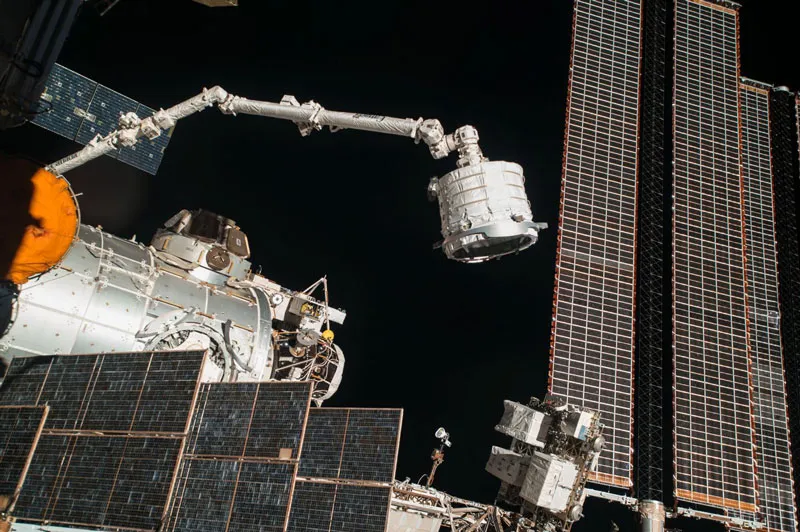
As if to prove the legitimacy of its superstitious number 13, the Crew-13 mission to transport the next batch of astronauts to the International Space Station is once again in danger. Previously, an oxidizer leak was discovered in the propulsion system of SpaceX’s Dragon spacecraft, causing a flight delay of about two weeks. On the International Space Station the day before Conveyor belt clogged Mobile robotic arms, often assisting with cargo, station and ship inspections.
Image source: NASA
NASA is eager to make sure everything is OK with the robotic arm itself and is currently involved in inspections of the Crew-12 spacecraft, which will soon need to return astronauts and a Russian cosmonaut to Earth. However, it is temporarily impossible to move the manipulator to another location, and it usually moves along a long truss attached to the station body. The current position of the manipulator may interfere with the GPS system and pose a threat to Dragon Crew-13’s docking system. Normally, the robot hand would be taken very far away, but that’s not possible right now, and NASA can’t say when that will happen.
The Canadaarm2 robotic arm was built by the Canadian Space Agency and delivered to the space station in 2001. This is a 17.6-meter-long robotic arm weighing about two tons, developed by the Canadian company MDA Space. Its unique design allows it to move across the surface of the space station. Both ends of the robotic arm are equipped with identical gripping mechanisms that can be alternately fixed to special power data gripping fixture adapters. The solution makes it possible to use robotic arms to assemble the space station, repair external systems and move large payloads weighing up to 116 tons.
Without robotic arms, it would be impossible for Northrop Grumman’s Cygnus truck and Japan’s HTV to dock with the space station. He picked them up and moved them to the docking point. SpaceX’s first Cargo Dragon spacecraft also uses this scheme to dock with the International Space Station, although now they do so independently. However, SpaceX has promised to retire the Dragon spacecraft within two to four years. If the failed robotic arm is not restored to operation by then, it will become a serious problem for the operation of the space station.
The problem occurred last Sunday. Equipment used to move robotic arms along the farm began to produce errors. The agency has not yet determined whether they are related to software or hardware. NASA once again emphasized that the problem was related to the transportation device of the robotic arm, not the robotic arm itself. At the same time, you have to understand that time is on the right side. The robotic arm was designed to operate for 15 years, but in fact it has been operating for 25 years, which again raises the issue of the end of the International Space Station’s operation.
If you find an error, select it with your mouse and press CTRL+ENTER.