



In 2026, global international internet bandwidth increased by 23%, reaching 2,259 Tbps. The average annual growth (CAGR) in the last four years was also 23%, reports TeleGeography.
The growth rate has stabilized in recent years, but capacity has more than doubled since 2022. True, growth rates differed from region to region. Thus, Africa became the leader, where the average annual growth was 35%, in Oceania it reached 25%. In general, global traffic growth is in line with capacity growth. Average and peak traffic grew at an average annual rate of 24%.
The rapid growth of traffic is driven by the emergence of new devices with Internet access, the active penetration of broadband access into emerging markets, the growth of broadband access speeds and the mass adoption of applications that require high bandwidth communication channels. It is argued that user traffic demands will increase, but this will not necessarily always lead to the need to increase backbone capacity.
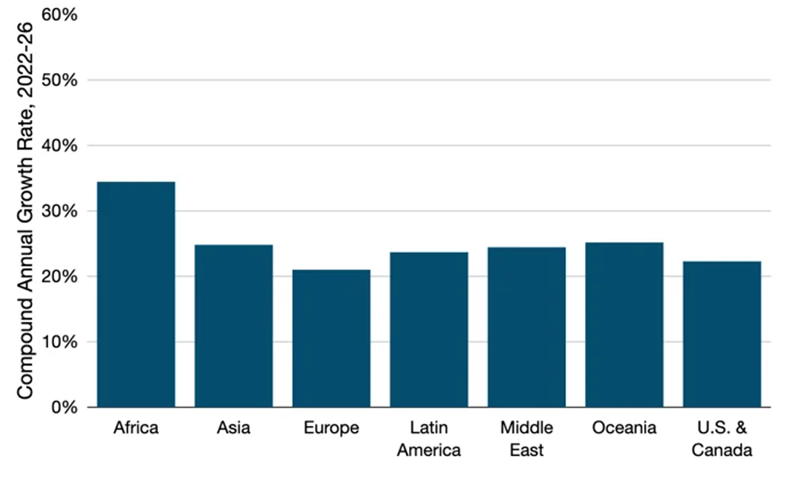
Image source: Telegeography
The most discussed driver of Internet development in the world is called artificial intelligence (AI), but so far its impact on global traffic is limited. According to AppLogic’s March Phenomenon study, AI-related traffic volumes are still negligible compared to video streaming and social media. It is noted that in 2025, AI-related traffic grew by 90% in fixed-line networks and by 80% in mobile networks. If the pace continues, AI could have a significant impact on international internet networks.
One of the important trends has been the increasingly active use private networks. The largest content providers are increasingly using their own networks, which are growing faster than classic Internet highways, expanding their presence in more and more new regions. Other companies also use such networks, including cloud and CDN providers and some data center operators. As a result, an increasing share of international traffic is transmitted over such networks.
While it is clear that increased Internet speeds and the emergence of new applications will lead to the creation of significant new traffic flows, it is unknown what proportion of new data will require the use of international communication channels. In the short term, the rise in importance of direct connections to content providers and content caching is expected to drive “localization”, limiting the use of international channels.
Prices for data transit are based on the cost of international transmission. In the case of commissioning of new international networks, construction and operation costs are distributed among an increasing number of fiber-optic pairs and fall on a larger “active” throughput, which allows reducing the cost of transmitting each packet.
Most WAN ports now require 100 Gbps throughput, and demand for 400 Gbps ports is growing noticeably in Europe and the US. At the same time, the development of new international infrastructure provides opportunities for further regional localization of content placement and makes it possible to reduce dependence on remote network hubs. As emerging markets grow, they will also be able to benefit from economies of scale in network development, if only by reducing the cost of data transmission to Internet hubs.
At the end of September Meta✴ announced cable Petalcalled “the first 1 Pbps transoceanic system.” A cable across the Atlantic with a length of about 7 thousand km will connect the USA and France, commissioning is planned for 2029. In addition, the company is behind one of the world’s largest cable systems 2Africa and is preparing the world’s longest system Waterworth.
Source:


