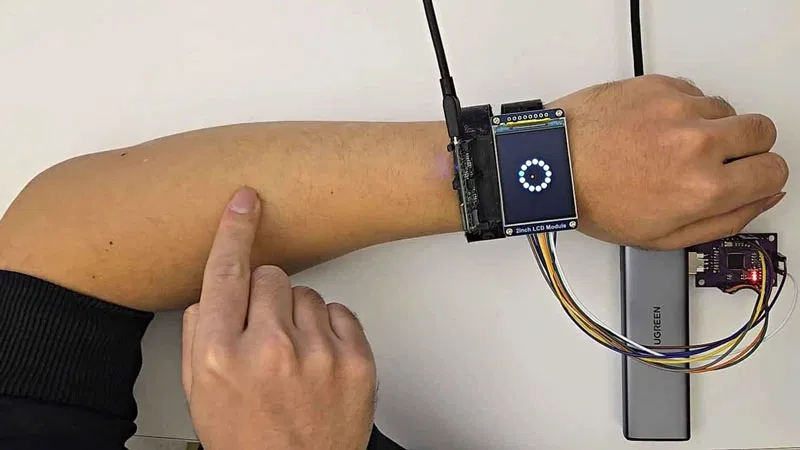
Every smartwatch owner has encountered the problem of selecting options on the small screens of these wearable gadgets. At least it’s not always convenient. Developers from the USA solved this problem in their own way by adding a tiny radar to the watch, which turned the user’s forearm into a very sensitive touchpad.
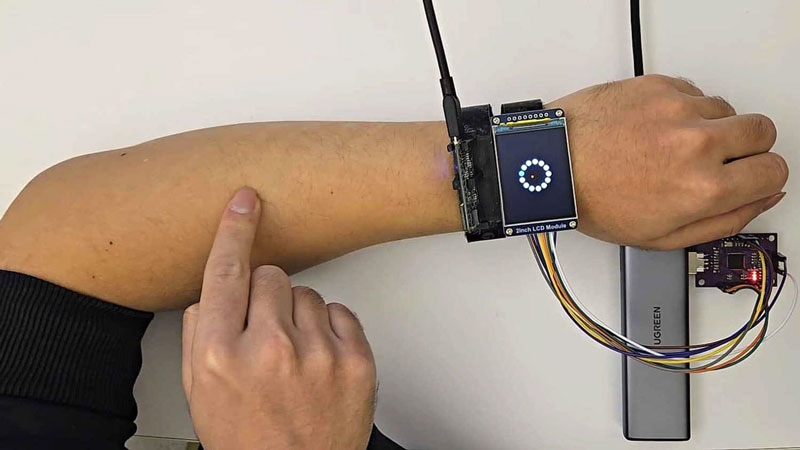
Image source: North Carolina State University
About the development reported researchers from North Carolina State University. They introduced EpiPad technology, which allows you to use the skin of your forearm as a touchpad to control your smartwatch. The system recognizes finger touches, movements of several fingers at once, and even pressing force. The development is designed to solve the problem of small screens of smart watches, on which it is inconvenient to perform gestures familiar to smartphones and laptops: scrolling with two fingers, zooming in by pinching the fingers and pressing with different forces.
The EpiPad is based on a compact, wrist-mounted millimeter wave radar. It registers slight deformations of the skin that occur when fingers touch the forearm. To determine the pressing force, the developers used analysis of changes in the phase of the radio signal, and machine learning algorithms to recognize gestures. The sensor array has dimensions of approximately 5 × 4 mm and in the future can be placed directly in the body of gadgets.
According to the results of tests involving 20 volunteers, the accuracy of gesture recognition was 92.8%, and the determination of pressing force reached an accuracy of 90.2%. The accuracy of finger position determination was 10.2 mm. Before starting work, each participant required an individual calibration lasting about four minutes. In a separate experiment, participants completed smartwatch control tasks in three ways: directly through the screen, using a cursor controlled by wrist tilt, and using an EpiPad. According to the authors, the latter option resulted in fewer errors and higher task performance.
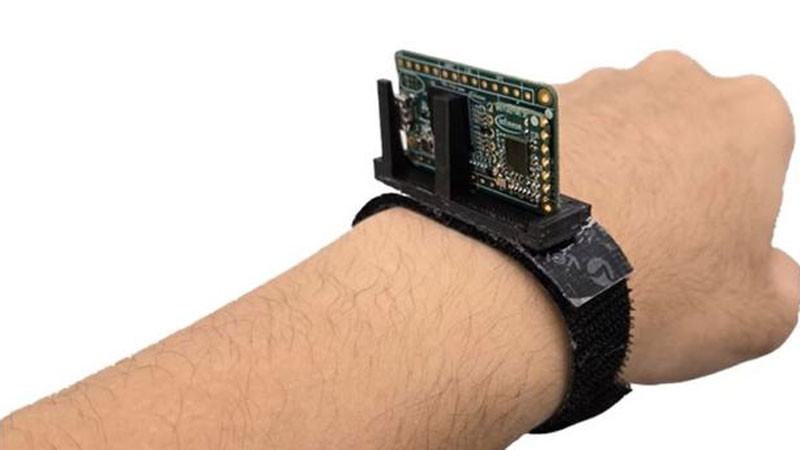
The presented prototype is made in the form of a bracelet with a protruding electronic board, but the developers believe it is possible to integrate its components directly into the body of a regular smartwatch. According to the head of the study, Chenhan Xu, the cost of the functional components of the system in mass production could be less than $10. As possible areas for further application, the researchers name not only smart watches, but also devices without screens, such as glasses with artificial intelligence, in which the user’s skin could serve as an additional control surface.
If you notice an error, select it with the mouse and press CTRL+ENTER.