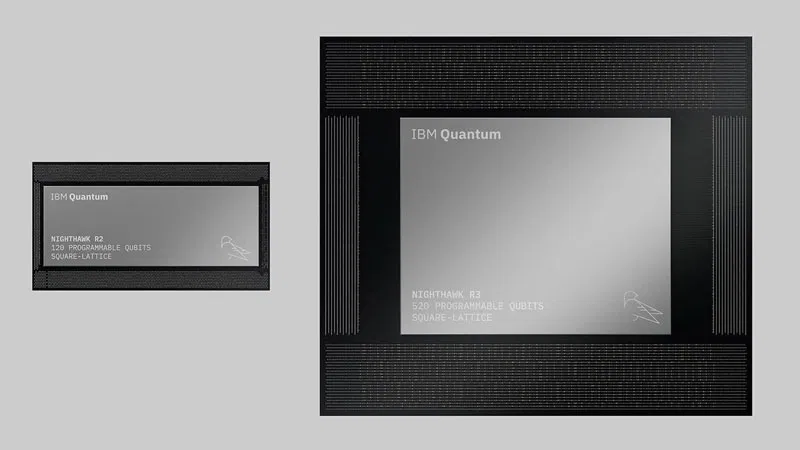
IBM introduced an updated version of the Nighthawk quantum processor, increasing the capacity and performance of the proprietary quantum platform by a factor of 10. More importantly, next year the processor will launch a two-rack cluster—a first-of-its-kind quantum supercomputer.
Image source: IBM
The previous version of the Nighthawk r2 processor, which became available in September 2026 (the original Nighthawk r1 processor was announced in November 2025), provides performance up to 100,000 measurements per second. It allows quantum circuits to run with more than 7,500 quantum operations on 120 programmable qubits. The Nighthawk r2 processor was the first to implement a high-speed qubit reset circuit, which reduces the gap between successive runs of circuits, or circuits, as quantum algorithms to be calculated are commonly referred to in English-language literature.
So, if the Nighthawk r1 processor needed 250 μs to reset the qubits to receive a new sample, then the Nighthawk r2 processor takes about 1 μs. Since quantum computing is based on statistical analysis of samples, the more runs and measurements of circuits, the more accurate the result will be. The third version of the processor presented today, in addition to tripling the number of qubits, also inherited a fast qubit reset scheme.
Overall Nighthawk r3 processor calculated to perform up to 10,000 quantum operations using 520 programmable qubits. In this case, the total number of physical qubits on the chip will be 2034. The architecture retains the connection of qubits along a square lattice, but additionally provides ten interchip connections l-couplers. They are designed to transfer quantum states between individual processors and combine several chips (racks) into a single system. IBM has already demonstrated quantum state transfer between Nighthawk r1 processors across four such connections with 99.3% accuracy. The company’s next goal is to increase this figure to 99.9%, as reported a couple of weeks ago.
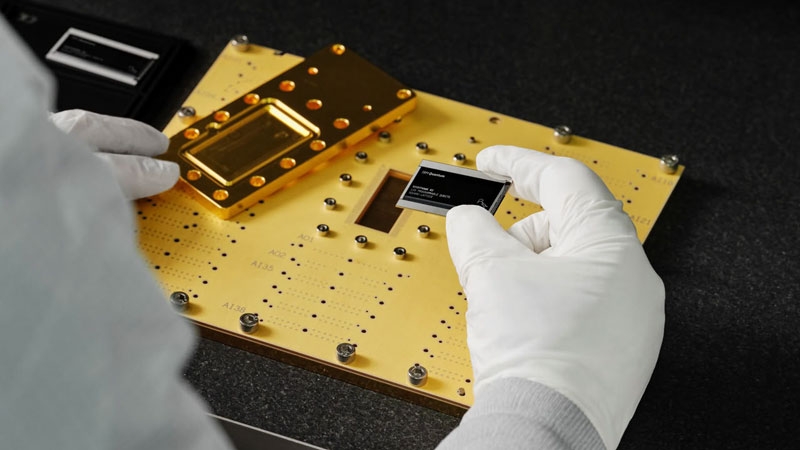
In 2027, IBM intends to combine two Nighthawk r3 processors into one system with 1040 programmable qubits. The cryogenic infrastructure for such scaling has already been tested: the company demonstrated combining two cryogenic modules into a single system that achieved operating temperatures below 15 mK in less than five days. IBM believes that there are no longer any obstacles to creating and running a two-rack cluster.
In parallel, IBM is developing the integration of quantum processors with classical high-performance computing (HPC) systems. This combination is necessary for processing measurement results, suppressing errors and implementing quantum error correction algorithms. It is obvious that as quantum computing platforms become more complex, their classical hardware will become more complex.
IBM recently partnered with Oak Ridge National Laboratory and AMD to launch a new quantum error correction platform that physically integrates Nighthawk processors with ORNL’s Umbra HPC system running on AMD Instinct MI355X GPUs and fifth-generation AMD Epyc processors.
IBM customers have seen promising results from this integration. For example, using the new environment, the Cleveland Clinic and RIKEN automatically processed 608 million samples to model biologically relevant structures, 33 times faster than using a manual workflow.
Separately, the company emphasized the increase in performance of the Nighthawk r2 quantum processors (which automatically extends to the r3 version) due to the accelerated reset of the qubit state in preparation for each new launch of the circuit (algorithm). According to IBM, the company’s customers and partners have completed more than 34 billion quantum circuits on r2, achieving speedups of up to 19 times compared to the company’s previous processors.
In particular, E.ON reported a 15x speedup when using quantum machine learning to optimize energy networks. In other cases, the acceleration of calculations was greater, and in others – less, which does not detract from the advantages of new products, but gives hope for a breakthrough in many areas of science and technology.
If you notice an error, select it with the mouse and press CTRL+ENTER.