
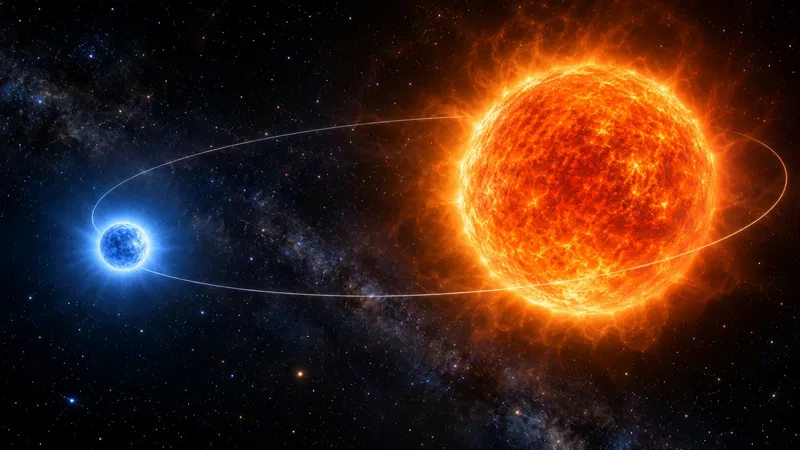
Astrometric data from the European satellite Gaia once again presented astronomers with a mystery: in space, at a distance of several thousand light years, a compact object was discovered, the formation of which cannot be explained within the framework of modern theories of stellar evolution. Solving this mystery could significantly advance scientists’ understanding of the Universe.
Image source: AI generation ChatGPT/3DNews
For obvious reasons, an object with the designation J0008+0128 and an estimated size of about 20 km cannot be seen from such a distance. Therefore, his research is based on a joint analysis of spectroscopic and astrometric observations. First of all, the object can be judged by its gravitational partner in the system – a red giant, with the observation of which there are no problems.
To measure the radial velocity of a red giant were used data from the LAMOST and SDSS/APOGEE surveys, as well as observations from the Northern Optical Observatory (NOT) telescope. Astrometric measurements by the European Gaia space telescope made it possible to complete the picture of the motion of stars and determine the orbital parameters. Analysis of the high-resolution spectra also showed the absence of spectral lines that could belong to the second star. Thus, the researchers obtained convincing evidence of the presence of an invisible compact object in the system.
The red giant’s mass is estimated to be between 1.2 and 2.7 solar masses. A range of 1.8–2.8 solar masses was obtained for the invisible companion. The orbital period of the system is approximately 1220 days, the eccentricity is about 0.1, that is, the orbit is relatively close to circular. Moreover, it is too large for an invisible and clearly supermassive object to pull part of the mass of its companion onto itself and thus grow to the measured size.
It is the combination of the large mass of the compact object and the significant distance between the components that makes the system unusual. If the companion is indeed a neutron star, as scientists have suggested, then it is one of the exceptionally massive representatives of this class that has not yet been observed in nature and is not even reproduced in models. They literally do not fit into the framework of modern ideas about the evolution of stars.
The authors tested possible scenarios for the system’s evolution using thousands of computer simulations, including the POSYDON model of the evolution of binary stars. However, none of them was able to reproduce the observed physical and orbital characteristics of J0008+0128.
Researchers are considering several hypotheses: the formation of an unusually massive neutron star directly from a supernova explosion, or the existence in the past of a triple system in which two internal components subsequently merged. In the second case, it could be the merger of a neutron star with an ordinary star or two neutron stars.
Clarifying the parameters of a supermassive neutron star, if it really is one, will provide a number of restrictions for determining the boundary between neutron stars and black holes. More precisely, it will help to better understand the differences between stars whose supernova explosions end in the formation of neutron stars or black holes.
If it is a neutron star, then the new parameters will give an idea of the density of its matter and its ability to resist gravitational collapse and transformation into a black hole. For the first time a supermassive object in this category of stellar remnants has been discovered, the new data will be a real discovery that can help scientists advance their understanding of the Universe and, perhaps, discover something new in physics.
If you notice an error, select it with the mouse and press CTRL+ENTER.