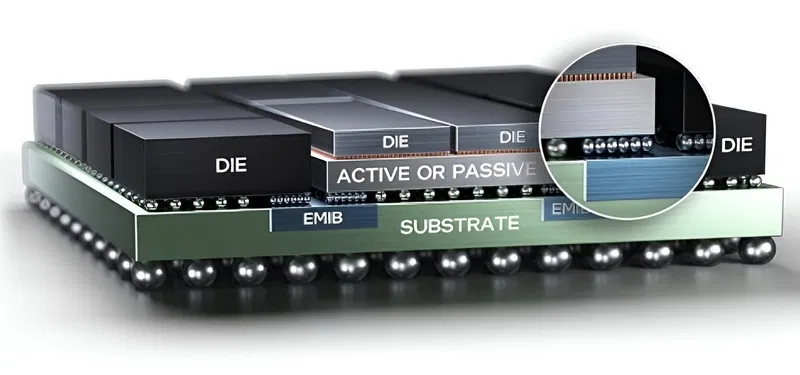
Microsoft announced it is strengthening its partnership with Intel under a new long-term agreement. Microsoft has become the first company to officially confirm the use of advanced EMIB (Embedded Multi-die Interconnect Bridge) packaging technology from Intel Foundry for its custom semiconductor solutions used in the Azure platform.
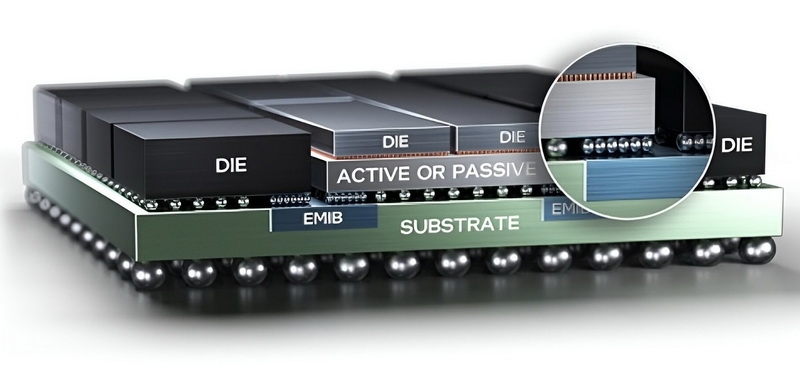
Image source: TechPowerUp
Specifically, Microsoft is leveraging EMIB-T technology, which uses through-silicon interconnects (TSVs) to provide vertical power delivery to multiple stacked dies. This allows the concept of vertical power supply for 3D modules to be implemented at the chassis level.
Microsoft’s portfolio of proprietary developments includes specialized accelerators, for example, Maia 200, designed for inference (inference) tasks in the field of artificial intelligence (including complex inference processes), as well as processors Cobalt 200optimized for the work of intelligent agents. The next generations of these solutions will be manufactured using Intel Foundry packaging technologies, including EMIB and its variant, EMIB-T.
The agreement also guarantees multi-year supply of Intel Xeon server processors, including future Xeon 7 (Diamond Rapids) models, for the Azure infrastructure. The companies will collaborate to integrate Intel Xeon processors with Compute Express Link (CXL), which will improve memory efficiency and system management across data centers. Microsoft estimates that the use of CXL memory and Intel Flat Memory Mode in Xeon 6 processors has increased the performance and memory flexibility of Azure M v4 series virtual machines when performing resource-intensive tasks by up to 2.3 times.
In addition, Microsoft plans to use Intel QuickAssist hardware acceleration technology (Intel QAT) and Intel Trust Domain Extensions (Intel TDX) confidential computing tools. The launch of the first cloud virtual machines with Intel QAT support made it possible to speed up the creation of SQL database backups by up to 2.5 times and increase the reliability of operations. In turn, Intel TDX technology provides encryption of virtual machine memory and processor register states when migrating confidential VMs between physical hosts.
“Microsoft and Intel have a clear understanding of the direction in which the infrastructure for artificial intelligence is developing. This is the creation of increasingly complex systems through joint optimization of silicon components, packaging technologies, computing resources, memory and software. By leveraging our advanced packaging technologies, particularly EMIB, to scale future generations of Azure infrastructure, Intel and Microsoft can combine the flexibility of heterogeneous integration with the manufacturing capabilities needed in the AI era. This will enable Azure customers to experience new levels of performance and cost efficiency,” said Naga Chandrasekaran, executive vice president, chief technology and operations officer, and general manager, Intel Foundry.
Saurabh Dighe, corporate vice president of systems and architecture for Azure at Microsoft, added that the company’s customers need infrastructure built around the workloads that really matter to them. According to him, the multi-year collaboration with Intel brings together advanced packaging technologies, specialized computing, memory and security features to develop the Azure cloud platforms, helping to move the industry forward and meet the growing demand for cloud computing and AI.
If you notice an error, select it with the mouse and press CTRL+ENTER.