Following the previously released AI models Gemini 4 Carbon and Hydrogen, Google introduced Gemini 4 Neon. The new neural network, according to the developer, provides “advanced reasoning capabilities for complex, high-intensity workflows, and does it faster and at a lower cost.”
Image source: blog.google
Gemini 4 Neon delivers Carbon-level performance, and even surpasses it in some tasks, but runs at Flash speeds and at a lower cost. The model is designed for tasks in which simply generating an answer is not enough: it needs to analyze the context, access various tools and perform a sequence of actions. In particular, Neon handles complex programming, analytics, and enterprise workflows.
The model works better with texts, produces clear, well-structured answers and more accurately analyzes files uploaded by users – spreadsheets, PDF documents and photographs. It can process voluminous content into summaries and reports, and extract additional information from other Google apps, including Gmail and Docs. When conducting research, Neon consults online sources to provide relevant information, such as when comparing prices or preparing analytics on the latest market data.
According to Google, the Gemini 4 Neon ranks third in the Artificial Analysis Intelligence Index with a score of 61 at the xhigh thinking level, behind only larger, slower models. In the Vals Index it is in second place with a score of 70.9%. In addition, Neon took first place in the Legal Research Bench and Tax Agent Bench, as well as in Zapier’s AutomationBench and Vending-Bench 2. In the latter, the model scored $16,843 in a long-term business management simulation.
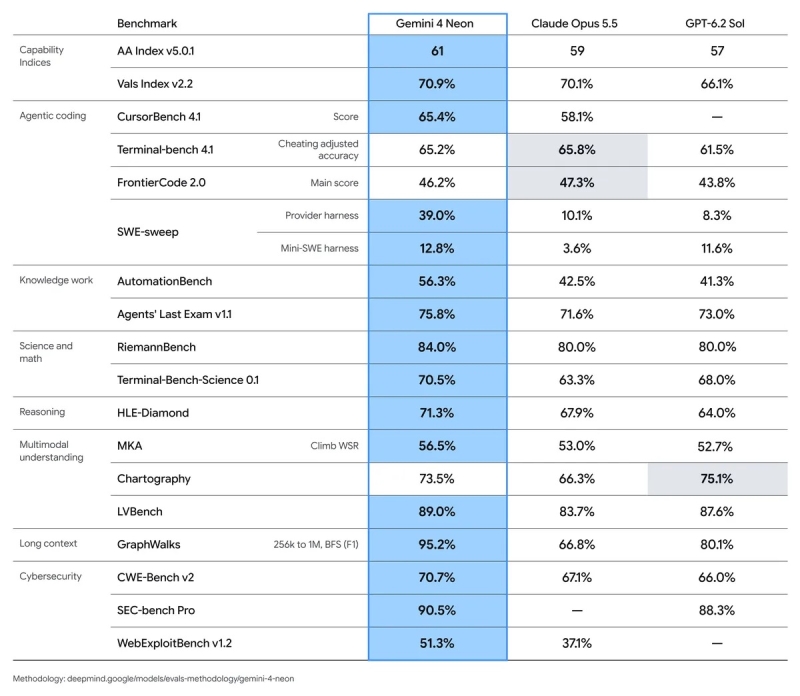
In programming tasks, Neon also shows good results: it took first place in the Artificial Analysis Coding Agent Index with a score of 58.6 points. In Terminal-Bench 4.1 the model scored 65.2%. Google specifically notes its ability to debug and refactor code in several files and repositories at once.
The developer cites cost-effectiveness as an important advantage. At the standard high level of thinking, Neon costs 32% less than Carbon to perform comparable tasks. Based on third-party testing, its operating costs are also 50-80% lower than competing leading-edge models.
Gemini 4 Neon has a contextual window with a volume of 1 million tokens and four levels of thinking, allowing you to choose a balance between the depth of analysis and costs. In the Gemini 4 family, the new model sits between the Hydrogen and the Carbon: the former is designed for fast daily tasks, the latter for the most complex and time-consuming projects, while the Neon combines depth of reasoning with efficiency.
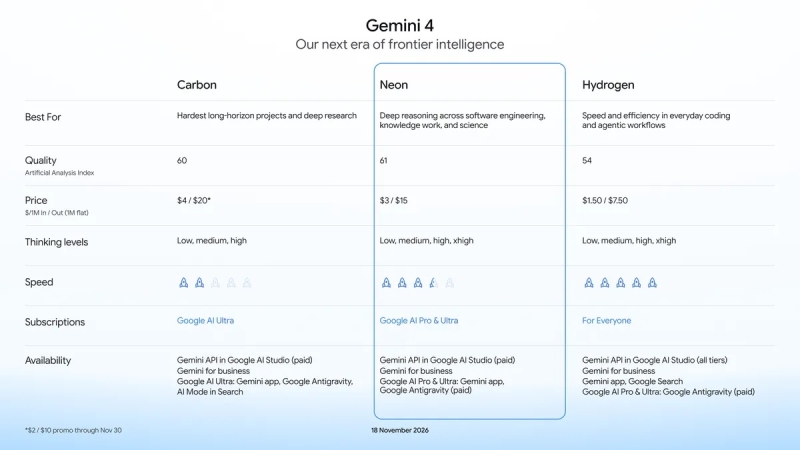
The cost of using the API is $3 per 1 million input tokens and $15 per 1 million output tokens. Cached input tokens cost $0.15 per million. The model is already available through Gemini API, Google AI Studio, Android Studio and Gemini for business. It can be used in the Gemini and Google Antigravity applications by subscribers of paid AI Pro and AI Ultra plans.
Separately, Google presented a version of Gemini 4 Neon for cyber, designed for cybersecurity tasks. It helps to identify vulnerabilities, check the possibility of their exploitation and correct errors in the code. The model scored 76% in the AutoBaxBench test, and 90.5% in the SEC-bench Pro. Access to this version will begin to be provided to Fairwind program members in the coming days.
If you notice an error, select it with the mouse and press CTRL+ENTER.