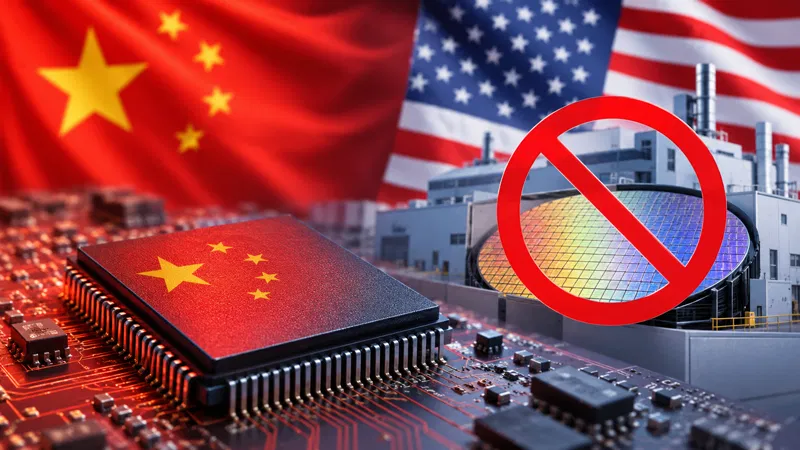
Shares of Chinese chip designers fell sharply on November 19 amid concerns that US export restrictions would make it difficult for them to access the advanced production capacity of foreign contract manufacturers. The rumor arose after Samsung began internal reviews of its customer base.
Image source: AI generation ChatGPT/3DNews
During trading in Shanghai, shares of Hygon Information Technology sank to 17%, Moore Threads Technology – 11%, Cambricon Technologies – 7.7%. At the same time, shares of Chinese contract chip manufacturers Hua Hong Grace Semiconductor and Semiconductor Manufacturing International Corporation (SMIC) in Hong Kong rose by 14% and 7.1%, respectively. Thus, investors have begun to consider the possibility of redistributing orders in favor of local factories, although their ability to replace foreign production remains a big question.
The reason for the sale was the new rules of the US Department of Commerce, which came into force on November 19. The document, published by the Bureau of Industry and Security (BIS), expands control over the production and supply of advanced chips using American technology. Overseas chip packaging and testing (OSAT) fabs and testing facilities must now conduct greater due diligence on customers, including the ultimate owners, ownership structure and possible control by Chinese entities.
An important change concerns the so-called presumption of classification: if a customer is not authorized, then he is automatically subject to export restrictions. To continue working with it, the manufacturer will need to provide evidence required by the regulator.
The new requirements are already affecting the largest contract manufacturers. By data Reuters, TSMC has suspended some orders from Chinese developers for 16 nm and smaller technology standards if the customers do not have American export licenses.
For other orders subject to restrictions, older 28 and 40 nm processes remain as a possible alternative, provided they are not paired with HBM memory and the need to use advanced packaging technologies. This significantly limits the production capabilities of modern artificial intelligence accelerators: most advanced AI processors are manufactured at 7 nm or less, and the combination of logic with HBM and advanced packaging can significantly increase the performance of such systems.
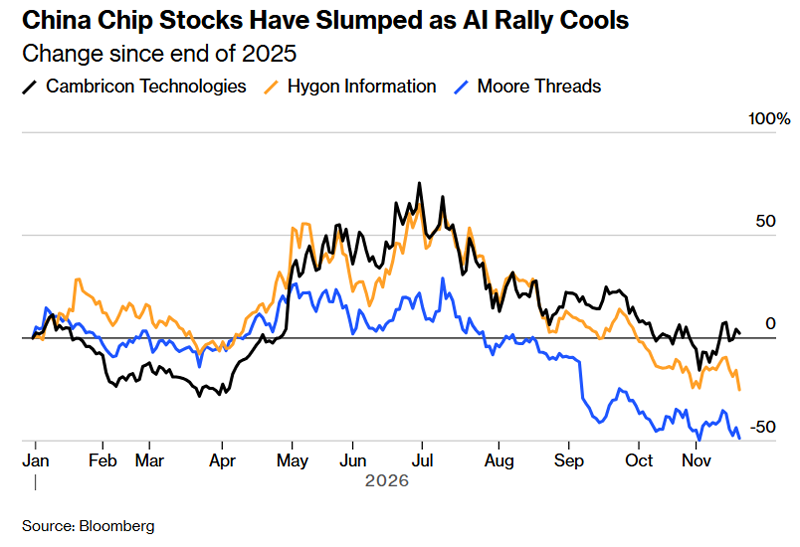
But most of all, investors were excited by the news of a possible tightening of customer checks by Samsung Electronics’ contract chip manufacturing unit. Bloomberg agency reported about the spread of such rumors in the market, but a Samsung representative declined to comment. The Financial Times also reported that Samsung and TSMC were suspending certain deliveries to Chinese customers. Against this background, investors doubt that Chinese manufacturers will be able to quickly replace foreign capacities with their own enterprises.
An additional pressure factor remains the overvaluation of shares of Chinese developers: according to Bloomberg, the value of Cambricon, Hygon and Moore Threads securities is overvalued by more than 45 times. Some analysts believe that this is not a reaction to the news about Samsung, but the beginning of a possible revaluation of this sector of the economy.
If you notice an error, select it with the mouse and press CTRL+ENTER.