SK hynix will become the largest shareholder of Japanese Kioxia, one of the leading manufacturers of NAND flash memory. This will strengthen the position of the South Korean company in the memory chip market, the demand for which is rapidly growing due to the development of artificial intelligence. At the same time, Kioxia will continue to operate independently.
Image source: kioxia.com
SK hynix plans to convert its Kioxia bonds into shares and secure an indirect stake of approximately 14.1%. Due to this, it will strengthen its strategic presence in the capital of one of the world’s leading flash memory manufacturers and create the preconditions for closer cooperation – while Kioxia will maintain independent management.
Both companies produce NAND chips – this memory is used for storage devices in a variety of devices from smartphones to servers and AI systems. In the second quarter, SK hynix’s share of the global NAND market was 19%, and Kioxia’s was 14%. The combined share of the two companies will exceed that of market leader Samsung with 28%, even without taking into account the 11% share of Kioxia’s manufacturing partner SanDisk
The NAND flash memory market is growing rapidly: the development of AI services is driving demand for high-capacity and high-performance drives for data centers, including enterprise-class SSDs. After years of boom and bust cycles, memory manufacturers are faced with a sharp increase in orders, which provoked shortages and higher prices for products. At the same time, shares of these companies declined slightly amid investor concerns about rising debt burdens and circular financing schemes in the AI sector.
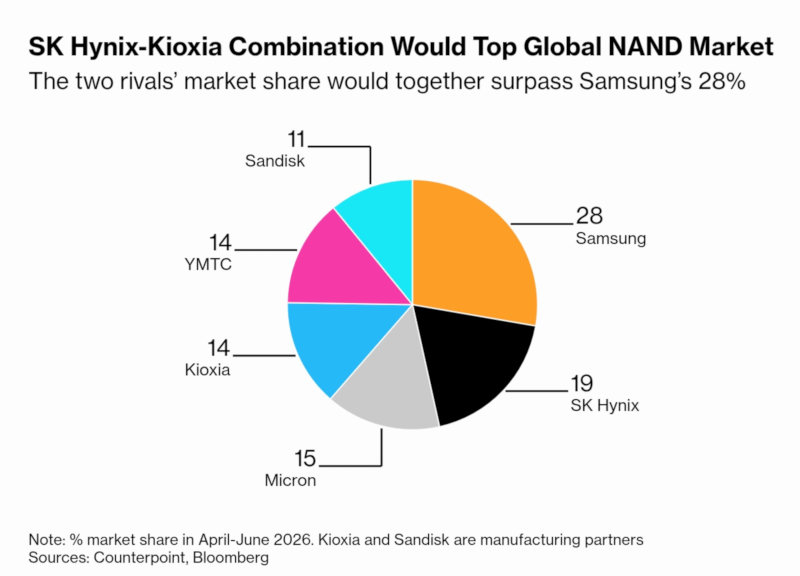
Image source: bloomberg.com
SK hynix said it does not intend to acquire additional shares in Kioxia and will not oppose the independent management of the Japanese company. Converting bonds into shares is unlikely to significantly change the competitive situation in the NAND memory market in the short term, experts say, but having a 14% stake gives SK hynix some influence over key decisions, which limits Kioxia’s flexibility in mergers and acquisitions, partnerships and joint ventures.
The Korean manufacturer may oppose the merger of Kioxia and Sandisk if it weakens its own competitive position. Increasing the stake or gaining control of Kioxia seems unlikely, given that for Japan, the NAND memory sector is viewed through the prism of economic security, and the development of national production capabilities is supported. AI investments are driving strong growth in NAND memory, and changes in shareholders are unlikely to have a noticeable impact on supply and demand in the near future.
SK hynix was part of a consortium led by Bain Capital that acquired Kioxia from Toshiba in 2018. Then SK hynix pledged to maintain its stake in Kioxia at a level of no more than 15% of voting shares until 2028, unless the Japanese company itself agrees to increase the share of the Korean partner. In its annual report, Kioxia cited SK hynix’s stake as a risk factor, noting that it creates a possible conflict of interest because the companies are direct competitors. Toshiba has been gradually reducing its stake in the former chip unit, opening the door for SK hynix to become Kioxia’s largest shareholder.
If you notice an error, select it with the mouse and press CTRL+ENTER.