Despite US export restrictions, the latest Nvidia accelerators for developing artificial intelligence systems are still relatively freely available in China. Journalists from The Washington Post were personally convinced of this when they agreed to purchase a “banned device” at the Huaqiangbei electronics market in Shenzhen. If only there was money…
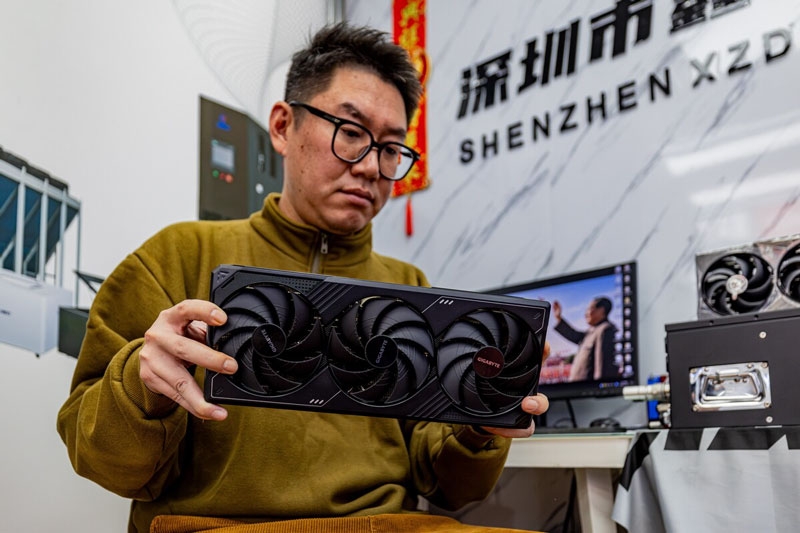
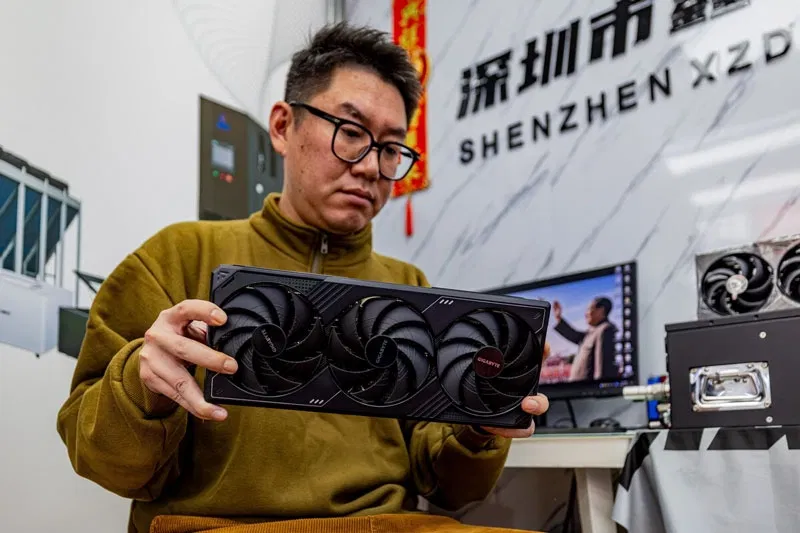
In one of the pavilions at the Huaqiangbei electronics market. Image source: Leung Man Hei/For The Washington Post
After negotiations with sellers it turned outthat on the local market you can purchase not only scarce video cards, but also servers with eight Blackwell B300 accelerators, which was completely unthinkable for American legislators. The asking price is 20 million yuan (about $3 million) per server. The uproar surrounding Jensen Huang’s dismissal has driven up prices, traders say. Before this, such a server cost about $2 million. But now, with Huang’s return to the post of head of Nvidia, the market expects prices for the company’s products to decrease and stabilize.
For comparison: the approximate cost of a similar configuration with eight Blackwell B300 accelerators in the US is about $500–600 thousand. However, Nvidia does not publish official retail prices for its most powerful accelerators. The difference between legal products and those of unknown origin, particularly from a supply chain perspective, is striking. Sellers noted that they were worried after Huang’s resignation, fearing that the market for scarce products would begin to become even more feverish than due to US sanctions.
According to sellers, server versions of AI accelerators are sourced through complex supply chains, including from Hong Kong. However, all this is just the words of intermediaries. Journalists were unable to directly buy or inspect the products, being content with promises and photographs of boxes with unknown contents. But sellers willingly demonstrated video cards, for example, the RTX 5090 and the professional RTX PRO 6000 accelerators, which journalists saw directly at retail outlets. One seller admitted to receiving the RTX PRO 6000 through Hong Kong, but was unable to explain the entire supply chain.
Analysts believe Nvidia chips are a “decisive factor” in the competition between the US and China in the field of artificial intelligence. It is not surprising that US authorities are trying to stop the supply of these products to China. In particular, the restrictions affect Nvidia products used to train large language models and other resource-intensive AI systems. At the same time, the presence of the company’s accelerators from Chinese traders does not in itself prove that Nvidia directly supplied them in circumvention of restrictions. The company denies knowingly violating US restrictions.
By the way, traders from Huaqiangbei do not hide the fact that buyers from other countries often come for Nvidia chips. For example, over the past five years, there have been many Russian and Iranian citizens among the buyers. If people bring money, they always find what they are looking for. The Chinese authorities do not particularly interfere with the sales of Nvidia products in the country, although there is some contradiction between the desire to “throw off the stranglehold of sanctions” and the desire to develop their own national developments. On the other hand, high prices for Nvidia products and difficulties in obtaining them legally stimulate the emergence of close analogues from local companies, for example, Ascend AI accelerators developed by Huawei.
To a certain, and perhaps to a significant extent, American authorities and regulators are themselves to blame for the current situation with the supply of Nvidia chips to China. Journalists attribute this to “confusion and vacillation” both in the Trump administration and in the agencies responsible for export control. In particular, on November 19, 2026, the Foreign Affairs Committee of the US House of Representatives published documents on licensing the supply of Nvidia and AMD accelerators to China. According to published materials, the American Bureau of Industry and Security (BIS) approved more than 879 thousand applications for the export of AI accelerators from both companies, with a total volume of requested supplies of about 3.4 million devices. Separately, The Washington Post found that almost 580 thousand approved Nvidia accelerators belonged to the H200 family.
Huang’s love-spy adventures added to the urgency of the situation. His alleged relationship with Singaporean Alice Huang, who was allegedly recruited by Chinese intelligence services, has raised concerns about the creation of an established network for the supply of sanctioned chips and company accelerators to China or their transfer to data centers leased by Chinese companies outside the country. Jensen Huang will speak on this matter at hearings in Congress and the Senate on December 1 and 3, 2026, respectively. However, the fact of espionage has not been established, although a serious stir arose around this case, which seriously shook world markets.
At the same time, a number of analysts believe that Nvidia chips do not play a decisive role in the Chinese artificial intelligence market. It is much more important for China to develop its own hardware base for AI and learn how to profit from this business.
If you notice an error, select it with the mouse and press CTRL+ENTER.