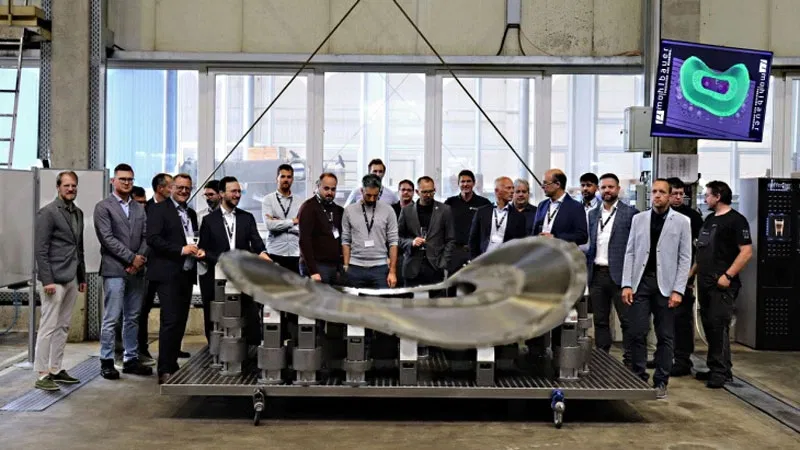
The German company Proxima Fusion announced the production of the first radial plate for a stellarator – a thermonuclear reactor in the shape of a figure eight, and not a donut like in the case of tokamaks. The plate will become the basis of a superconducting magnet for the world’s first stellator with a positive energy output, which began to be created in Germany.
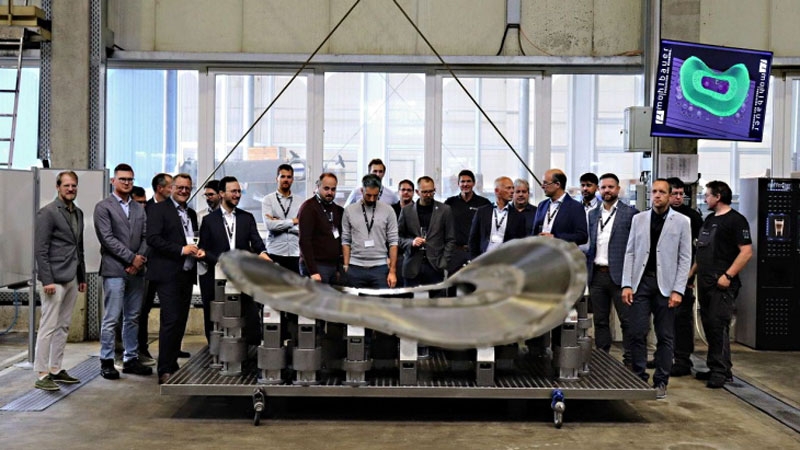
Image source: Proxima Fusion
Plate or Stellarator Model Coil (SMC), intended to test the technology of high-temperature superconducting magnets for future thermonuclear reactors. The part was manufactured by three German industrial companies: Rolf Kind GmbH provided the starting material, Pro Beam GmbH connected the elements using electron beam welding, and Mühlbauer Maschinenbau carried out high-precision machining. This is the first of several radial plates needed to create a demonstration magnetic coil.
Radial plates serve as the supporting structure of the magnet: high-temperature superconducting cables (HTS) are laid in the channels provided by the design, which must maintain a strictly specified position during operation of the magnetic system. A particular difficulty lies in the geometry of the quasi-isodynamic stellarator (QI-stellarator): its magnetic coils have a complex spatial shape with bends and convolutions in three dimensions. Therefore, the load-bearing plates must also have a very complex geometry. In addition, the structure must withstand significant mechanical loads arising from the operation of powerful electromagnets.

Salvador Dalí. The Persistence of Memory. 1931
To connect metal elements, electron beam welding was used in the world’s largest civilian chamber, owned by Pro Beam GmbH. With this method, a focused stream of accelerated electrons transfers its kinetic energy to the material, melting it locally. The process makes it possible to obtain deep welds with relatively little heating of the surrounding metal, which reduces thermal deformation and helps maintain the accuracy of a complex volumetric structure.
According to Pro Beam representatives, when manufacturing parts for fusion plants, it is necessary to simultaneously ensure high mechanical strength and tight tolerances. After welding, the plate underwent precision machining, for which only one attempt is given and this is another test.
The production of the radial plate is part of a magnetic system development program that aims to demonstrate the feasibility of industrial production of high-temperature superconducting magnets with complex three-dimensional geometries. According to plans by Proxima Fusion, which is the developer of the fusion reactor and the customer of its components, by the end of 2027 the demonstration coil should undergo tests to verify key elements of the magnets.
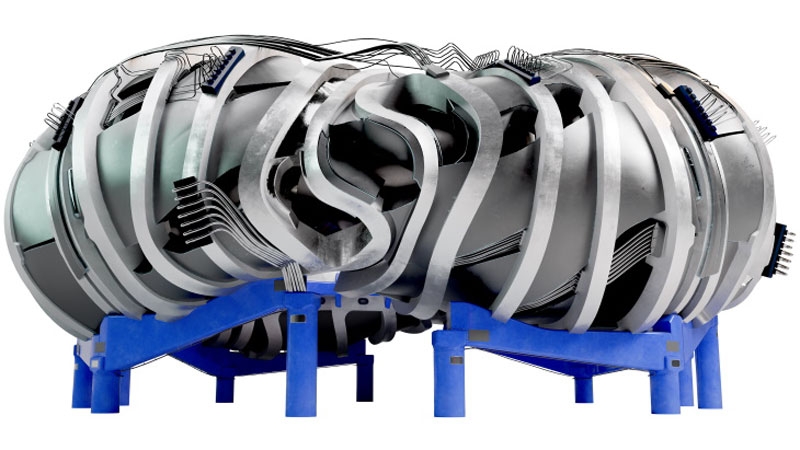
The experience gained is expected to be used to create the Alpha installation, a demonstration stellarator in which the company intends to achieve a positive energy balance of thermonuclear plasma (to be built next to the Max Planck Institute for Plasma Physics), and subsequently the commercial power plant Stellaris on the territory of a former nuclear power plant in the city of Gundremmingen, Bavaria, Germany. Alpha should start operating by 2030, and Stellaris – in the first half of the 30s, becoming the first thermonuclear power plant in Europe.
If you notice an error, select it with the mouse and press CTRL+ENTER.