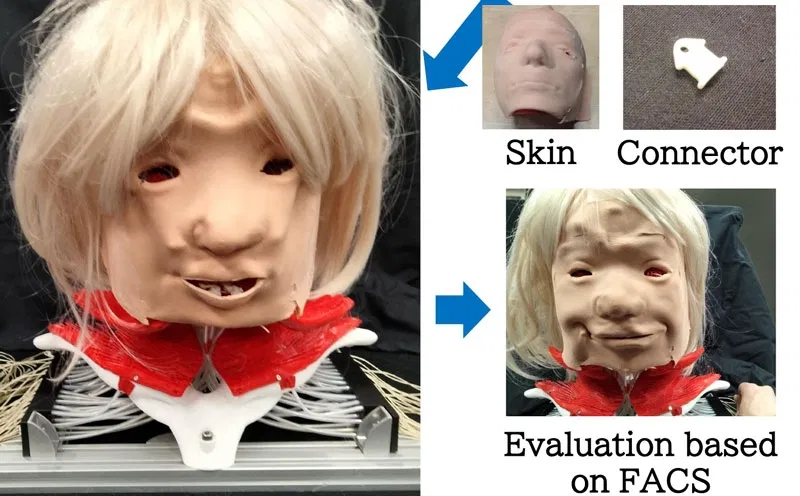
Researchers at The University of Tokyo have developed a robotic model of the human face that fairly fully reproduces its anatomy. The goal of the project was to develop a muscle drive mechanism with motors located outside the front part of the head, the volume of which is not enough to reproduce full facial expressions.
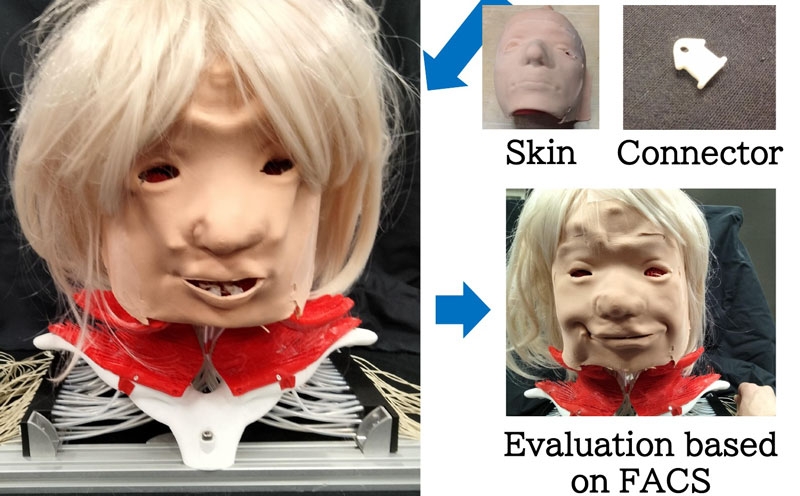
Image source: The University of Tokyo
Robots that imitate human facial expressions are already being produced, but they are not able to show the full range of basic movements of the facial muscles and skin. This would require so many drives and levers that they would not all fit into the front of the machine’s head. Therefore, Japanese engineers decided to reproduce as completely as possible the muscle structure responsible for facial expressions, and move muscle control outside the head.
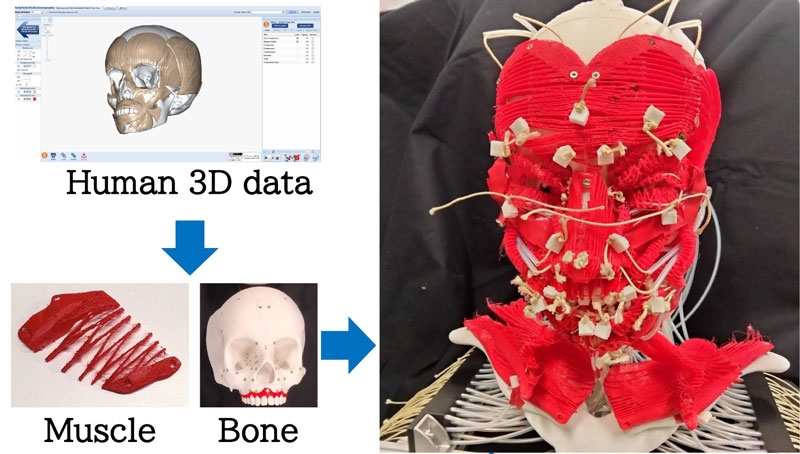
In design implemented 65 artificial muscles representing 34 anatomical types. Their location, geometry and attachment points were determined on the basis of volumetric anatomical atlases. The muscle elements are made of thermoplastic polyurethane (TPU) in a zigzag structure, which allows them to contract and stretch. The contraction is achieved by the tension of control cables routed through polytetrafluoroethylene (PTFE) tubes. It is this design that allows the drive mechanisms to be moved outside the front part of the robot. Silicone skin is molded in separate sections. Muscle simulators are attached to the skin from the inside.
For testing, the FACS (Facial Action Coding System) system, adopted in 1978, was used, which describes facial expressions using 47 separate so-called motor units (Action Units, AU) – individual movements of a part of the face. In the first stage, the researchers manually pulled the control cables without the skin installed and were able to reproduce 40 of 47 basic movements, including raising the eyebrows, moving the lower jaw, moving the eyeballs and sticking out the tongue. After installing the silicone skin, only 30 movements could be reproduced. At the same time, the robot was able to demonstrate facial expressions characteristic of a person: sticking out his chin, raising and lowering the corners of his mouth, wrinkling his nose, and more.
There were also a lot of disadvantages, for example, to puff out the cheeks and create some lip movements, it would be necessary to install a pneumatic drive, which is not available in the current version. The insufficient elasticity of the silicone skin and the peculiarities of the connection between the muscles and the eyelids prevented the full movement of the eyes, in particular, they did not allow them to close.
In the future, the researchers plan to move on to more complex facial expressions involving more muscles, and also hope to replace manual control with remote actuators.
If you notice an error, select it with the mouse and press CTRL+ENTER.