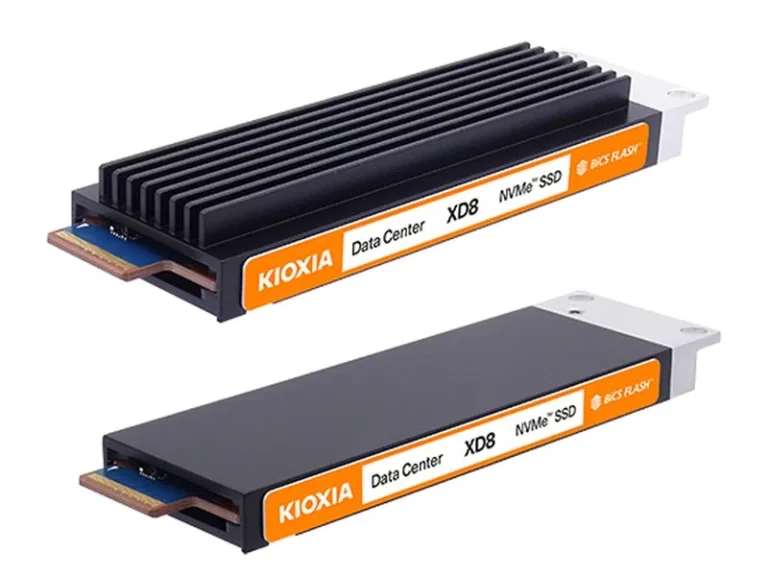
Huawei Technologies is developing high-bandwidth HBM memory, which could theoretically outperform Samsung and SK Hynix products in some specifications. The company is looking to manufacture a critical component for its AI accelerators in China, despite U.S. sanctions limiting access to cutting-edge technology.
The development became known from the title of Huawei’s scientific work, which company representatives plan to present in February at a conference in San Francisco. According to her description, as she writes BloombergChinese engineers have created an HBM architecture with twice the pin density for data transfer compared to the memory that is currently being mass-produced by South Korean manufacturers. Increasing the number of such connections will theoretically significantly increase memory bandwidth and speed up data exchange with processors performing resource-intensive artificial intelligence tasks. However, it is not yet known how far Huawei has progressed from theoretical development to the creation of finished chips.
The new work fits into Huawei’s broader strategy to develop its own semiconductor manufacturing. In particular, the company previously introduced the concept of τ (tau) scaling, which involves increasing chip performance by reducing signal transmission delays and optimizing interconnects, and not just by reducing transistor sizes. One of the directions of this approach was the technology of dense vertical connection of elements.
Now Huawei can develop the same idea for HBM memory: increasing the connection density will allow more data to be transferred between the chip layers and the processor. This will allow you to compensate for potentially lower memory frequencies using a wider bus.
The release of its own HBM is especially important for China, since Samsung, SK hynix and Micron cannot supply such memory to Chinese customers due to American restrictions. At the same time, the reserves of previously purchased foreign microcircuits are not endless.
Today, Huawei has actually become one of the main Chinese suppliers of AI accelerators thanks to the Ascend family, which gained popularity after the supply of advanced Nvidia chips was limited. The company aims to release at least one new accelerator every year until 2029 to meet growing demand from Chinese AI developers including DeepSeek and Moonshot.
However, manufacturing advanced memory will be challenging because Chinese companies lack access to the most advanced extreme ultraviolet (EUV) lithography facilities needed to produce advanced semiconductors. Therefore, Huawei has to look for alternative ways to improve their performance.
In parallel, the Chinese CXMT is experimenting with the 4F2 architecture (a characteristic of a device or memory element in which one memory cell occupies an area of 4F2, where F is the minimum technological size) for server RAM, hoping to reduce the gap with manufacturers from South Korea and the United States.
Reports of advances by Chinese developers in the production of advanced memory and semiconductors for artificial intelligence systems have already increased investor concerns: shares of Samsung, SK hynix and Micron have come under pressure amid fears that competitors from China could displace them in the global memory market in the future.
If you notice an error, select it with the mouse and press CTRL+ENTER.