Global smartphone sales fell 16% year-on-year in the third quarter of 2026 due to lingering RAM shortages and rising device prices. According to the analytical company Counterpoint Research, the crisis hit the Android platform the hardest, whose market share dropped to a historic low for the third quarter, while Apple and Huawei were able to increase supplies.

Image source: NoypiGeeks
At the end of the reporting period, the share of Android decreased from 79% to 74%. The platform suffered from rising chip prices more than its competitors, since it is widely represented in the budget segment, where the decline in demand was the sharpest. Only the autumn releases of the flagships Oppo, vivo and Xiaomi, as well as current folding smartphones from Samsung, helped mitigate the decline.
The iOS operating system increased its share from 17% to 21%, updating the record for the third quarter. iPhone sales grew by 2% year on year despite the general market decline and rising prices – the main driver of demand was the iPhone 18 Pro series models, which surpassed last year’s iPhone 17 Pro in popularity.
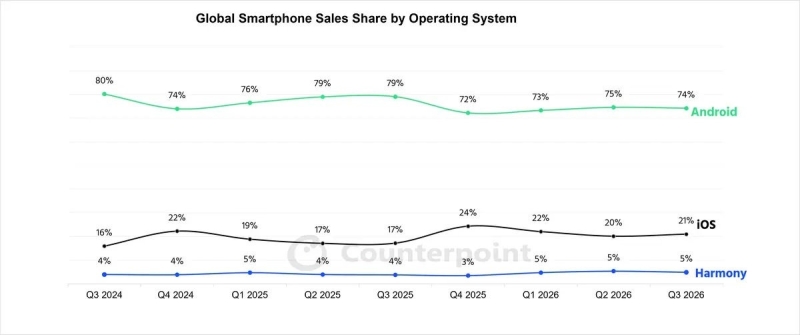
Image Source: Counterpoint Research
Huawei’s proprietary HarmonyOS platform retained 5% of the global market and significantly strengthened its position in China, where its share grew from 17% to 22% over the year. Huawei smartphone shipments in China jumped 12% as the local market fell 10% thanks to strong demand for the Enjoy 90 Pro Max, Nova 16 and Mate 80 lines, but a September price increase could slow this growth in the fourth quarter.
In key markets, iOS remains the leader in the US (54% versus 46% for Android), in China Android occupies 60% (versus 22% for HarmonyOS and 18% for iOS), and in India it holds 92%. According to Counterpoint Research, pressure on the budget segment will continue at least until the end of 2027, when memory prices are expected to stabilize – because of this, Xiaomi and vivo have already cut their supply plans for next year by about a quarter.
If you notice an error, select it with the mouse and press CTRL+ENTER.