In energy networks on all five continents of the Earth, despite their isolation from each other, for more than ten years they have been recording mysterious bursts that synchronously repeat every 60 seconds. And only this year scientists found out what causes these impulses. Meanwhile, the consequences could be dire.
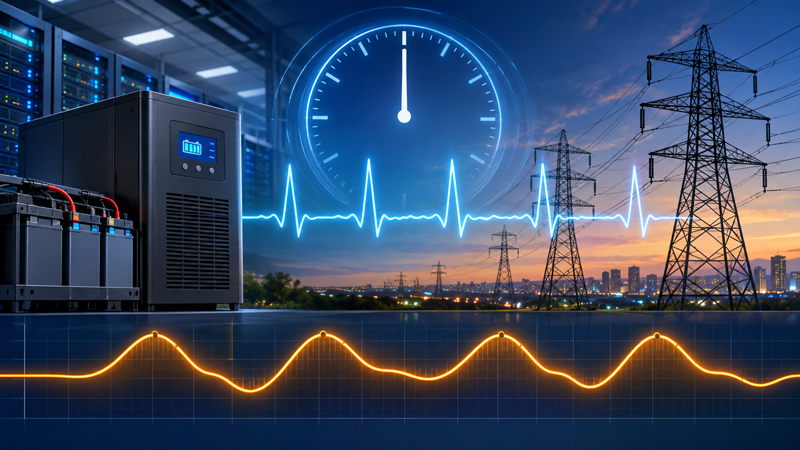
Image source: AI generation ChatGPT/3DNews
The problem got serious about it physicists from the Jülich Research Center (Forschungszentrum Jülich). It was previously assumed that a slight imbalance between load and consumption in electrical networks is caused by the equipment of hydroelectric power plants – water turbines are more inertial than gas turbines and react with a delay in the process of compensating for the imbalance. As it turned out, hydroelectric power plants alone cannot explain the anomaly.
Scientists analyzed frequency measurement data from power grids in Europe, North America, Australia, Asia and Africa. The characteristic minute signal was detected in 12 power systems, including continental Europe, the UK, Scandinavia, Australia, Malaysia, South Korea and South Africa. Deviations from the base frequency (50 or 60 Hz depending on the local standard) are only a few millihertz (MHz), but are highly regular and persist for years.
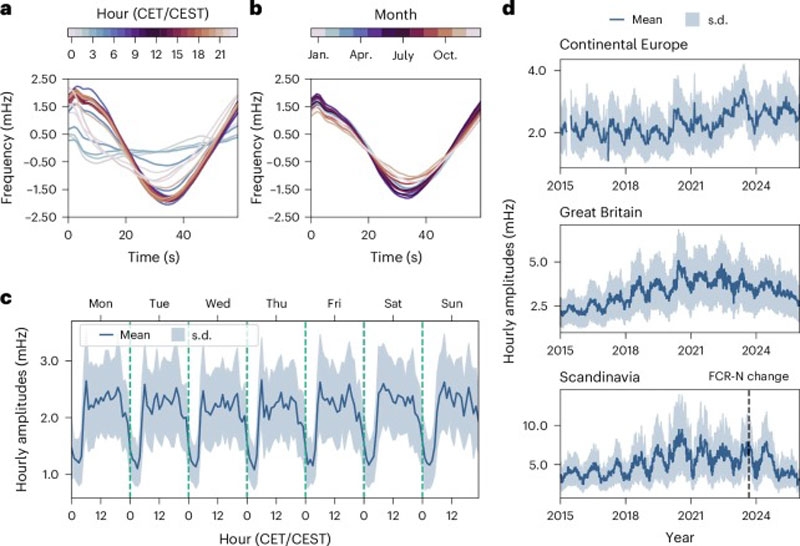
Image source: Nature Energy 2026
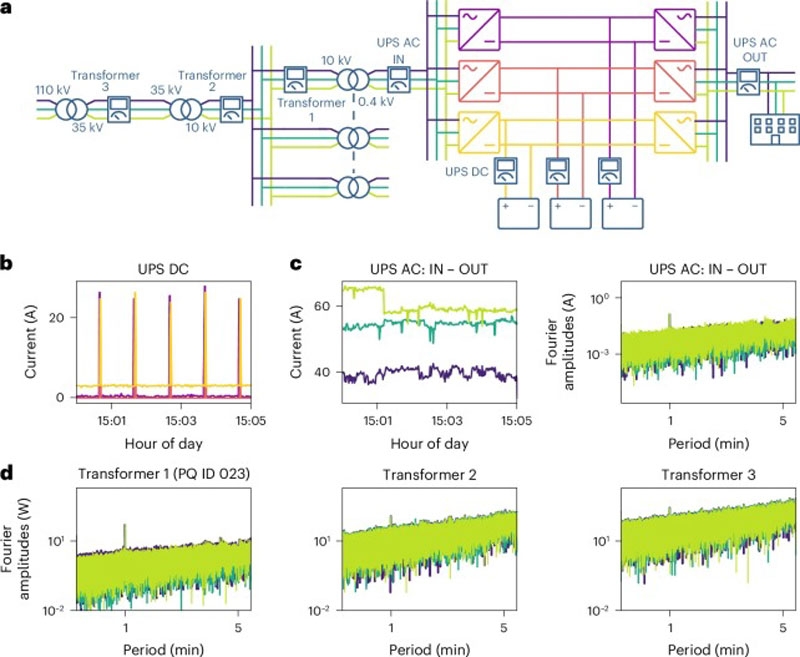
The clue, according to the researchers, was found when studying the electrical distribution network of the research campus in Jülich. Measurements at 80 points showed that characteristic vibrations are present in buildings with UPSs, but are absent in buildings where there are no such devices.
A more detailed study of one uninterruptible power supply traced short synchronous current pulses from the battery terminals to the building’s electrical infrastructure, all the way to the connection to the 110 kV high-voltage grid. The UPS manufacturer has confirmed that the pulses occur during automatic battery tests triggered by management software that synchronizes the UPS’s internal clock using network protocols.
It turned out that many UPSs synchronize their clocks on a planetary scale. This occurs either via a local network with access to the Internet and time synchronization services, or via GPS in the case of advanced solutions. Since the algorithm for checking the battery charge of UPSs is the same, they all simultaneously create a short-term load on local power systems, and hydropower further enhances this impact, like resonance. Tens and hundreds of UPSs would not make a difference. But thousands and tens of thousands of devices caused power systems to pulsate synchronously every minute.
In some power systems, the amplitude of the effect has increased significantly over time. For example, in Ireland, minute frequency fluctuations increased from approximately 3 to 12 MHz between 2016 and 2021. This creates a problem: we are talking about loads on equipment with a total capacity of tens of megawatts. If the situation is left to chance, then as data centers, UPS systems and other digital technologies related to the generation and balancing of power grids develop, the wear and tear of equipment will increase, and the risk of accidents in power systems will also increase.
Scientists sent their proposals to UPS manufacturers, the essence of which boils down to a request to desynchronize battery testing protocols. This should eliminate the cumulative effect of the UPS and prevent its consequences.
If you notice an error, select it with the mouse and press CTRL+ENTER.