By the beginning of the SC26 conference, an updated TOP500 ranking of the 500 most powerful supercomputers in the world was released. According to recent data, the share of systems based on AMD technologies in the list has reached 40%, which is an increase of 14 percentage points. more than in 2025. Now the rating includes 202 systems with AMD components (a year earlier there were 177). The main newcomer to the ranking was the Lux supercomputer, created by AMD together with the US Department of Energy (DOE) and ranked 14th.
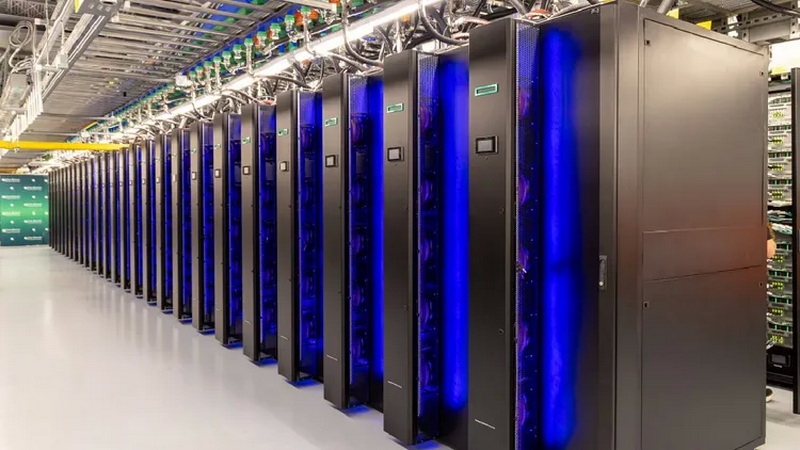
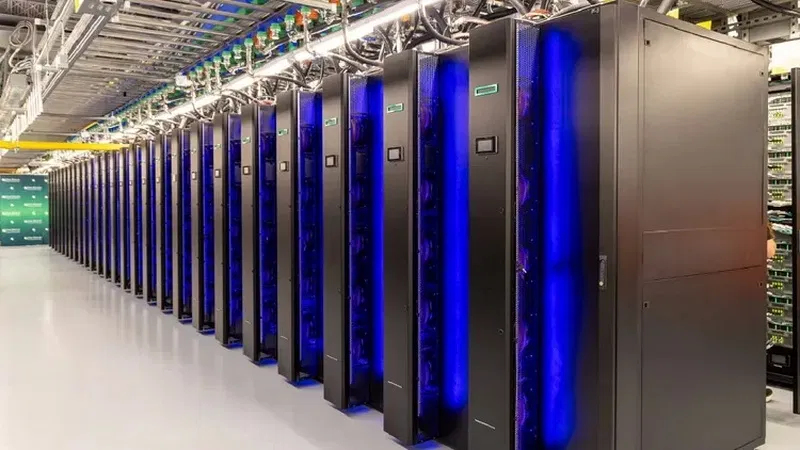
Image source: Oak Ridge National Laboratory
AMD’s position in the top ten remains stable. Chinese supercomputer LineShine, which debuted in June, still holds the top spot. In second position is the El Capitan system, running on AMD chips. It is followed by Frontier (3rd place), HPC7 (6th place) and HPC6 (8th place) – the composition of the top ten remains the same as in the previous version of the TOP500 ranking.
The Lux supercomputer was announced just over a year ago as part of a $1 billion deal between the US Department of Energy and AMD to create two computing systems. It was built by HPE as part of the government’s Genesis Mission program. The supercomputer is located at the Oak Ridge High Performance Computing Facility (OLCF) at Oak Ridge National Laboratory, the same location where the Frontier system is located.
Lux uses more than 4,000 Instinct MI355X GPUs distributed across more than 500 nodes hosted on HPE ProLiant Compute XD685 servers. When running high-performance computing (HPC) using double precision (FP64), the system achieves 317 petaflops of performance. In neural network training tasks, peak performance reaches 20 exaflops (in FP8 format), and in inference (inference) tasks – 40 exaflops (in FP4 format). With 288GB of HBM3E memory per GPU, the total system memory capacity is 1.1 petabytes. The system is based on AMD EPYC processors (the exact model and generation are not specified) and AMD Pensando network solutions.
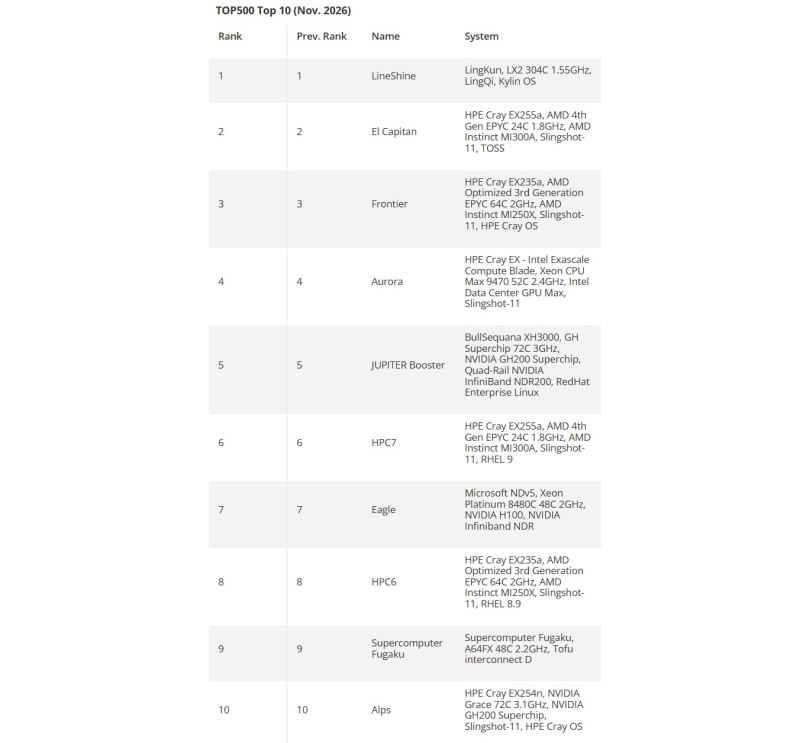
Image Source: Tom’s Hardware
The machine’s computing resource is estimated at 3.5 million node-hours per year, half of which is reserved for research within the Genesis Mission. The program was established by executive order in November 2025 and includes training scientific foundation models on federal data sets and creating “AI agents to test new hypotheses, automate research processes, and accelerate scientific breakthroughs.”
Lux is the first dedicated supercomputer for the Genesis Mission. However, it complements already existing computing systems, which are also partially used for scientific research. These include, for example, the Aurora supercomputer (based on Intel technology) at Argonne National Laboratory, which took fourth place in the latest TOP500 ranking.
The Lux supercomputer is intended primarily for AI research and is not a successor to Frontier. In 2028, the launch of a new generation exascale supercomputer, Discovery, is expected. It is also being developed jointly by the US Department of Energy (DOE), AMD and HPE.
If you notice an error, select it with the mouse and press CTRL+ENTER.