While Silicon Valley companies are modestly silent about developing artificial superintelligence in their data centers, capable of recursive self-improvement, the Chinese are taking the liberty of publicly admitting it. It seems that the Chinese company Z.ai has become the first in the world to announce the creation of an AI model based on the transformer loop architecture, which will force the AI to literally think twice before answering the question.
Image source: Z.ai
Overall we are talking about announcement of a new version universal language model (General Language Model) GLM-5.4 with 750 billion parameters, which followed the announcement in mid-August of the GLM-5.3 model with 700 billion parameters. The number of parameters has not increased so much that this could justify “cheating” the model index counter, but other changes certainly point towards this, and this is the new Loop Transformer architecture. According to unofficially unconfirmed rumors, OpenAI began using the same architecture in the GPT-6 Astra AI.
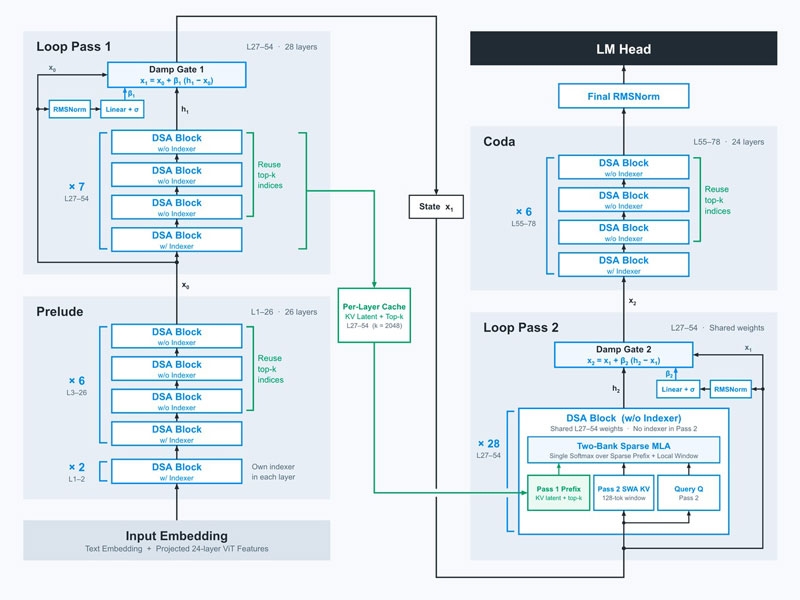
The main feature of the architecture is the reuse of the same neural layers: instead of sequentially increasing the number of parameters, the developers forced part of the network to perform calculations twice, refining the intermediate results. According to the company, this approach allows increasing the depth of calculations and improving the model’s ability to solve complex problems without a corresponding increase in the number of parameters. Z.ai also claims that the level of intellectual capabilities of GLM-5.4 is comparable to models containing 2-3 trillion parameters, but this assessment has not yet been confirmed.
The new version of the model is based on pre-trained GLM-5, which the developers did not create anew, but converted to a loop architecture using additional training. To do this, we identified a block of 28 layers and organized its double passage with common weights. At the same time, we had to solve the problem: during repeated processing, the volume of intermediate data could increase excessively, disrupting the work of subsequent layers. To solve this problem, Z.ai introduced special control mechanisms (gates) that regulate the degree of change in the internal representation of each token.
The first pass mainly forms the general context, and the second refines the results obtained. Additionally, a common KV cache is used – memory in which intermediate results of processing previous tokens are stored. The second pass reuses the data stored in the cache, storing its own results for only a small sliding window. This avoids duplicating data in the cache and saves video memory.
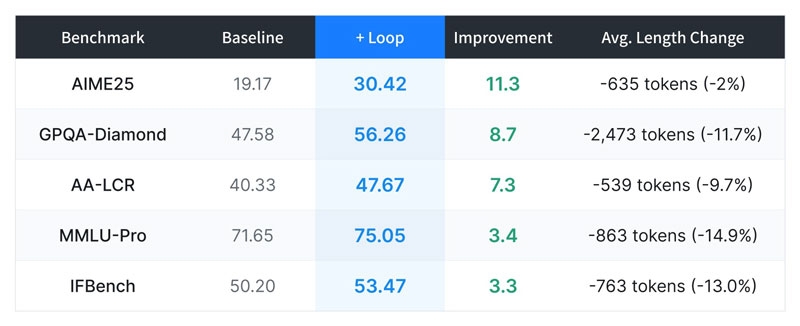
The effectiveness of the architecture was tested on models with sizes of 1, 4 and 30 billion parameters. Specifically, the two 30 billion models had the same number of parameters, but the loop transformer version used about 10% more computational resources during training. On the AIME25 math test, her result increased from 19.2 to 30.4 points, on the GPQA-Diamond science test – from 47.6 to 56.3, and on the AA-LCR long context processing test – from 40.3 to 47.7 points. At the same time, the length of answers—the number of tokens involved—in individual tests decreased by 2–14.9%, and saving tokens is always useful.
Z.ai positions GLM-5.4 as a tool for so-called Generalized Coding, in which code becomes a means of solving problems far beyond traditional software development. As demonstrations, the company presented a music video created by the model, a 3D model of a six-axis robotic arm in FreeCAD, a computer game with physics, maps and a combat system, as well as an interactive 3D scene with birds.
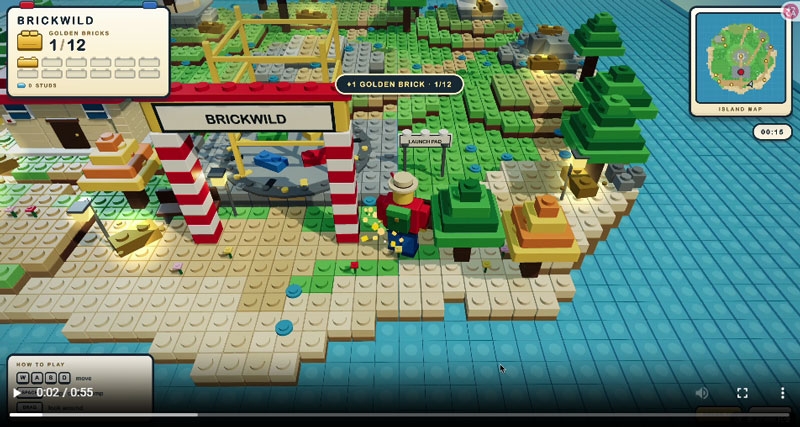
The GLM-5.4 model is already available through Z.ai Chat and programming tools GLM Coding Plan and ZCode. The API is still in the preparation stage, and the developers promise to publish the weights after additional security checks are completed. At the same time, the company itself acknowledges the problem of excessively long reasoning cycles, which can increase the time it takes to complete individual tasks.
If you notice an error, select it with the mouse and press CTRL+ENTER.