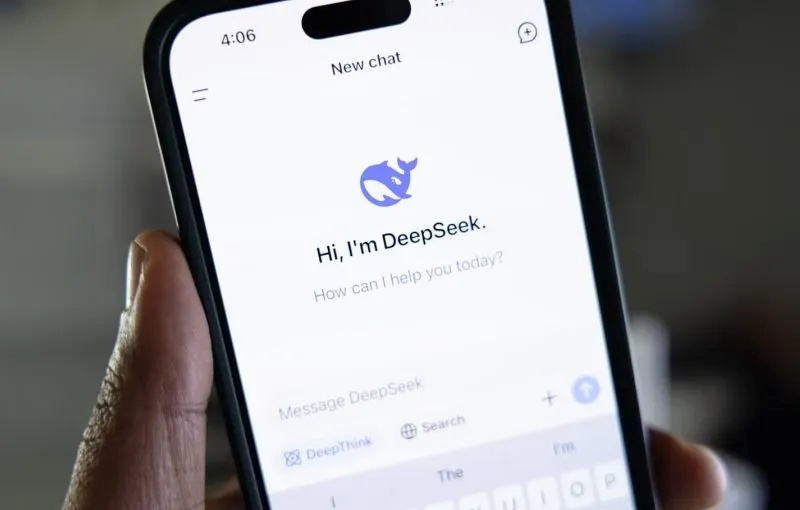
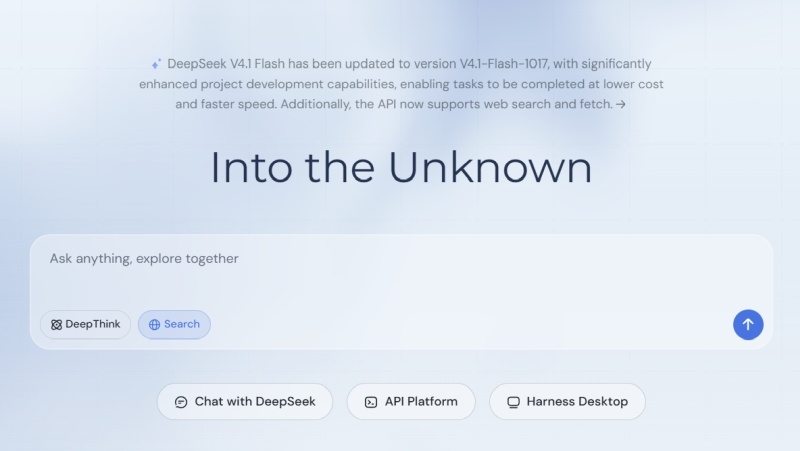
DeepSeek has tightened usage limits for free users of its app and web version. The continuation of long dialogues has been disabled, the volume of one request is limited to 40,000 characters, and a daily quota for the number of messages has been introduced. The company explained this by a lack of computing power. Over the past week, the number of requests for the V4.1-Flash-1017 model reached a record 59.2 trillion tokens, which brought the model to first place in the world.
Image source: DeepSeek
Since October, there have been at least eight service outages. Many DeepSeek users have encountered “insufficient computing power” or “usage quota reached” notifications. Some users report that access to the service is limited after just two hours of continuous use. The company has not yet provided clear explanations regarding the quota rules and has not announced when the restrictions will be lifted.
Judging by user reviews, the innovations include three main restrictions. Firstly, it became impossible to continue long conversations that had no activity for more than seven days (some users received a notification with a 72-hour warning). Secondly, the maximum length of a single text request has been reduced to approximately 40,000 characters. Thirdly, a daily communication quota was introduced: when it is exhausted, the message “server is busy, usage quota has been exhausted” appears.
These restrictions primarily affect the consumer version of the application and the web interface. The API used by developers is not affected, as it has separate limits on the number of simultaneous requests and has a pay-as-you-go model.
According to statistics from the API aggregator platform for large language models OpenRouter, for the week from October 19 to 25, version V4.1-Flash-1017 (updated by DeepSeek on October 17) took first place: the volume of requests reached 33.6 trillion tokens, which is 801% more than the previous week. In second place was the earlier version, V4.1 Flash, with 18 trillion tokens.
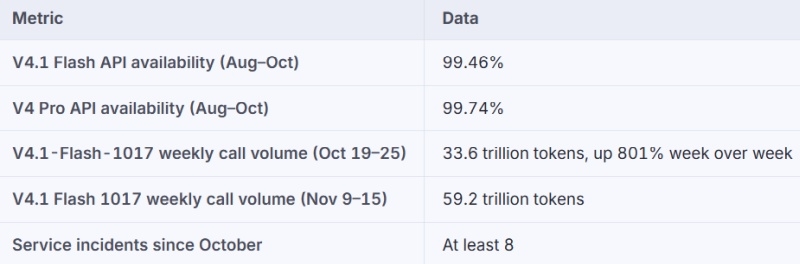
It is noteworthy that during that period, all five top positions in the ranking were occupied by Chinese large language models. By the week from November 9 to November 15, the volume of requests for V4.1 Flash 1017 increased even more – to 59.2 trillion tokens, which allowed the model to maintain global leadership. The model, launched on September 10, gained 15.8 trillion tokens in the week of September 14. Thus, in just two months the volume almost tripled, while the expansion of computing power clearly did not keep up with this pace.
According to DeepSeek’s official service status page, there have been at least eight incidents since October affecting the end-user web version, in-app conversations, and the API for the V4 Pro and V4.1 Flash models. In particular, on October 15, the largest outage of the month occurred, lasting more than four hours. It restricted access to both the user interface and API of two flagship models – this was the largest incident in a month.
The introduction of restrictions did not come as a complete surprise. On November 13, DeepSeek officially opened access to a full-fledged API that provides all the capabilities of the application – web search, “deep” (analytical) thinking, working with files and links, as well as voice input. In addition, the company has published the source code for the chat interface (chat-demo) under the MIT license. According to the developers, this allows you to create a “complete copy of the DeepSeek application.” Users can theoretically use the API to create their own service, but in this case the computing resources will no longer be free.
To manage the load, DeepSeek has implemented a number of measures: in particular, differentiated tariffs for APIs depending on the time of day (during off-peak hours, the cost of services is half as low, which encourages developers to access the system at this time). There are also separate limits on the number of simultaneous connections: for the deepseek-flash and v4-pro models they are 2500 and 500 sessions, respectively, and these resources are completely separate from those allocated to ordinary users of the application.
For DeepSeek, such restrictions are a way of redistributing resources: the company sacrifices some of the capabilities when working with long contexts in order to ensure stable operation of the service for active users. This primarily affects tasks that require a very long context – for example, processing large documents, analyzing large fragments of program code, or long-term creative processes. Previously, users could work with such tasks for free.
Earlier, elements of quota management logic were discovered in the web interface code, which gave rise to rumors about the possible launch of a paid subscription for ordinary users. However, a detailed analysis showed that the code contained neither prices for tariff plans, nor sections for subscribing, nor payment instruments, and the mention of “upgrade” actually referred only to updating the web version of the service itself.
This approach is consistent with the position of DeepSeek founder Liang Wenfeng. He has repeatedly emphasized that the company’s long-term goal is to create strong artificial intelligence (AGI), and products for individuals and businesses are only “by-products along the way to this goal.” When it comes to pricing, Liang adheres to the principle of “no subsidies and no excess profits.” According to him, the limiting factor is the lack of computing resources, and not the reluctance to scale.
DeepSeek plans to build a gigawatt-scale data center in Ulanchub, equipped with at least 160,000 Chinese-made AI chips. It is expected that the entire cluster will be put into operation gradually – between the end of 2027 and the beginning of 2028. In October, DeepSeek completed a second round of financing worth RMB 105.5 billion (about $15.9 billion), bringing the company’s valuation to RMB 615.5 billion (about $92.5 billion). The company has not confirmed either the amount of investment or the purpose of its use, but the prevailing opinion on the market is that the funds will primarily be used to develop computing infrastructure.
The problem of lack of computing power is relevant not only for DeepSeek. OpenAI has entered into a seven-year computing collaboration agreement with AWS, committing to invest $38 billion. Anthropic disclosed in its IPO prospectus that it has an agreement with Google to purchase at least $114.5 billion worth of computing resources through July 2033. Executives at a number of Chinese technology companies have also noted in earnings calls that computing power is being maxed out and hardware is in short supply.
This sends a clear signal to the entire industry: With demand for computing resources growing exponentially, the era of “unlimited context” in free large language models is coming to an end. Sooner or later, the cost of computing in one form or another will fall on the shoulders of users. How Chinese large-scale model developers balance their desire to increase query volume with limited computing power will be a key competitive factor in the next phase of market development.
Now the market is waiting for an answer to the question: will DeepSeek launch a paid tariff for private users? For now, the company will only note that its existing conversational product is “just a relatively basic form,” without giving any timeframe. Balancing transparency of rules with quality of user experience, the company faces its first public test on the road to commercialization.
If you notice an error, select it with the mouse and press CTRL+ENTER.