
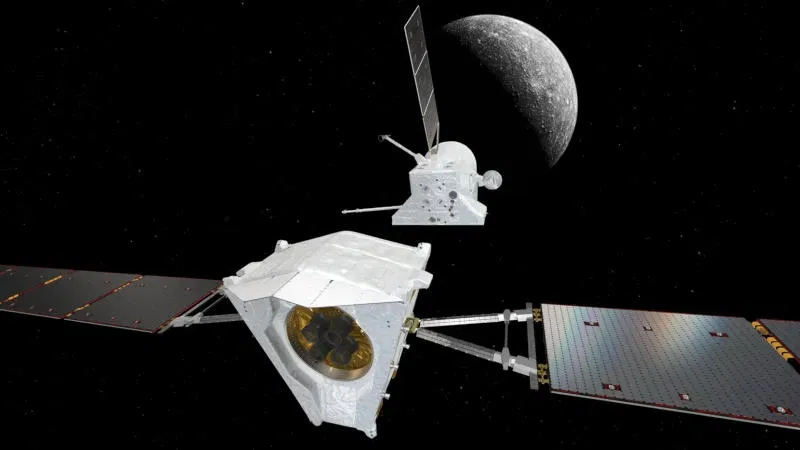
The BepiColombo spacecraft is scheduled to enter Mercury orbit on November 21. This will be an important stage of the mission, but not the beginning of full-fledged scientific observations: first the device will have to go through a series of maneuvers and split into two orbital probes. The full-time scientific program will begin in April 2027. BepiColombo will study the surface and internal structure of the planet, its exosphere and magnetic field.
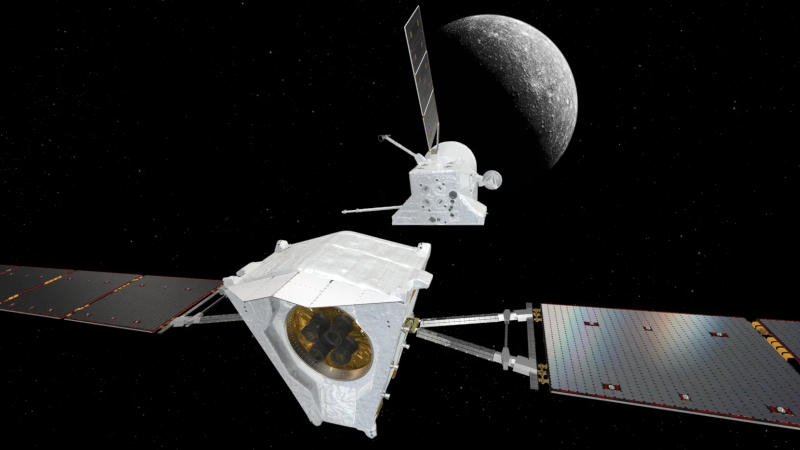
Image source: esa.int
The BepiColombo mission is a joint project of the European Space Agency (ESA) and the Japan Aerospace Exploration Agency (JAXA). The device launched in October 2018. Getting to Mercury is difficult: the Sun greatly accelerates the probe flying towards it, so to enter the planet’s orbit you need to gradually adjust its speed and trajectory. During the journey, BepiColombo performed nine gravity assist maneuvers – near Earth, Venus and Mercury.
In 2024, the power supply system experienced a problem that prevented the engines from operating at full power. Engineers developed a new trajectory, and the arrival was postponed from December 2025 to November 2026. There was no need to change the scientific objectives of the mission.
BepiColombo consists of two scientific devices – the European Mercury Planetary Orbiter (MPO) and the Japanese Mercury Magnetospheric Orbiter (Mio) – as well as a protective shield. The transport module, which provided the flight to Mercury, separated from the complex in September. MPO and Mio are scheduled to enter orbit around the planet together on November 21 and separate in December. Mio will move to its elongated orbit; MPO will continue to maneuver and should reach its target science orbit in March 2027.
The devices will operate in different orbits to solve different scientific problems. The MPO has 11 instruments to study the surface, composition of the planet and its exosphere. Among them are spectrometers, a laser altimeter for relief mapping and equipment for analyzing Mercury’s rarefied gas envelope. The MPO’s orbital period in the target orbit will be approximately 2.3 hours.
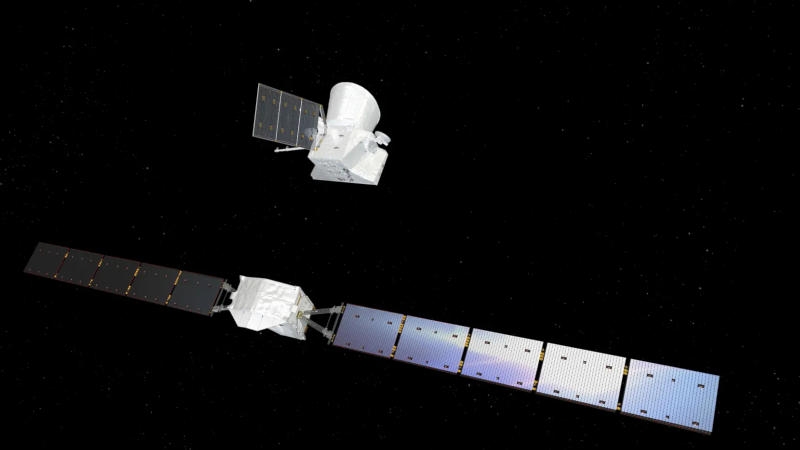
Mio has five instrument clusters. From a more elongated orbit with an orbital period of about 9.3 hours, it will study Mercury’s magnetic field and magnetosphere, exosphere and solar wind.
The main scientific mission is designed to last approximately one Earth year – that’s more than four years on Mercury. It can be extended if the condition of the devices and the fuel supply allow the work to continue.
Scientists hope that the collected data will help understand several mysteries of the planet. For example, the source of Mercury’s magnetic field is shifted about 400 km north of the planet’s center, and the field itself is much weaker than Earth’s. The exosphere is constantly replenished with matter from the surface, but the role of different processes in this is still unclear. Finally, Mercury has an unusually large iron core: understanding how the planet formed and how it has changed is one of the main goals of the mission.
If you notice an error, select it with the mouse and press CTRL+ENTER.