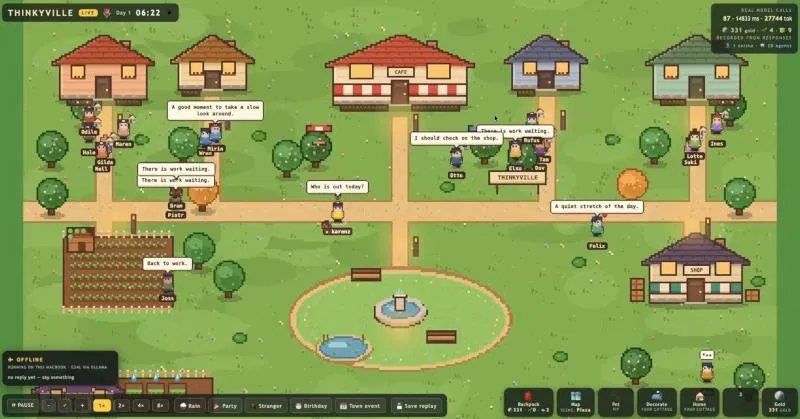
Thinking Machines Lab, founded by former OpenAI CTO Mira Murati, has released Inkling 2 Mini, a multimodal AI model with open weights under the Apache 2.0 license. It accepts text and images and responds with text. The model can be run locally on Mac computers with Apple chips and at least 32 GB of combined memory, as well as on the Nvidia DGX Spark desktop system.
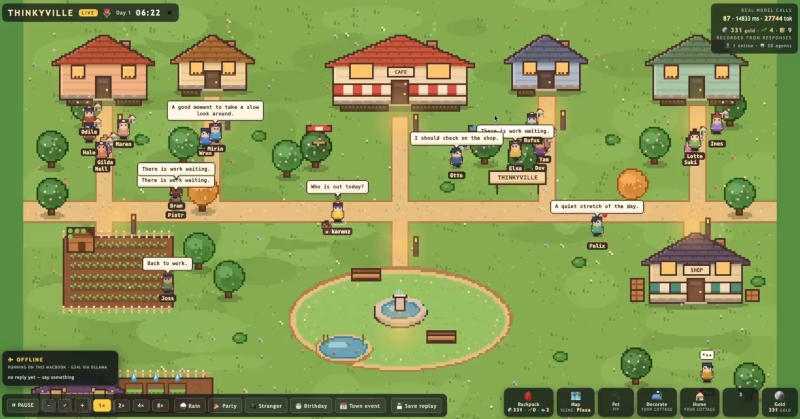
Image source: thinkingmachines.ai
Inkling 2 Mini is designed for a wide range of tasks, including writing code and working as part of AI agents. The original set of weights takes up about 20 GB and is available on Hugging Face. For other systems with discrete GPUs, the developer recommends at least 32 GB of video memory. The model supports context up to 1 million tokens, but the ability to run it on a Mac with 32 GB of memory does not mean that on such a computer it will be possible to use the entire context window: as it fills, the size of the attention cache grows.
On Mac, the model can be run through Ollama or Exo Labs. Hugging Face has also added support for Transformers, Llama App and MLX. Quantized versions in GGUF format are available for llama.cpp. In the Thinking Machines cloud, the model can be launched and further trained through Tinker, and Tinker Playground is available to get acquainted with it in the chat.
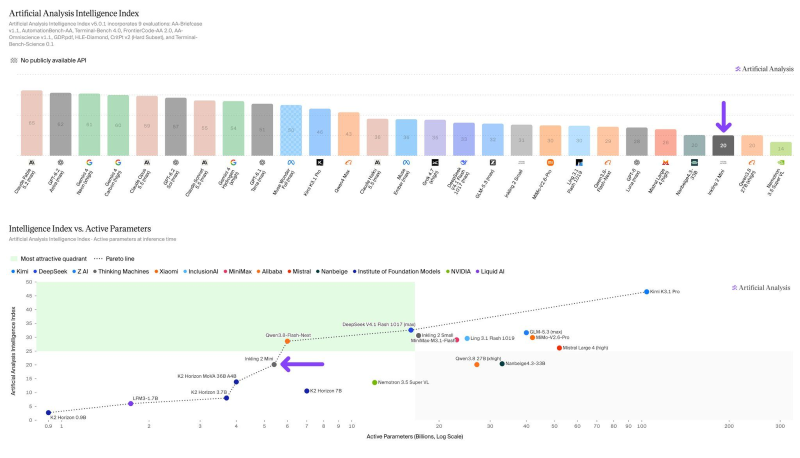
Image source: Artificial Analysis
The main feature of Inkling 2 Mini is the reuse of some layers. The model is built on a 24-layer transformer with a “mixture of experts” (MoE) architecture and has 26.4 billion parameters, of which 3.4 billion are active. When processing each token, the first six and last six layers are executed once, and the middle 12 are executed three times with the same weights. Thus, there are 48 uses of layers per token, although only 24 weights need to be stored. Taking into account repetitions, the number of uses of weights per token reaches 5.4 billion. This scheme saves memory on the scales, but each additional pass requires calculations.
Thinking Machines also released a research variant with a variable number of passes. In the developer’s experiments, as their number increased, the text chain of reasoning was shortened, but remained readable. Hugging Face verified that the option worked, but did not evaluate it in detail.
In the Artificial Analysis Intelligence Index rating, the Inkling 2 Mini model scored 20 points – the same as the Alibaba Qwen3.8 27B in xhigh mode. Inkling 2 Mini generated approximately 38% more output tokens, but its estimated computational load was approximately 2.8 times lower. Artificial Analysis evaluates it by the product of the number of active parameters, taking into account repeated passes, and the number of tokens.
Thinking Machines warns that when running as part of an agent, the model may delete or overwrite files without confirmation, inaccurately report actions taken, and go into loops, especially when debugging code. The developer recommends running the agent in an isolated environment, asking for confirmation before taking actions that could lead to data loss, and limiting the number of agent output tokens and steps.
If you notice an error, select it with the mouse and press CTRL+ENTER.