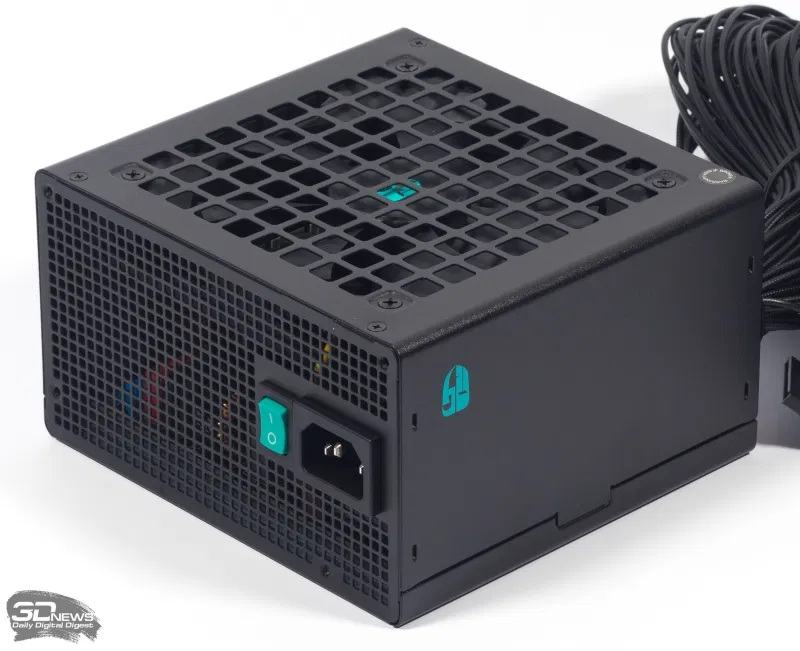
In addition to “gold” power supplies, we sometimes test “bronze” ones, but very rarely “silver” ones. GamerStorm PF800D V2 will give us the opportunity to correct this omission
⇣ Contents
Since the first ATX 3.0 power supplies hit the market, we have most often dealt with “gold” models. Platinum or bronze were less common, but during all this time we tested surprisingly few power supplies of the 80 PLUS Silver class. Today’s guest of the 3DNews laboratory is the second oldest representative of the “silver” PF-D V2 series from GamerStorm and, as one can assume, its filling is something between neighboring categories.
⇡#Technical characteristics, design, price
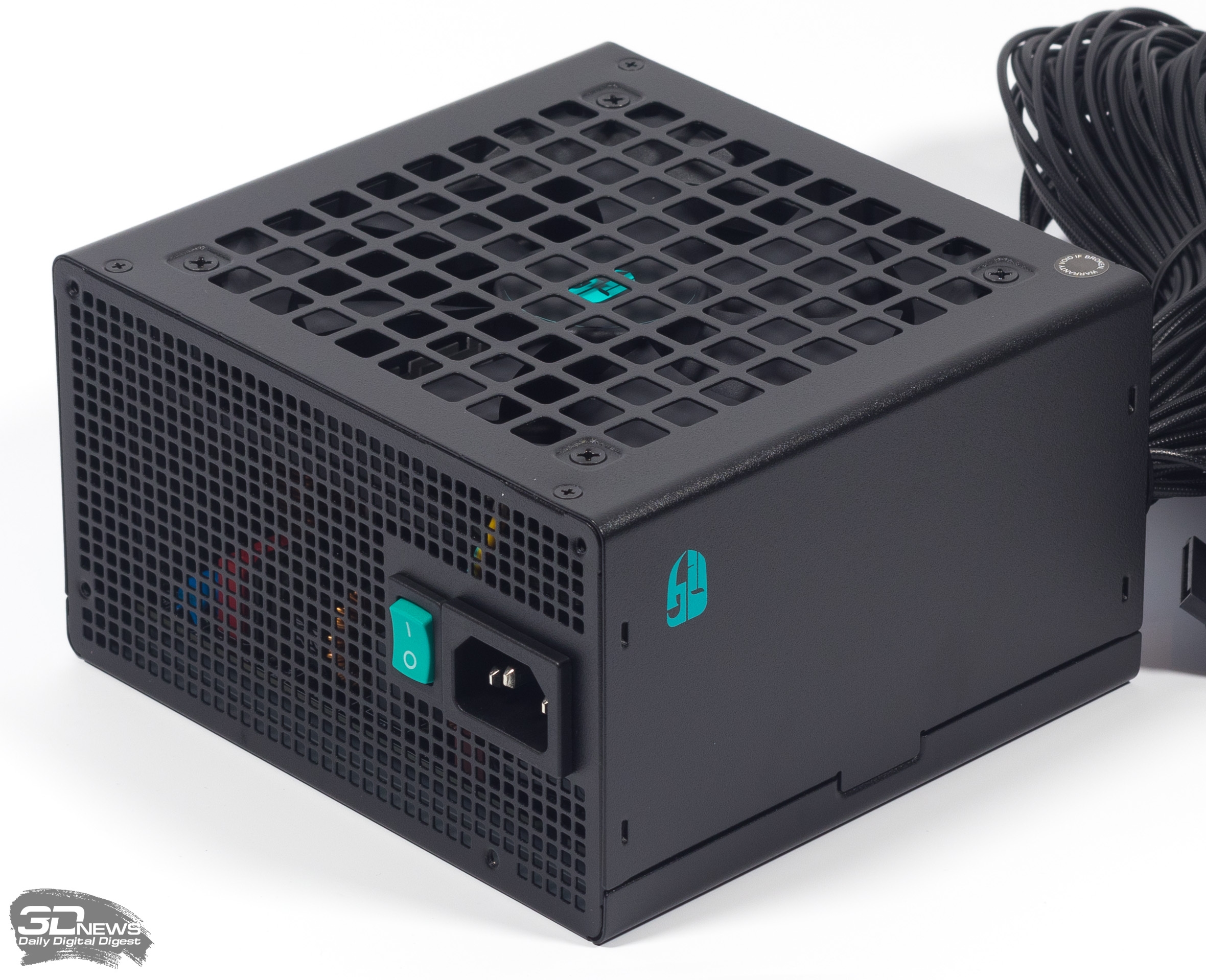
The first thing that catches your eye from the list of characteristics of the GamerStorm PF800D V2 is the 80 PLUS Silver certificate marked 230V EU. This means that the power supply is designed to operate only in European electrical networks with voltages from 200 to 240 V. Moreover, the device boasts an ATX 3.1 Pass certificate from the Cybenetics laboratory, which confirms compliance with this standard. GamerStorm PF800D V2 can deliver all 800 W of rated power over the 12 V line, but the small 3.3 and 5 V lines are limited to a total power of 100 W.
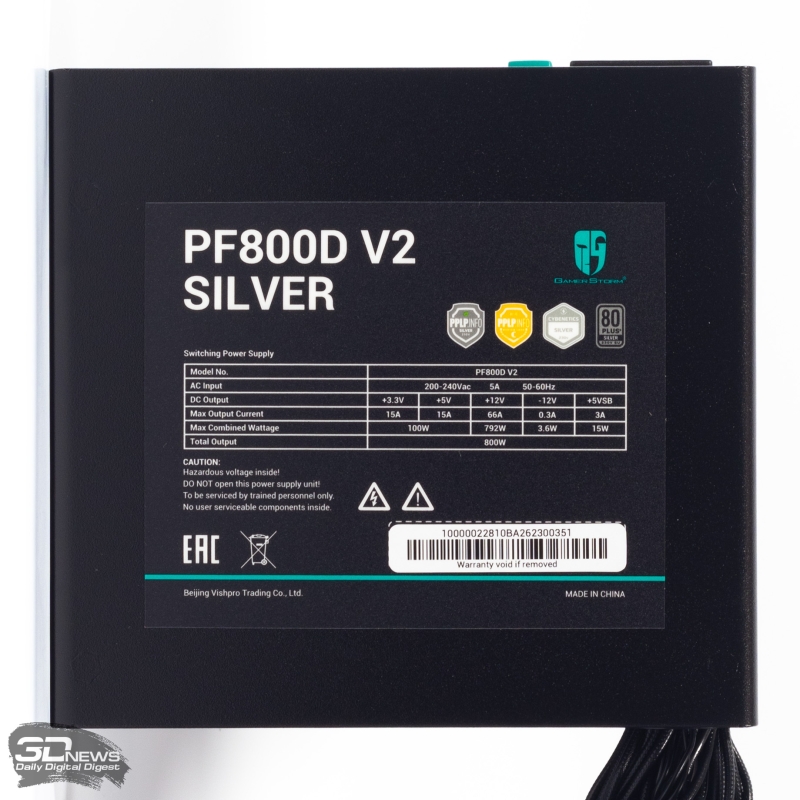
The PSU case is only 140 mm deep and is blown by a 120 mm fan. There is no switch between active and semi-passive cooling modes – the fan always works.
Cable type Number of cables End connectors on the cable Length to the first connector, mm Conductor cross-section 24-pin 1 1 550 18/22AWG EPS12V 1 2 (2 × ATX12V) 620 18AWG 12V-2×6 1 1 600 16/24AWG PCI Express (6+2) 1 2 550 18AWG PCI Express (6+2) 1 1 550 18AWG SATA + Molex 1 3 × SATA + 1 × Molex 350 18AWG
The output cables of the GamerStorm PF800D V2 are non-removable. Most conductors are 18AWG – with the exception of 12V-2×6 cable, which has 16AWG main conductors. The metal of the conductors is not attracted to the magnet, and the insulation is embossed to imitate fabric braiding. The 12V-2×6 signal pins are configured for 450W.
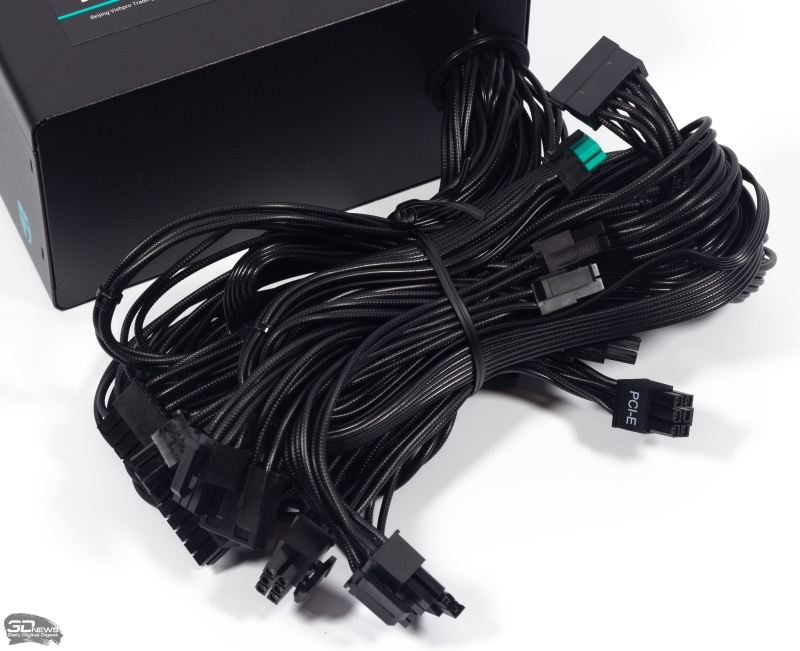
During the period of work on the review, the power supply could be purchased for an amount starting from 5,350 rubles. The manufacturer gives it a five-year warranty.
⇡#Internal structure
The power supply is created on the platform of Helly Technology, whose products we rarely see inside desktop power supplies.
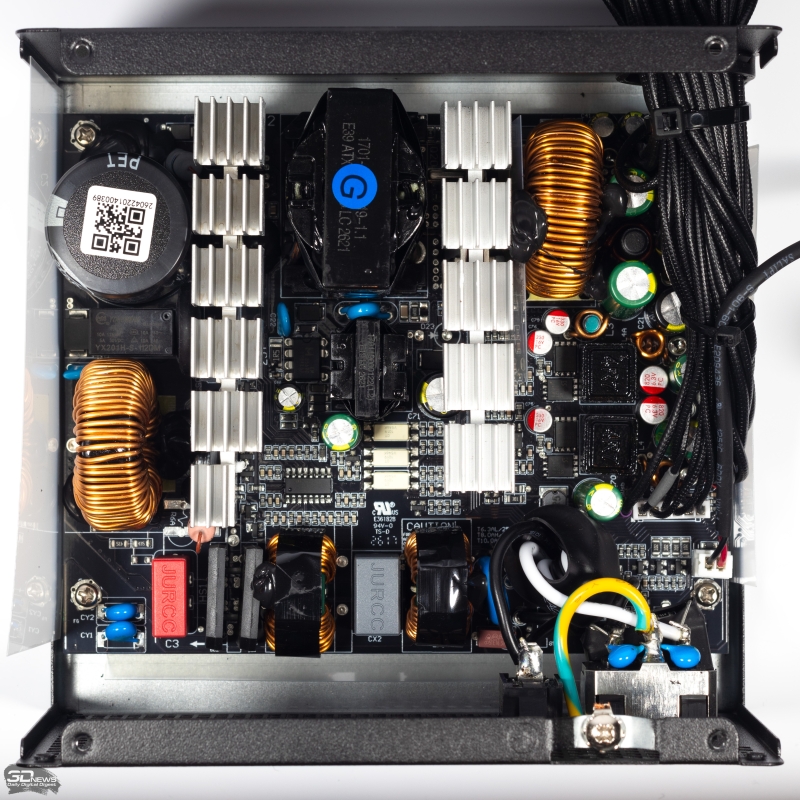
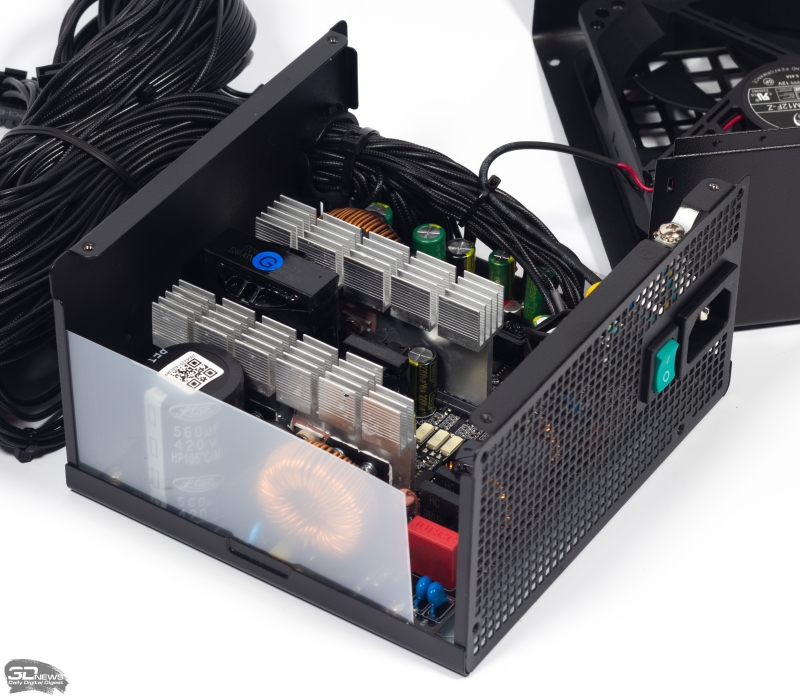
According to the list of components on the primary side, the GamerStorm PF800D V2 board differs little from the “golden” models: there is a two-stage EMI filter, a varistor for protection against voltage surges, and an inrush current compensator based on a thermistor. Unless the fuse is missing.
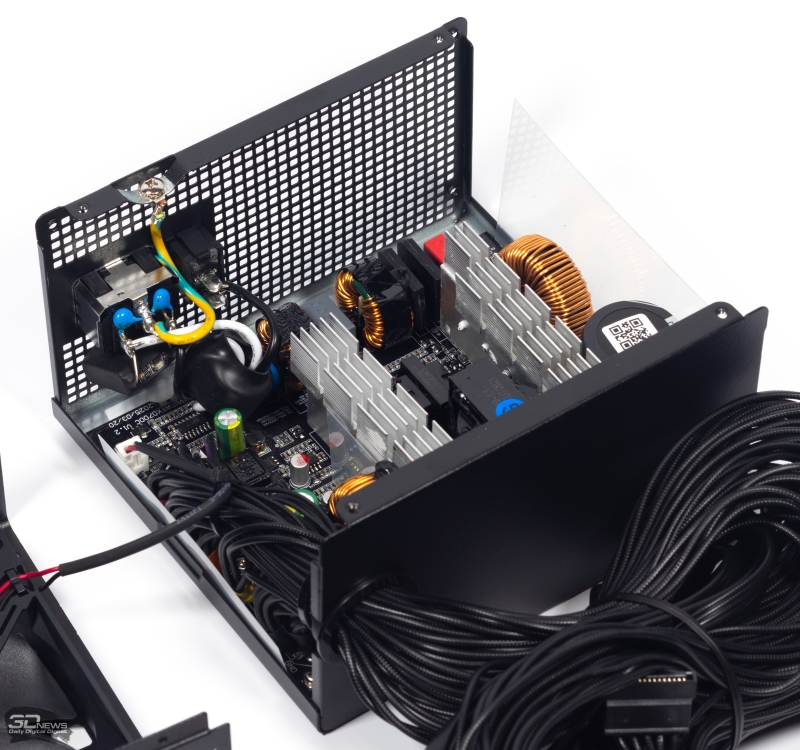
The power factor correction circuit is active. The main converter has a half-bridge topology without LLC. The rectifier on the secondary side is assembled in the old fashioned way – using Schottky diodes. But small lines of 3.3 and 5 V, as in the “golden models,” are formed from 12 V using DC-DC converters, the components of which are soldered on the main printed circuit board.
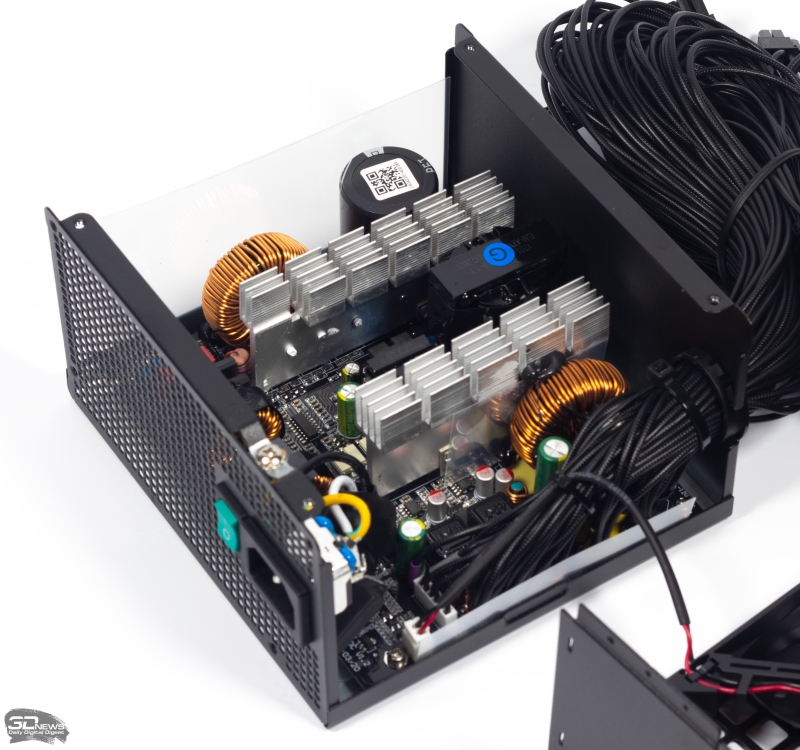
The set of electrolytic capacitors is made up of products under the brands ChengX (China) and Ltec (Taiwan).
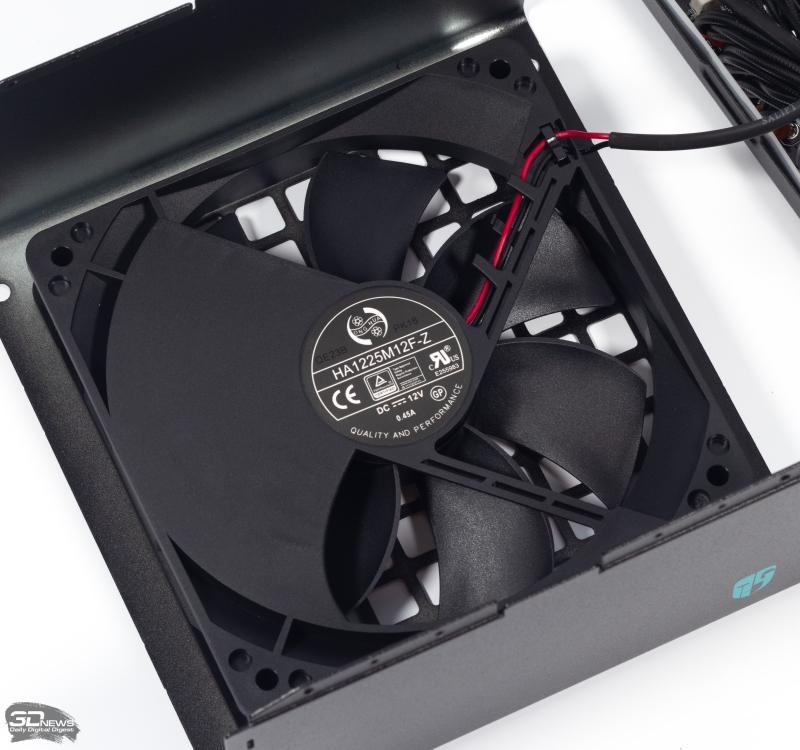
The fan, produced by Hong Hua, a well-known company in this field, operates on a hydrodynamic bearing.
⇡#Testing methodology
Equipment:
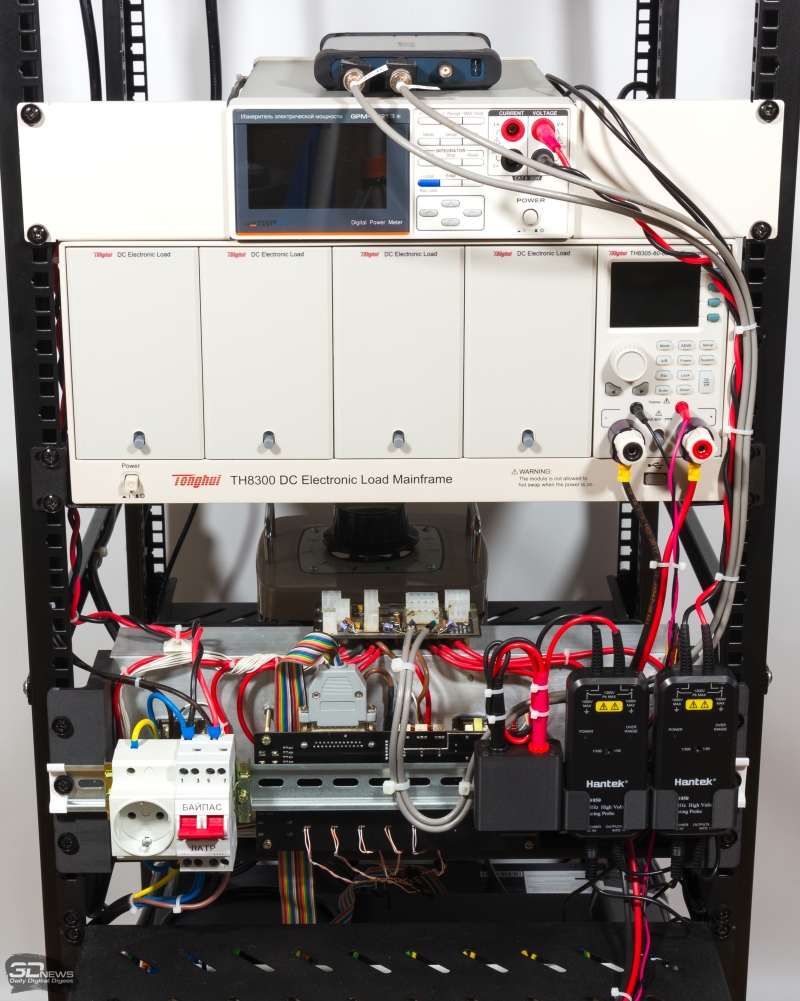
multi-channel electronic load PSU-Test-950W from the MicroDip company: four channels with a current of up to 30 A for lines of 12, 5 and 3.3 V, a channel with a current of up to 5 A for a standby power line of 5 V (maximum total power – 994 W); Tonghui TH8300 electronic load chassis and Tonghui TH8305-80-80 500W modular load for 12V line; power meter GW Instek GPM-78213; OWON VDS1022I oscilloscope; high-voltage insulated differential probes Hantek HT8050; resistive (so-called Z0) probes: RG-58 coaxial cable, 455 Ohm resistor in series, 50 Ohm final termination; Ippon Innova RTB 3000 UPS in constant frequency mode as a quasi-reference power supply (U ≈ 230 V, f ≈ 50 Hz, crest factor ≈ 1.45, THD ≈ 1.48%). There are no other consumers connected to the UPS other than the device under test; laser tachometer DT2234A.
The testing procedure for multi-line ATX power supplies includes the following tests.
Standby mode
The PS_ON# signal is inactive, there is no load on the 5 V standby power line.
Measured parameters:
efficiency; power factor.
Load on standby power line 5 V
The PS_ON# signal is inactive, the power of the 5 V standby power line varies from 1 W to the maximum value (within the specifications of the device under test) in 1 W steps.
Measured parameters:
efficiency; power factor; voltage of the standby power line is 5 V.
The ATX standard allows the voltage of the 5 V standby power line to deviate from the standard by a value of −5 to +5%.
Cross load
The purpose of cross-load testing is to measure the performance of the device under test under many different line power combinations (within the specifications of the power supply and electronic loads). The following types of cross-load tests are performed:
maximum current of each line (excluding the 5 V standby power line) without load on other lines; the maximum total power of small lines is 3.3 and 5 V at the maximum current of one of them and the maximum current of the standby power line is 5 V. The remainder of the total power of the device under test is exhausted due to the load on the 12 V line; the power of the 12 V line varies from 0 to maximum in steps of 100 W, and the combined power of the 5 and 3.3 V lines varies from 0 to maximum in steps of 20 W. The currents of the 5 and 3.3 V lines are equal. Additional steps may be introduced to achieve maximum power.
Measured parameters:
efficiency; power factor; fan rotation speed of the device under test (if the power supply has a semi-passive cooling mode, it always turns on); line voltage.
The ATX standard, starting with version 3.0, allows a deviation of the 12 V voltage from the standard by a value of −7 to +5%, and of the remaining lines – from −5 to +5%.
DC voltage ripple
Testing is performed under the following conditions (within the specifications of the device under test and the electronic loads):
maximum current of each line (excluding the 5 V standby power line) without load on other lines; the maximum total power of small lines is 3.3 and 5 V at the maximum current of one of them and the maximum current of the standby power line is 5 V. The remainder of the total power of the device under test is exhausted due to the load on the 12 V line.
The peak-to-peak voltage ripple is measured using an oscilloscope with a 26 MHz bandwidth and resistive probes. According to the requirements of the ATX standard, an electrolytic capacitor with a capacity of 10 μF and a ceramic capacitor with a capacity of 0.1 μF are connected in parallel with the load to each of the lines.
The test result is the maximum obtained values for each line under test conditions. The permissible ripple range on the 12 V line is 120 mV, and on other lines – 50 mV.
Maintain DC voltage after power failure
The maximum power of the 12 V line and the maximum combined power of the 5 and 3.3 V lines are set (within the specifications of the device under test and the electronic loads). Then the power to the device under test is turned off with a switch, and an oscilloscope is used to measure the time interval between turning off the power and the moment when the voltage of the 12 V line drops to the minimum acceptable value (11.16 V) – hold-up time.
The ATX standard up to version 3.0 imposes a requirement of 17 ms for hold-up time under maximum load on the power supply. In the ATX 3.1 standard, this value is reduced to 12 ms, and 17 ms is the recommended value under a load of 80% of rated power.
Fan speed
All cross-load tests measure the fan speed of the device under test. The results are recorded after the speed has stabilized with each change in load power.
Sources
We also recommend to readers our article “Design of computer power supplies and methods for testing them.” Refer to it to find out why and how this or that component mentioned in the review works, and how to interpret the test results.
⇡#Test results
Standby mode
The GamerStorm PF800D V2’s phantom power is lower than most other power supplies we’ve tested previously, at just 0.12 W.
Standby mode P (⏦), W λ 0.122 0.004
Standby power 5 V
The 5VSB line has an expected efficiency of around 75%, but the standby voltage is poorly stabilized and, with a maximum rated current of 3 A, is outside the reference range.
Standby power supply 5 V P (set), W U, V I, A P (⎓), W P (⏦), W Efficiency, % λ 5 4.89 0.95 4.70 6.30 75 0.11 10 4.78 1.95 9.32 12.10 77 0.19 15 4.71 2.95 13.90 18.40 76 0.27
Efficiency and power factor
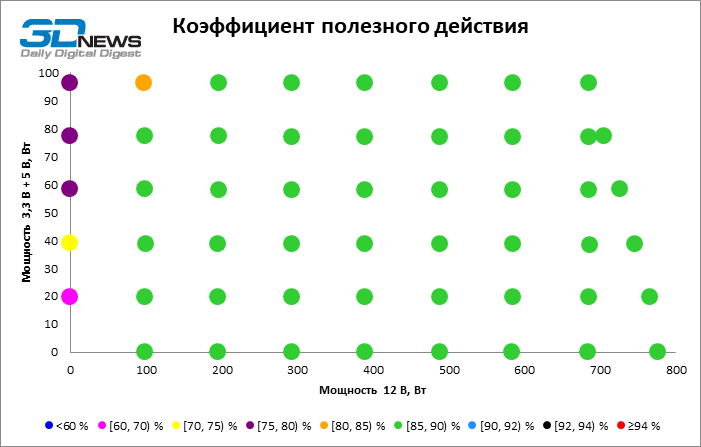
The energy efficiency of GamerStorm PF800D V2 reaches 89%, and on average is 86%, which is a completely acceptable result for a “silver” power supply. High load on the small 3.3 and 5 V lines, as usual, causes a decrease in efficiency of up to 66%. In turn, the maximum power factor is 0.99 – in this the hero of the review exceeded our expectations.
Stress stabilization
The 12 V voltage deviates from the nominal by no more than 2%, the voltage of the small lines 3.3 and 5 V is within 4%, but the 5 V standby power line again exceeds the range specified in the ATX standard.
Cross load (maximum line power) P (set), W 3.3 V 5 V 12 V 1 12 V 2 12 V 3 Standby 5 V P (⎓), W P (⏦), W Efficiency, % λ Fan, rpm U, V I, A U, V I, A U, V I, A U, V I, A U, V I, A U, V I, A 50 3.25 14.76 5.05 0.00 12.08 0.00 12.09 0.00 0.00 0.00 4.97 0.00 47.99 68.80 70 0.60 1,006 75 3.33 0.00 4.88 14.78 12.08 0.00 12.08 0.00 0.00 0.00 4.97 0.00 72.09 95.00 76 0.68 1,025 792 3.32 0.00 5.03 0.00 11.84 20.56 11.85 20.59 12.05 24.00 4.91 0.00 776.74 884.00 88 0.98 1,535,800 3.24 14.76 4.94 9.91 11.83 20.61 11.84 20.64 12.09 15.09 4.55 2.95 780.81 915.00 85 0.99 1,620 800 3.28 7.46 4.89 14.78 11.83 20.61 11.84 20.64 12.08 15.09 4.64 4.64 788.59 912.00 86 0.99 0 Cross-load (all tests) 3.3 V 5 V 12 V Standby 5 V Efficiency, % λ U, V U, V U, V U, V Max. 3.33 5.05 12.09 4.97 89 0.99 Avg. 3.25 4.93 11.95 4.81 86 0.90 Min. 3.19 4.86 11.83 4.55 66 0.37
Voltage ripple range
The Vpp values on all lines are well within the permissible limits.
Voltage ripple range P (set), W 3.3 V 5 V 12 V Standby 5 V I, A Vpp, mV I, A Vpp, mV I, A Vpp, mV I, A Vpp, mV 50 14.76 16 0.00 18 0.00 18 0.00 22 75 0.00 20 14.78 18 0.00 18 0.00 28 792 0.00 26 0.00 22 65.15 32 0.00 28 800 14.76 20 9.91 20 56.34 28 2.95 24 800 7.46 18 14.78 22 56.34 30 4.64 26
Hold-Up Time
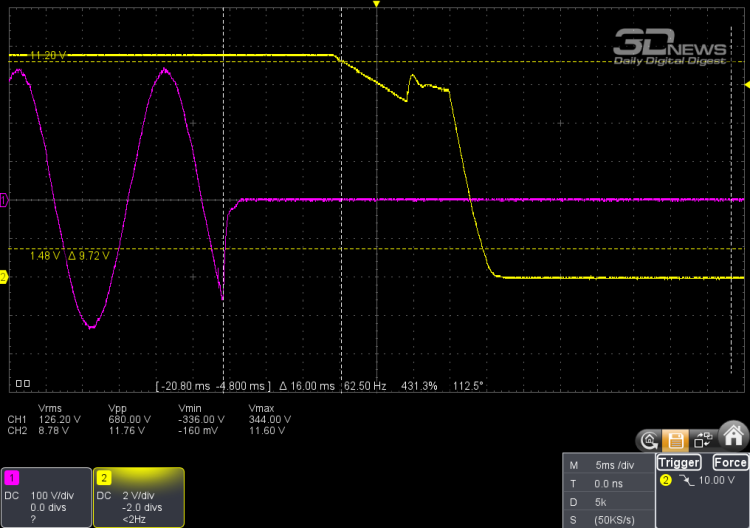
The 12 V voltage drops below the permissible value 16 ms after a power failure under maximum load – this is also an acceptable result in ATX 3.1 specifications.
Fan speed
The consequence of low efficiency compared to “gold” power supplies is a continuously running fan, and at a fairly high speed even in the absence of a payload.
Fan rotation speed, rpm
Power 3.3 V + 5 V, W
120 N/A N/A N/A N/A N/A N/A N/A N/A N/A 100 1,040 1,043 1,045 1,049 1,050 1,055 1,060 N/A 1,683 80 1,024 1,026 1,030 1,032 1 035 1,038 1,038 1,575 1,640 60 1,015 1,017 1,020 1,022 1,025 1,029 1,031 1,505 1,627 40 1,009 1,007 1,008 1,012 1,014 1,017 1,018 1,030 1,602 20,992 996,998 1,001 1,005 1,009 1,010 1,012 1,573 0 976 981 985 989 993 998 998 999 1,535 0 100 200 300 400 500 600 700 Max. Power 12 V, W
⇡#Conclusions
GamerStorm PF800D V2 clearly illustrates the niche that 80 PLUS Silver category power supplies occupy in the modern market. The price of this model makes it possible to save a lot compared to “golden” solutions of similar power. But since 80 PLUS certification levels are determined by efficiency, the GamerStorm PF800D V2 requires continuous airflow from a fairly high-speed fan. There are other signs of cost reduction, such as a garland of fixed cables. But of all the performance characteristics, the hero of the review can only be blamed for the unsatisfactory stabilization of the 5 V standby power line.
If you notice an error, select it with the mouse and press CTRL+ENTER.