Microsoft presented a large line of AI models, including for programming and searching for vulnerabilities. It included MAI Code 2 for writing program code, which, according to the company, is almost as good as Anthropic and OpenAI in performance, but is much cheaper. The line also includes new models for image generation and audio transcription.
Image source: BoliviaInteligente/Unsplash
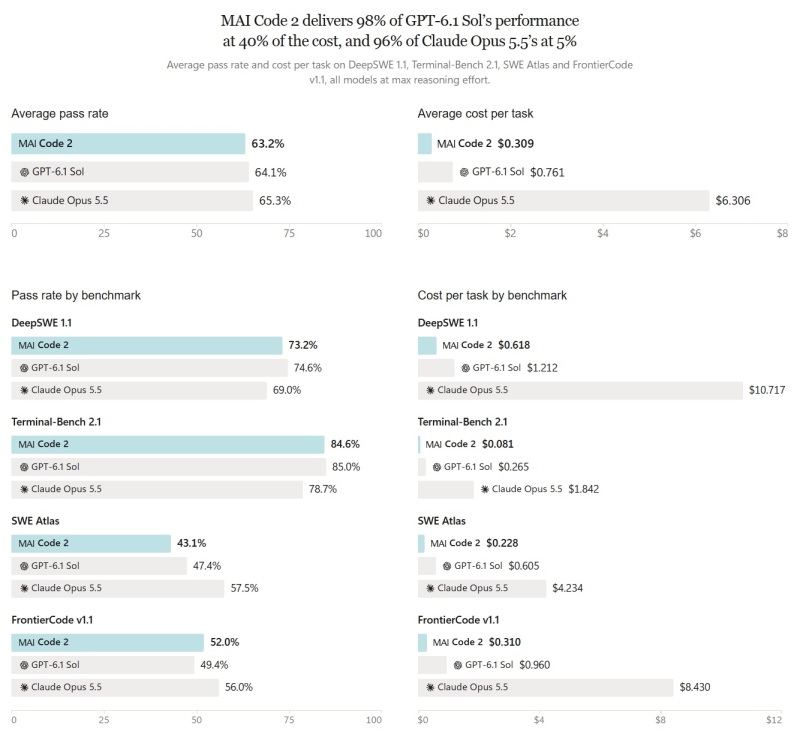
Based on test results published Microsoft,MAI Code 2 provides 98% of the performance of GPT-6.1 Sol at a cost of about 40% of its cost of use. Compared to Claude Opus 5.5, the performance is 96% of the performance at a cost of just 5% of the competing model. The test covered routine corporate tasks, working with code and software tools.
Microsoft also conducted a blind comparison of the models’ capabilities in creating interfaces. The developers who participated in the evaluation preferred the results of MAI Code 2 over GPT-6 Sol in preparing interface elements, control panels and visualizations in 68% of cases. At the same time, the company emphasizes that the model is currently focused primarily on standard programming tasks and is not optimized for fundamental scientific research and long-term autonomous operation of AI agents.
For more massive and repetitive operations, Microsoft has prepared MAI Code 2 Flash. The model is designed to explain program code, make small changes, fix bugs, and quickly refine projects. According to the company, its performance is comparable to GPT-6 Luna at 65% of the cost of the latter and with Claude Haiku 5.5 at about 20% cost. MAI Code 2 is available through GitHub Copilot, and a lightweight version of Flash is also available in limited preview through Microsoft Foundry.
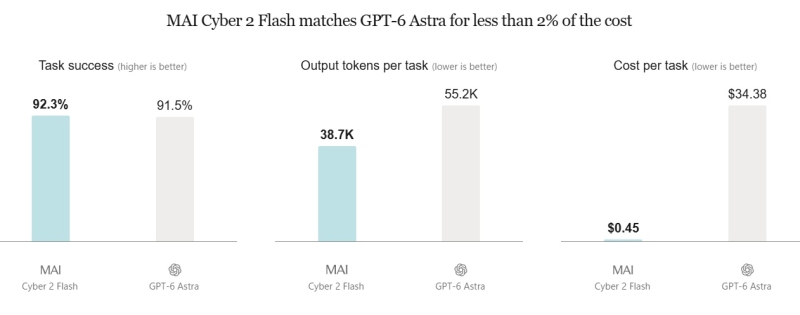
A separate area is occupied by MAI Cyber 2 Flash, designed to protect software and search for vulnerabilities. Microsoft claims that in the CyberGymE2E test its performance is comparable to the GPT-6 Astra, although the cost of completing the task is less than 2% of the cost of using a competing model. Compared to the previous MAI Cyber 1.1 Flash, the cost of processing output tokens has decreased by 86%. The company also reports that previous MAI Cyber models already provide nearly 40% of MDASH scans, with 90% of customers who started using them for scanning continuing with these tools.

In the field of image processing, Microsoft introduced MAI Image 2.7 and its lightweight Flash version. MAI Image 2.7 took first place in the Artificial Analysis rating for the quality of image editing, beating GPT Image 2.6 Sunburst in the maximum configuration at a cost about five times lower. In generating images from text descriptions, the model took fourth place in the overall ranking, which, according to Microsoft, corresponds to second place among AI developers. The Flash version is designed for mass generation and allows you to create about 1000 images for about $10.
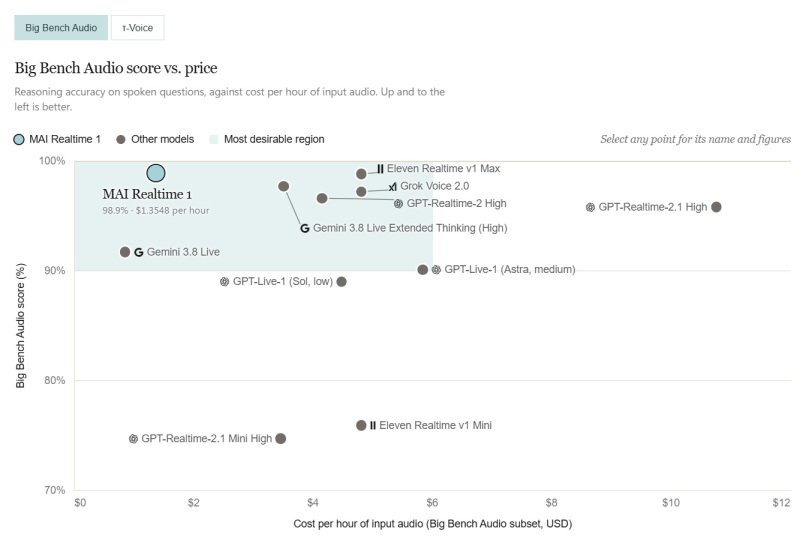
For voice interaction, the company developed MAI Realtime 1. Based on internal and external testing, including testing using Dynamics 365, the model outperformed GPT-Realtime 2.1. Processing costs start at $0.01 per minute of audio.
Another development, MAI Transcribe 2, is designed to recognize and convert speech to text. It is based on Dragon Copilot Transcribe, which is used in the medical field to document conversations between doctors and patients. According to Microsoft, the system processes about 10 million such requests monthly, and the use of the model has reduced the number of errors in multilingual transcription by half. About a third of American doctors now use the technology.
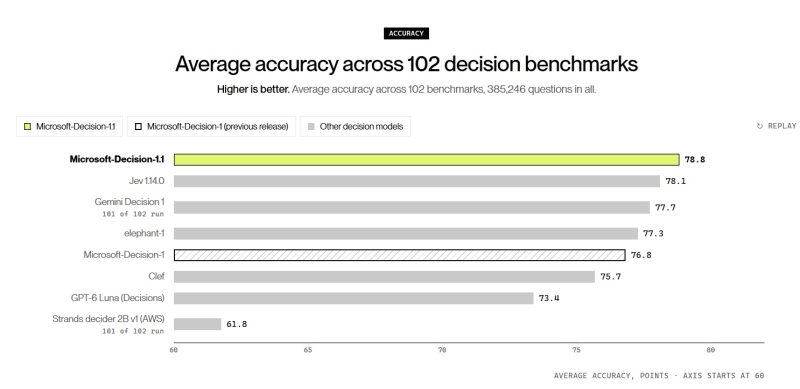
In addition to generative models, Microsoft introduced Decision 1.1, designed to automatically select the appropriate AI model for a specific request. This routing allows simple tasks to be routed to faster, cheaper models, leaving expensive systems for complex requests. According to the company, Decision 1.1 is 50 times faster and 79 times cheaper than GPT-Sol 6.1. Now it is used by about 4,000 clients, and in the Artificial Analysis Decision Index, Microsoft’s development is ahead of Jev, Google and OpenAI models.
The company paid special attention to the ability to adapt AI to business tasks. The new MAI Licensed Weights program allows organizations to take core Microsoft models, enhance them using their own data, and run them on a secure Azure cloud infrastructure. At the same time, customers independently control access to models, and their data and changes made remain at the disposal of the organization.
The hardware basis for the development of AI infrastructure is complemented by Maia 200, the second generation of Microsoft’s own accelerator. The company said the chip is already in production infrastructure and delivers 1.7 times more processed tokens per watt of electricity compared to the company’s previous Maia 100 accelerator.
All developments will be presented on November 17 at the Microsoft Ignite 2026 conference. Some models are already available through GitHub Copilot and Microsoft Foundry, others can be tested through the MAI Labs platform or obtained through limited access programs. The cost depends on the specific model and volume of use.
If you notice an error, select it with the mouse and press CTRL+ENTER.