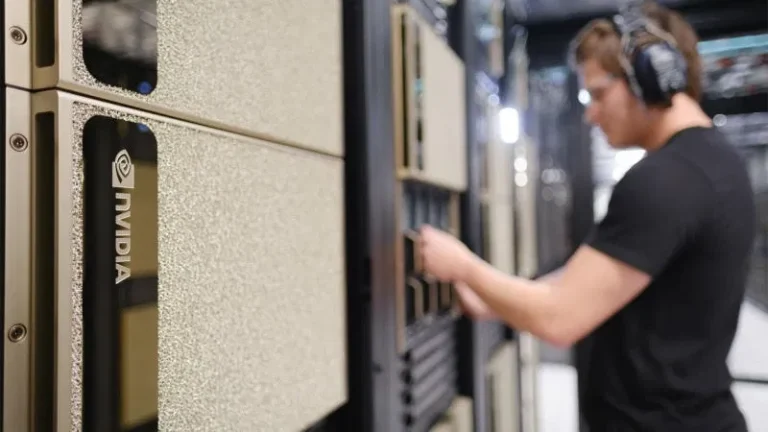

Nvidia announced the DGX Spark HPC Developer Kit, a so-called development kit that includes four DGX Spark mini-PCs on the GB10 Grace Blackwell Superchip platform, connected in a ring topology. It is aimed at researchers, scientists and developers who will be able to run multi-node scientific tasks, models and artificial intelligence agents directly on the desktop, without waiting in line to access a large GPU cluster.

Image source: nvidia.com
The system scales from one to four nodes – they are connected using Nvidia ConnectX-7 network adapters, eliminating the need to purchase and configure a separate network switch. The four-node configuration provides 512 GB of shared memory and 20 TB of NVMe storage space. Using the NVFP4 format, models with up to 700 billion parameters, for example DeepSeek V4.1, can be deployed on such a cluster.
As a reminder, each DGX Spark system is equipped with an Nvidia GB10 Grace Blackwell superchip, which combines a Blackwell GPU and a 20-core Arm processor. The processor includes 10 high-performance Cortex-X925 cores operating at frequencies up to 4 GHz, and 10 energy-efficient Cortex-A725 cores operating at up to 2.8 GHz. The Blackwell GPU features 6,144 CUDA cores and delivers up to 1 Pflops of FP4 performance. The system uses 128 GB of coherent unified LPDDR5X memory with a 256-bit interface and a bandwidth of 273 GB/s. The power consumption (TDP) of the GB10 chip is 140 W.
The company will soon release a guide to using the Nvidia HPC SDK, which will enable the DGX Spark cluster to leverage GPU-accelerated C, C++ and Fortran compilers, libraries, and Message Passing Interface (MPI) tools—the same development tools used on Nvidia’s powerful supercomputers.
The toolkit allows you to perform scientific modeling, run models and AI agents directly on your desktop. Applications such as LAMMPS using the Kokkos library for materials modeling and NAMD for molecular dynamics problems are demonstrated. The platform is effective for working with such specialized tools as GROMACS (molecular dynamics), OpenFOAM (fluid dynamics), WRF (weather modeling); Nvidia NIM microservices are supported, including OpenFold3 and Boltz-2 for predicting biomolecular structures; Nemotron 3.5 Super VL can be further trained by adapting the model for tasks in the field of biomedical and chemical sciences.
The company provided several examples of practical applications of Nvidia DGX Spark. Kvantify used the system for quantum chemical calculations, simulating quantum systems with 70 qubits and 975 logical operations. CYRAN AI this equipment helped speed up the processing of JPEG 2000 satellite images. OpenFold used DGX Spark to additionally train models for predicting the structure of proteins and their interactions with drugs. These systems have also been used to predict bacterial properties from genome sequences; as well as for launching and further training a model of 12 billion parameters.
If you notice an error, select it with the mouse and press CTRL+ENTER.