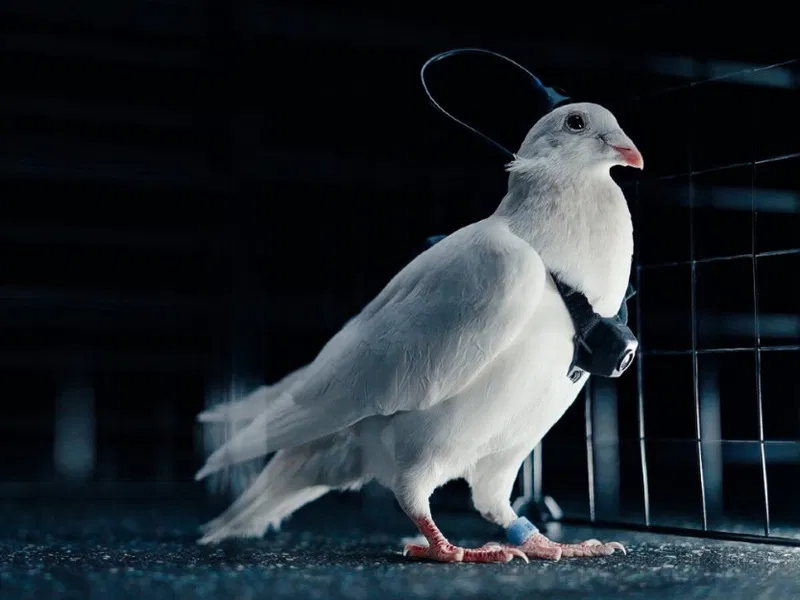
The Russian company Neiry has begun accepting orders for aerial photography using pigeons with electrodes implanted in their brains for remote flight control. The service is currently operating in test mode and is available only in Russia, and the cost of shooting starts from 300 thousand rubles per square kilometer.
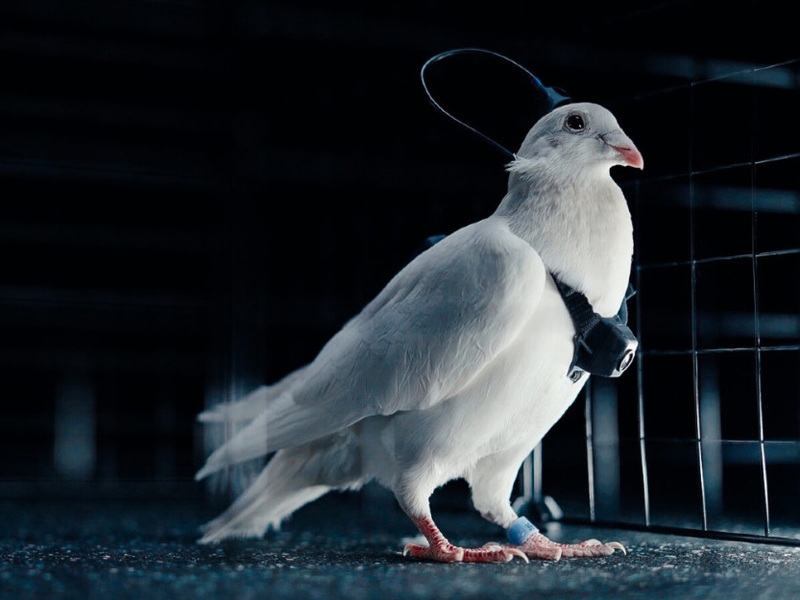
Image source: Neiry
Over the past year, developers have significantly expanded the capabilities of biodrone birds, told Forbes with reference to the Neiry press service. Outside the laboratory, the pigeons made more than 100 flights and took over 1,000 photographs. The duration of the longest flight exceeded 10 hours, and the maximum control distance was more than 100 km.
According to Neiry founder Alexander Panov, experts taught the birds to take off and land on command, gain altitude and perform other maneuvers. In this case, ordinary training is not required: the desired direction of movement is set through a neural interface that affects certain areas of the brain.
For control, developers use biocompatible electrodes implanted in the pigeon’s brain. They are connected to a stimulator and controller placed in a small backpack on the bird’s back. The operator loads the flight path, after which the system transmits electrical impulses that encourage the pigeon to move in a given direction.
Neiry considers the main advantage of biodrones to be flight duration. Unlike mechanical drones, birds do not require batteries to operate their engines, and they are able to navigate around obstacles on their own. The developers also claim that pigeons can take pictures in places where the operation of conventional drones is limited.
The company said that it sent requests to the Ministry of Natural Resources, the Ministry of Education and Science, the All-Russian Research Institute of Ecology and other organizations. According to Neiry, the responses received did not reveal any contradictions with current legislation. However, the company did not provide independent confirmation of the ability to operate such flights without additional permits.
Among potential customers, Neiry is considering organizations that need to regularly inspect extended objects. Pigeons are supposed to be used to monitor power lines, pipelines, gas distribution centers and urban infrastructure. Another area could be environmental monitoring.
To protect personal data, images are processed by artificial intelligence before being transferred to the customer. Algorithms automatically blur the faces of people accidentally caught in the frame. According to the developers, the cost of such surveying is comparable to using traditional drones.
Neiry also claims to follow approved ethical protocols when working with birds. Experts strive to achieve 100% survival rate for pigeons after electrode implantation operations. However, the company does not provide detailed statistics on postoperative complications in the message.
Neiry presented the first version of the PJN-1 biodrone pigeon in November 2025. At that time the project was at the flight testing stage. The company has also explored the possibility of installing neural interfaces on other birds, including crows for carrying cargo and gulls for monitoring coastal areas.
If you notice an error, select it with the mouse and press CTRL+ENTER.