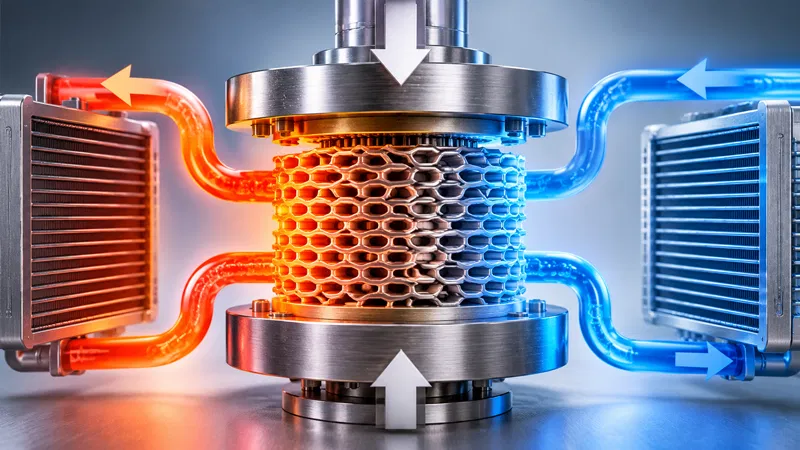
Traditional vapor compression refrigerators no longer fit into the planet’s energy balance – they consume a lot of energy and use environmentally destructive refrigerants. They are promised to be replaced by solid-state refrigerators that combine energy efficiency, safety and simplicity.
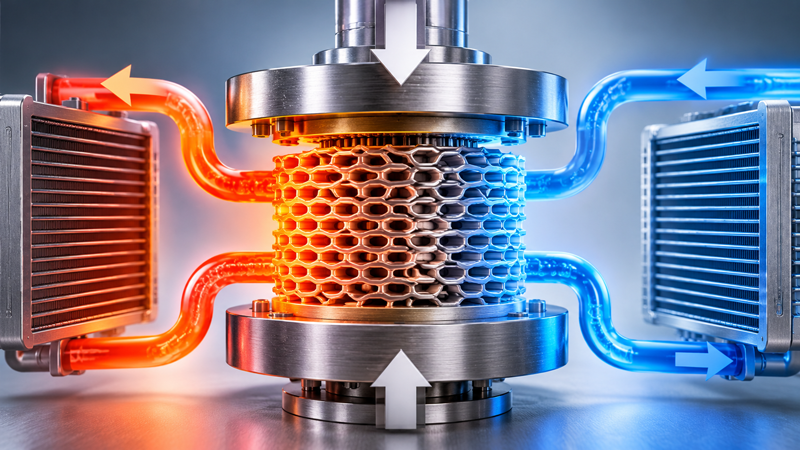
Image source: AI generation ChatGPT/3DNews
About a breakthrough in the field of solid-state refrigeration units based on the elastocaloric cooling effect reported scientists from the Hong Kong University of Science and Technology (HKUST). They reported successes twice earlier this year, moving gradually from concept to working devices. The new work is devoted to the most important stage – the organization of an inexpensive and accessible production process for reliable solid-state refrigeration elements, which has been a problem until now.
Recall that elastocaloric cooling is a phenomenon in which heat is absorbed and released as a result of a reversible phase transition in shape memory alloys. Unlike traditional refrigeration units, which use a compressor and circulating refrigerant, this technology is based on the mechanical deformation of a solid material. Deformation slightly displaces the crystal lattice of the material and leads to the release or absorption of heat during mechanical action on the metal and its return “straightening” on its own.
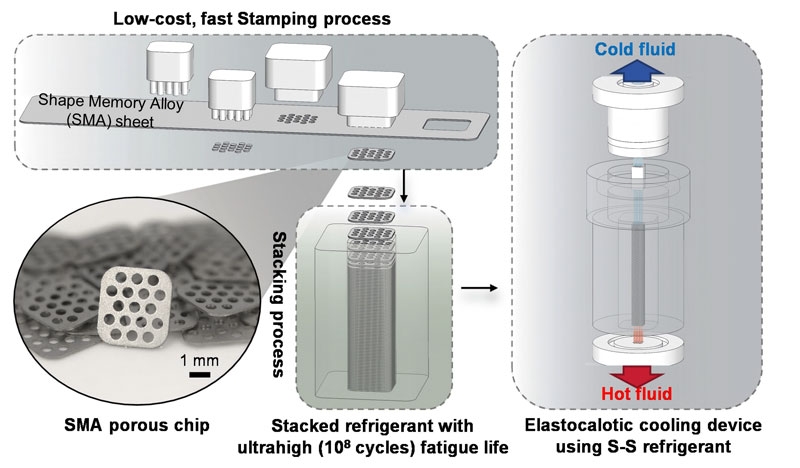
Image source: HKUST
This effect has been known for a long time. However, it was difficult to reconcile the long-term mechanical strength of a solid-state element with the ease of its production. The design was either short-lived or extremely complex and expensive to manufacture. The development of scientists from Hong Kong has demonstrated the ability to withstand deformation for 100 million cycles, which corresponds to 10 years of continuous operation under normal conditions. It was possible to establish the production of elements of the refrigeration unit using simple stamping, which can significantly reduce costs.
The main design feature of the solid-state refrigeration element is its honeycomb-inspired structure. Scientists have proposed a stamping and laying technology: thin sheets of NiTi shape memory alloy are first punched in the form of groups of honeycombs, and then small plates are cut from them. After this, the plates with honeycomb-like holes are stacked on top of each other, forming a tubular structure.
This architecture increases the heat transfer area, and the gaps between individual elements prevent cracks in one of them from spreading along the entire structure. Unlike traditional solid thin-walled elements, the new structure is less susceptible to longitudinal destruction and loss of stability under repeated mechanical loads.
The stamping method can produce up to 100 porous elements per minute—more than 100 times faster than traditional wire discharge cutting (WEDM). The developers estimate that this reduces production costs by 95%. Based on the new design, the researchers assembled an experimental refrigeration module just 30 mm long, consisting of 200 NiTi elements. The prototype demonstrated a maximum temperature differential of 11.7 K (11.7 °C) and a specific cooling performance of 3.85 W/g. This can be compared to the situation where a conventional 600 W refrigerator cools an element weighing about 150 g.
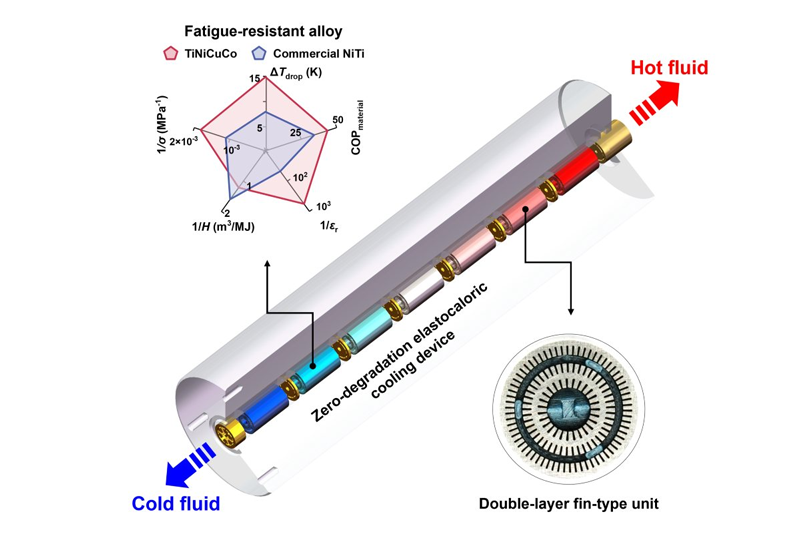
In conclusion, we will make an important disclaimer: scientists showed only the cooling element. To transform it into a full-fledged refrigerator, it is necessary to develop a system for regulating the supply of coolant, precisely coordinated with the phases of transition of the alloy from one state to another (its own heating and heat absorption), as well as a mechanical drive for cyclic deformation of the cooling element. In the simplest case, this could be, for example, an electric motor with an eccentric. Scientists promise to focus their efforts on solving these problems in the course of further developments.
If you notice an error, select it with the mouse and press CTRL+ENTER.