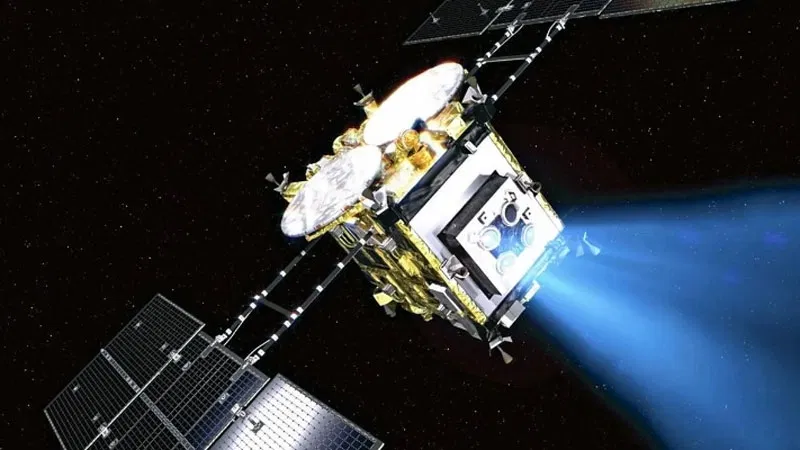
The Japanese space agency JAXA has abandoned its goal of bringing the Hayabusa2 robotic probe to asteroid 1998 KY26. The new target of the mission was asteroid 2015 BM510, which is not intended for landing. And the point is not that 1998 KY26 could have turned out to be the lost Soviet Phobos-1 station. On Hayabusa 2, the last of four traction engines broke down.
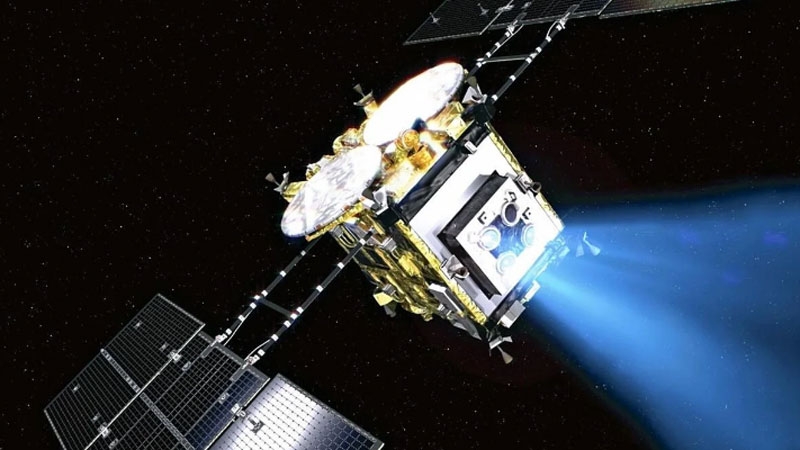
Image source: JAXA
In the standard mission program, after the flyby of the Torifune asteroid (2001 CC21) in July 2026, the device was supposed to continue moving towards Earth, perform a gravity assist maneuver in December 2027, and then enter a rendezvous trajectory with 1998 KY26 in 2031. However, in mid-August 2026, numerous electrical discharges began to occur on the station’s main ion engine. Attempts to restore its functionality continued for about two weeks, but were unsuccessful. As a result, the ion source of this engine failed, and the malfunction also affected the power supply system of this engine.
There are four ion engines (A, B, C and D) installed on board Hayabusa 2, using xenon as a working fluid. By November 2026, the device had consumed 57.3 kg of xenon, and the total operating time of the propulsion system had reached 20,153 hours. Three of the four engines failed. Only engine B was left running. The engineers were able to find a way to use elements from one engine to start another, which they called a crossover configuration: using the ion source of engine D together with the neutralizer of engine B.
The proposed scheme allowed the installation to continue operating, but the remaining resource is difficult to predict. To reach asteroid 1998 KY26, an additional velocity change of approximately 650 m/s was required, which required more than 10,000 hours of further operation of the ion engines. JAXA recognized the execution of such a maneuver as unreliable.
The mission’s new target will be the near-Earth asteroid 2015 BM510. Instead of entering orbit around it, Hayabusa 2 will perform a high-speed flyby, which will occur in April 2028. The asteroid’s diameter is estimated to be between 17 and 74 m and its rotation period is about 49 minutes. The object belongs to spectral class D, whose representatives are considered relatively primitive bodies capable of containing significant amounts of organic compounds and water. To change the trajectory to a new object, it is enough to change the speed by about 24 m/s, and JAXA expects to use chemical attitude control and orbit correction engines that can guarantee a velocity delta of up to 30 m/s.
Scientific interest in 2015 BM510 stems primarily from its combination of small size, presumed primitive structure, and exceptionally fast rotation. Scientists expect to obtain data that will help understand why such bodies are not destroyed by centrifugal forces (2015 BM510 rotates about 9.5 times faster than the Ryugu asteroid, from which Hayabusa-2 has already taken soil samples).
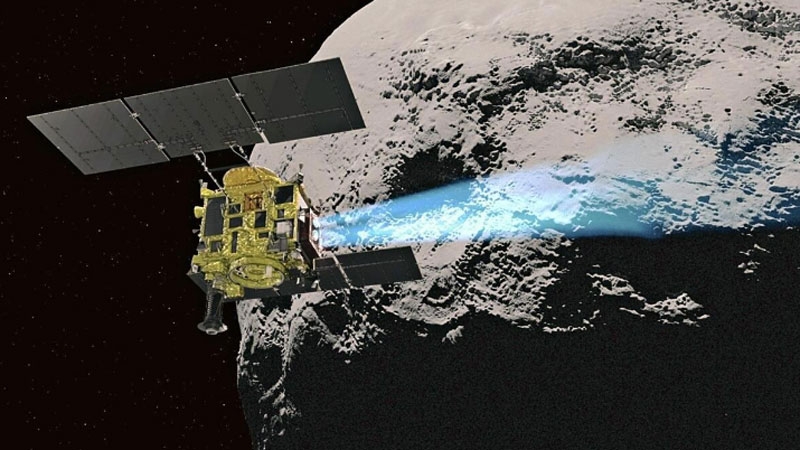
In addition, pointing the device at such a small and dim object will require high navigation accuracy: immediately before the flyby, the asteroid may be too faint to be detected by onboard cameras at long distances. JAXA estimates that successful completion of such an operation will be the first study of a rapidly spinning D-class asteroid and will demonstrate technologies potentially applicable to planetary defense programs.
As for the connection between asteroid 1998 KY26 and the lost Soviet Phobos-1 station, two papers were published this fall that report coincidences of photometric curves and the possibility of explaining the non-gravitational acceleration of the object by the pressure of solar radiation on the structural elements of the device. Hayabusa-2 could test this version, but now it will not do so.
If you notice an error, select it with the mouse and press CTRL+ENTER.