In its first earnings report since the departure of longtime leader Jensen Huang, Nvidia tried to convey a clear message to investors: he will not return to the post, and the company will cope just fine without him. The semiconductor giant raised its sales forecast for next year, promised to improve access to critical components, dispelled rumors of Huang’s possible return and increased its share buyback program by $150 billion.
Image source: Brecht Corbeel / unsplash.com
In the third quarter of the current fiscal year, which ended for Nvidia on October 25, the company earned $115.84 billion, which is double the $57 billion in the same period a year earlier. Net income amounted to $65.3 billion, again more than double last year’s $31.9 billion. Earnings per share (excluding a number of items) amounted to $2.68. Analysts had forecast revenue at $109.3 billion and earnings per share at $2.47.
Investors initially reacted positively to the news: shares immediately jumped 5.4%; Subsequently, on the alternative trading platform Blue Ocean, they again went into the “red zone”. “Supply volumes are growing, our customers and partners remain with us, and our employees are full of determination. We will get through this,” said Nvidia interim CEO Colette Kress. For her, this was an extremely important moment – after the scandal with Huang, the company’s shares sank noticeably. Nvidia has been a major beneficiary of the artificial intelligence boom, and Huang has been an outspoken promoter of the industry. Now the company is trying to prove that the scandal will not prevent it from maintaining its growth momentum.
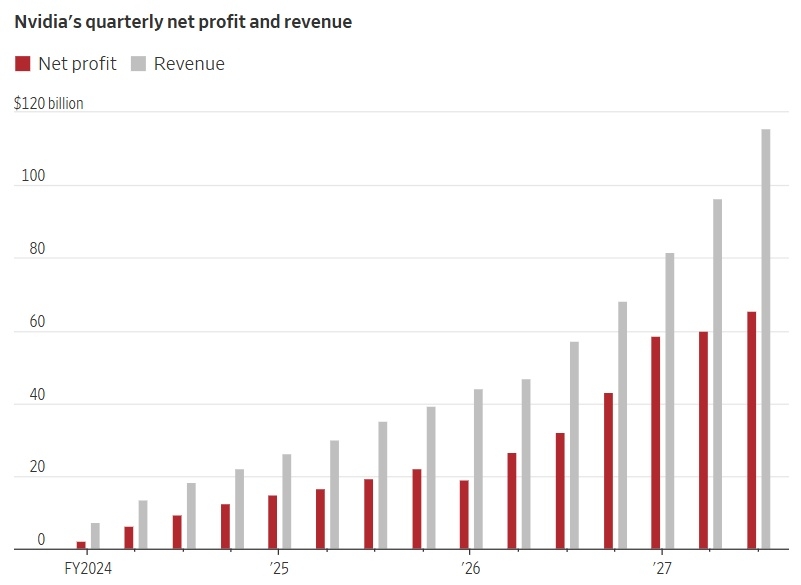
Image Source: WSJ
According to the results of the current financial year, revenue growth will be 75%, says Nvidia’s forecast – previously expected 70%. In the fourth quarter of the fiscal year, sales will be $130 billion with an error of 3% in both directions; analysts on average predicted the figure at $125.3 billion. “Work is proceeding as usual. We keep in touch with our clients, suppliers and partners. All of them are 100% on our side,” the lady assured.
For the first time in its 33-year history, the company is operating without Huang at the helm. She is under external pressure to consider returning him to a leadership position. The day before, he said that he was ready to return to the position of general director if the board of directors agrees to this. Huang cited massive support from people who believe he should return. However, the company has already begun the search for a new permanent CEO; During a conference call, Chairman Harvey Jones dismissed the possibility of Huang’s return: “The Board of Directors unanimously accepted his resignation and does not intend to return Jensen to the post of CEO.” To search for a new head of the company, the recruitment agency Heidrick & Struggles was involved.
Nvidia has announced that it will no longer supply its licensed Hopper architecture data center products to China. US export controls allowed the company to sell this previous generation of equipment, but there was growing dissatisfaction among lawmakers over the sale of these solutions to China. Beijing also creates obstacles to the import of Nvidia products, which seeks to encourage the use of products from local manufacturers.

Nvidia’s spending commitments have increased significantly, partly due to higher prices for memory chips. Now the company will have to spend a total of $518 billion, up from $366 billion three months ago. The bulk of these funds will be directed to component suppliers, with the peak of payments to be made next year. Nvidia expects to spend $203 billion in this category in fiscal 2028. Gross margin—the portion of revenue remaining after deducting production costs—will be about 71.5% in the current quarter. Three months ago this figure was 75%; According to Colette Kress, the figure will reach its minimum value in the current quarter.
Customers and suppliers have expressed support for Nvidia during the crisis, Ms. Kress noted. This week, Nvidia’s offices were visited by executives from TSMC, a leading semiconductor contractor and Nvidia’s most important supplier. Huang’s departure created a noticeable vacuum: as CEO, he actively traveled the world promoting Nvidia technologies and developing the AI ecosystem. He used the company’s resources to invest in various startups as well as its customers and suppliers, thereby supporting a capital-intensive industry.
Huang promised to allocate more than $100 billion to finance other companies involved in the development of AI infrastructure. He called on representatives of various industries to actively implement AI; called on policymakers to remove barriers to growth and downplayed concerns about AI-related threats. The day before, the company spoke about measures to ensure access to the necessary components – in particular, it expanded its commitments to such suppliers as Kinsus Interconnect Technology and Samsung Electro-Mechanics. At the same time, Nvidia made it clear that it will henceforth be more cautious about investing in companies in the AI industry. “As the market matures and additional sources of capital become available, we carefully evaluate future investments, commitments and guarantees,” Kress said.
Nvidia is the largest supplier of chips and other equipment that runs AI software and services. Therefore, the company’s financial results serve as an important indicator for the entire sector that now dominates global stock markets.
In the data center chip business, Nvidia’s main source of revenue, sales in the third quarter of the fiscal year (ended October 25) more than doubled to $107.6 billion – analysts had predicted $101.9 billion. During the quarter, this division demonstrated sales volumes that collectively exceeded the annual figures of competitors Intel and AMD.
The edge computing segment, which now includes GeForce gaming graphics cards, brought in only $8.2 billion, which corresponds to 42 percent growth compared to the third quarter of the previous year.
If you notice an error, select it with the mouse and press CTRL+ENTER.