


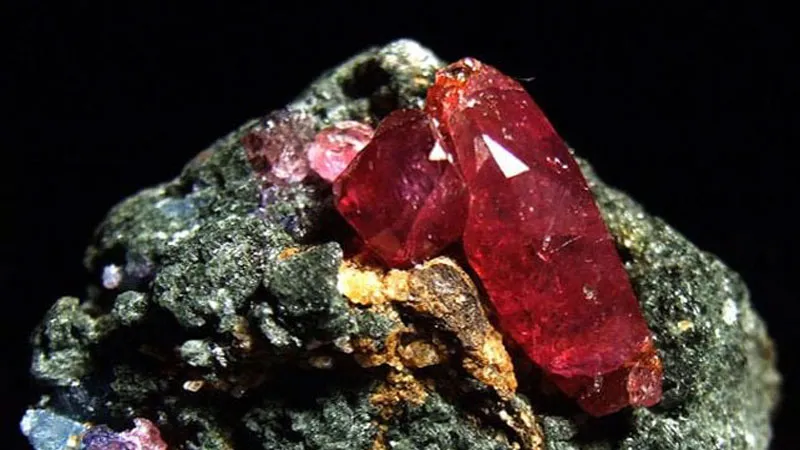
NASA Perseverance Mars Rover discovered for the first time On Mars, corundum is crystalline aluminum oxide (Al2O3), and on Earth, variations of corundum form rubies and sapphires. An unexpected discovery was made while examining three rock samples from the rim of Jezero Crater. Previously, corundum had not been detected either from orbit, directly on the Martian surface, or in Martian meteorites. The necessary conditions for its formation don’t actually exist on Mars.
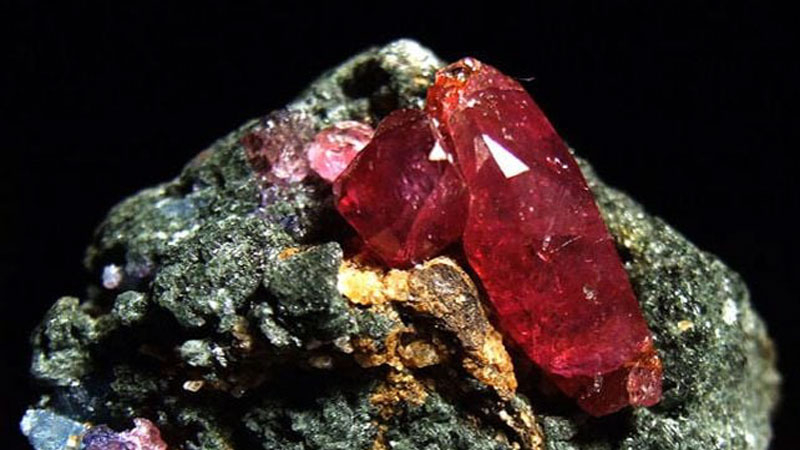
Earth ruby. Image source: Wikimedia
Let us clarify right away that we are not talking about a single large stone, but microscopic inclusions of corundum in three plagioclase-rich fragments known as Hampton Creek, Coffee Bay, and Smith Harbor. They are all so-called “traveller” boulders – fragments of rock that were previously separated from the original outcrop and carried great distances by changes in terrain, so the exact location where they formed remains unknown.
The mineral was identified using the rover’s SuperCam complex and its TRL time-lapse luminescence spectroscopy mode. A green laser with a wavelength of 532 nm excites impurity atoms in the crystal lattice, and a spectrometer records the light they emit. This measurement is usually performed at night so that sunlight does not interfere with the observation of the weak afterglow. Typical exposure times are around 0.5 milliseconds.
The device detected extremely characteristic spectra in three stones, indicating the presence of chromium in the crystals. When this element is concentrated enough, earth rubies will appear red. In the Smith Harbor sample, the glow disappears in about 3 milliseconds, which is very close to the behavior of terrestrial corundum. Furthermore, based on indirect evidence, the scientists concluded that single crystals were less than 200 microns in size – the resolution limit of the rover’s dedicated cameras. If they don’t see it, it means less.
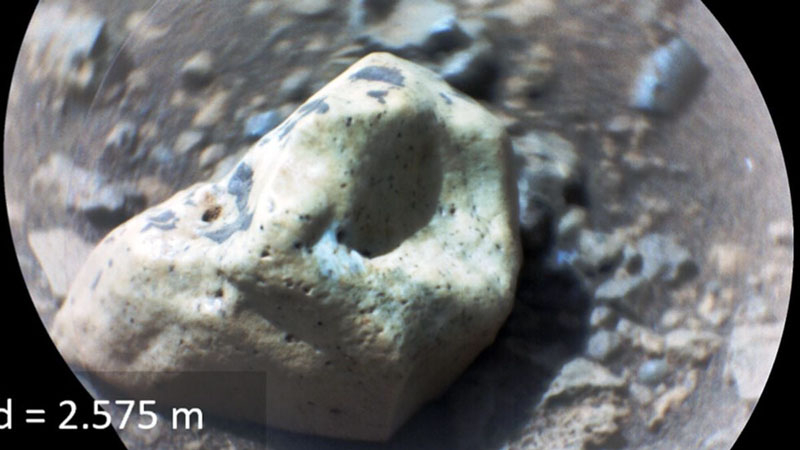
One of the Martian samples containing corundum
The strangest thing is what rock corundum is found in. In order to form it, aluminum-rich and silicon-poor environments are generally required: if there is an excess of silicon, the aluminum primarily combines into aluminosilicates, including Plagioclase. However, all three Martian samples are rich in plagioclase. Under normal circumstances, it should not contain corundum.
Researchers are considering several mechanisms by which corundum appears: magma crystallization, exposure to hydrothermal fluids, and general geological processes. However, they believe the most likely origin of the impact is related to the formation of Jezero Crater itself. Powerful asteroid impacts can produce extreme temperatures and pressures over a short period of time and trigger the necessary crystallization reactions. As a result, impact corundum has been previously found in terrestrial impact structures and in lunar rocks.
This version is supported by the microscopic size of the Martian grains, the location of the discovery directly on the rim of an ancient crater, and the proximity of rocks of apparent impact origin. It’s possible that hot springs also played a role after the impact, changing the original rock, making some areas rich in aluminum and poor in silicon. Studying samples on Earth would help solve this problem, but unfortunately, missions to bring samples back from Mars have been put on hold.
If you find an error, select it with your mouse and press CTRL+ENTER.