
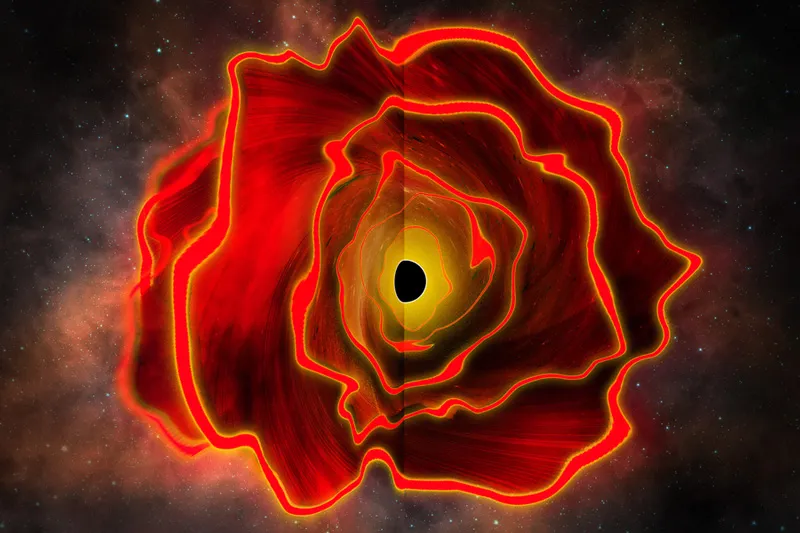
Scientists use the James Webb Space Telescope Found There is an unusual object in the early universe, MoM-BH*-1, which they propose to attribute to a new astrophysical source – a “black hole star”. The object belongs to a new type of source called “little red dots” that Weber first began to discover. The peculiarity of MoM-BH*-1 is that its spectrum is similar to that of stars, but such stars do not exist in nature.
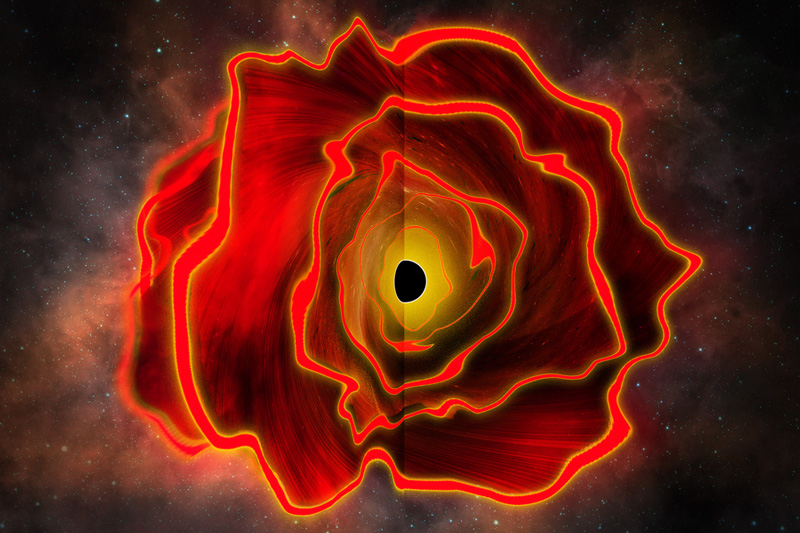
Image source: MIT
The object was discovered about 660 million years after the Big Bang, and its spectrum z = 7.7569 confirms its redshift. On the surface, it looks like one of the mysterious “little red dots” detected by the Webb Collective, but its radiation is produced almost entirely by an active black hole hidden within a huge, dense shell of gas. The shell is about the size of the solar system and is 100 billion times more luminous than the brightest stars.
Therefore, it cannot be a star because the nuclear fusion in its core is not sufficient to release such a huge amount of energy. But the supermassive black hole at the center of the object likely produced the observed energy during the accretion of matter. On the other hand, the object shows up in the spectrum balmer leapstar qualities, and very strong. Such spectra are not seen in the case of nebulae or clouds of gas and dust surrounding a black hole. In other words, the object has a dense envelope of gas found only in stars. In particular, the spectrum contained only hydrogen and helium, with no sign of heavier elements.

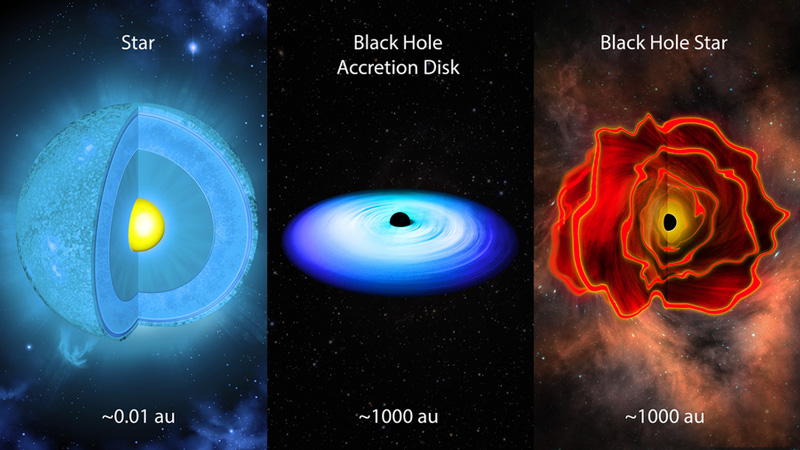
Simulations show that placing an accreting black hole inside a nearly spherical shell of very dense hydrogen can produce the observed spectrum. In the best-fitting model, the gas density reaches 1011 centimeters-3the characteristic turbulence velocity is about 500 km/s. This shell measures about 10-100 AU, or about the size of the solar system, and is so opaque that it itself begins to act as the star’s “photosphere.”
Unlike ordinary stars that generate energy through thermonuclear fusion, the source of energy here is material falling into the central black hole. This model requires very little dust, so the object’s red color is primarily due to the dense gas absorbing radiation.
The exact mass of the central black hole remains uncertain because the unusual gas environment and multiple scattering of photons distort the width of the spectral lines. Standard methods may overestimate the mass of such objects by up to two orders of magnitude. The author’s model gives about 106–107 The mass of the sun. Such a configuration could provide very rapid black hole growth, even faster than the theoretical Eddington limit, helping to explain how a black hole with a mass of about a billion solar masses emerged in the universe less than a billion years after the Big Bang.
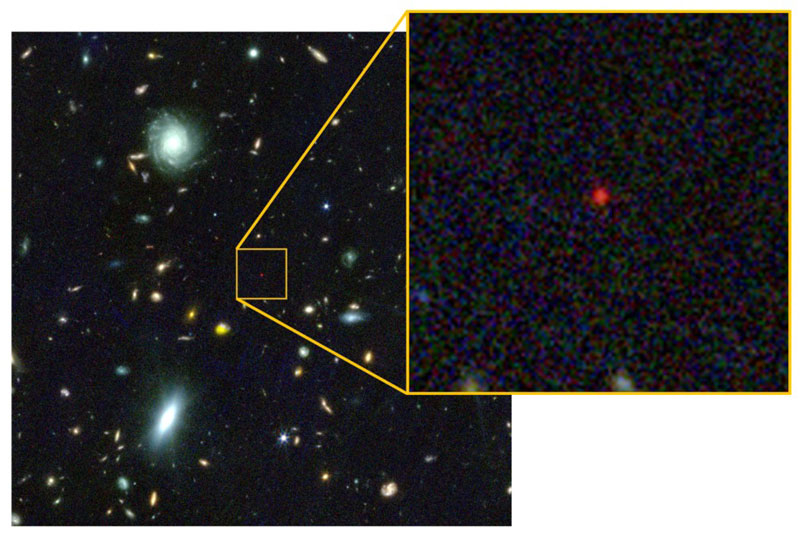
In the end, scientists believe that the MoM-BH*-1 object may be an almost “pure” example of the same mechanism that produced the many “little red dots” discovered by Webb, the nature of which astronomers have been debating for the past two years.
If you find an error, select it with your mouse and press CTRL+ENTER.