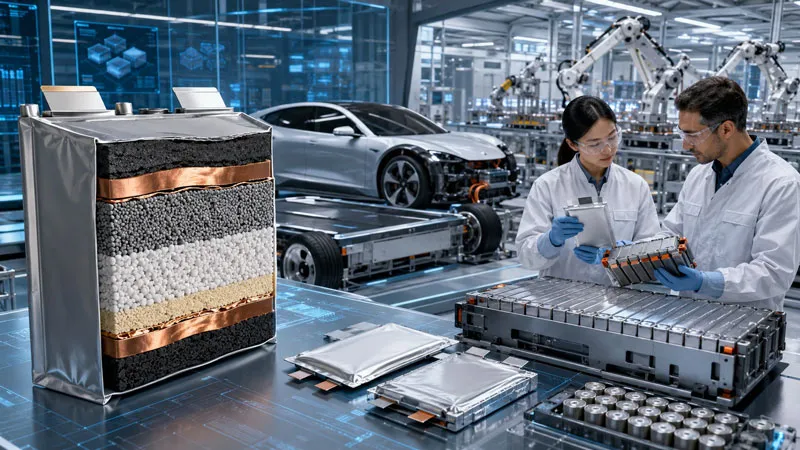
Develop all-solid-state batteries (ASSB) in 2026 keep going From laboratory experiments to testing under real conditions and preparing the technology for large-scale production. According to TrendForce data, Toyota, Honda, Nissan and Samsung SDI are slightly ahead of competitors in small-scale production of solid-state batteries, providing broad validation of the technology in electric vehicle applications.
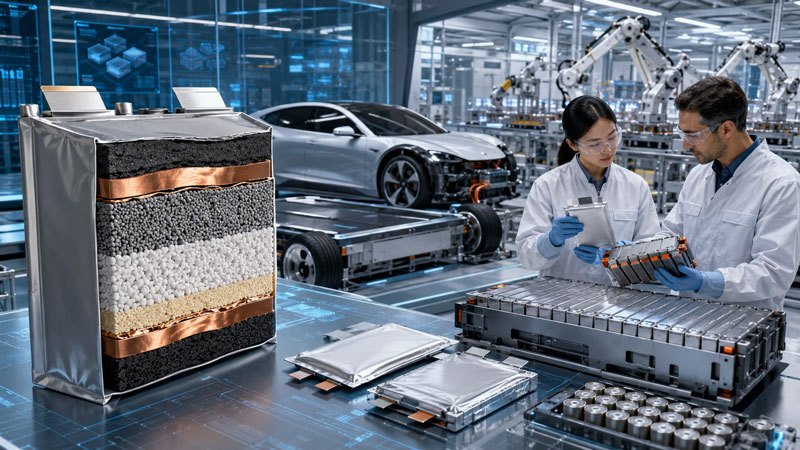
Image source: AI Generation ChatGPT/3DNews
Analysts pointed out that the technical readiness level of all-solid-state batteries has improved significantly. If early ASSB development was mainly in the TRL 1-3 stage – from idea formulation to laboratory proof of concept, today individual companies are approaching TRL 5-6 levels. This means that developers have begun to improve the production process, improve the stability of mass-produced battery characteristics, and meet the requirements of the automotive industry.
Sources said that in the first half of 2026, Japanese and Korean companies made progress in testing samples for pilot production. Some automotive ASSB batteries have been subjected to performance and reliability testing, including charge-discharge cycling and durability evaluation. In particular, Nissan tested a car battery with a 23-layer stack structure: it showed higher capacity retention compared to traditional liquid lithium-ion batteries. Chinese companies CATL, BYD and FAW are simultaneously developing their own small pilot production lines and are approaching TRL Level 4-5.
At the same time, solid-state batteries are starting to be viewed as a technology for more than just the EV market. Samsung SDI, Maxell, Ilika, Huineng and Factial also focus on drones and electric vertical take-off and landing eVTOL vehicles (air taxis), microelectronics, construction equipment and robotics. TrendForce said that some of these applications already have specific projects and orders, so the ASSB market, even in its early stages, may be formed in multiple directions at the same time, among which high energy density, compactness and better battery performance are particularly important.
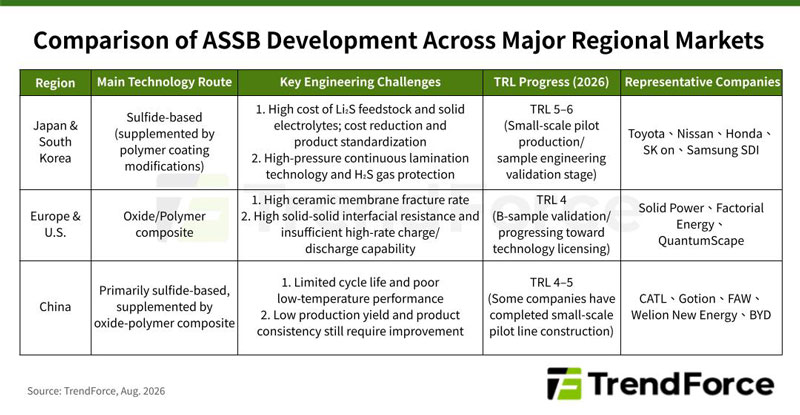
Image source: TrendForce
At the same time, the raw material base for such batteries began to develop. The most common direction at this stage is sulfide solid electrolyte, which increases the demand for lithium sulfide Li2Global production of this feedstock will exceed 600 tons by mid-2026, and analysts expect production to increase to thousands of tons per year by 2027.
Monthly supplies of lithium sulfide from some producers have increased from kilograms to tons, and its price has fallen by more than half in the past six months to about $219 per kilogram in June. While overall demand remains small due to the small scale of all-solid-state battery trial production, successful trials of full-scale automotive batteries could significantly increase demand for the material.
If you find an error, select it with your mouse and press CTRL+ENTER.