


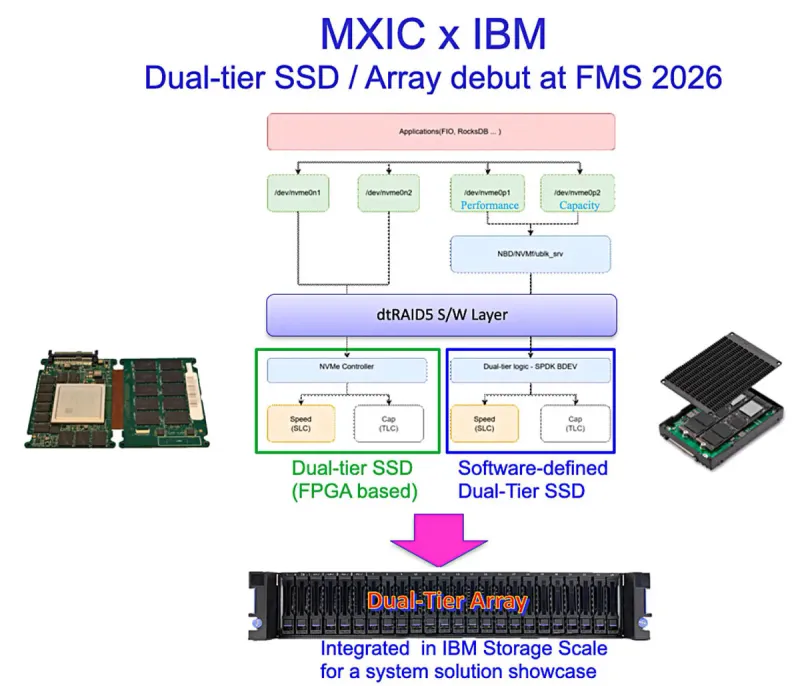
Taiwanese company Macronix reportedly collaborated with IBM Research to develop a so-called Dual-Tier SSD blocks and files. The idea is to combine a high-performance layer based on SLC NAND flash memory wafers and a high-capacity layer based on TLC NAND in a single device.
The system treats each tier of the dual-tier SSD as a separate NVMe drive. Special software is responsible for redistributing data between layers. Therefore, the most commonly used information is placed in the SLC partition, which provides high write and read speeds but relatively small capacity. In turn, “cold” and “hot” data can be stored in less productive but larger TLC partitions.
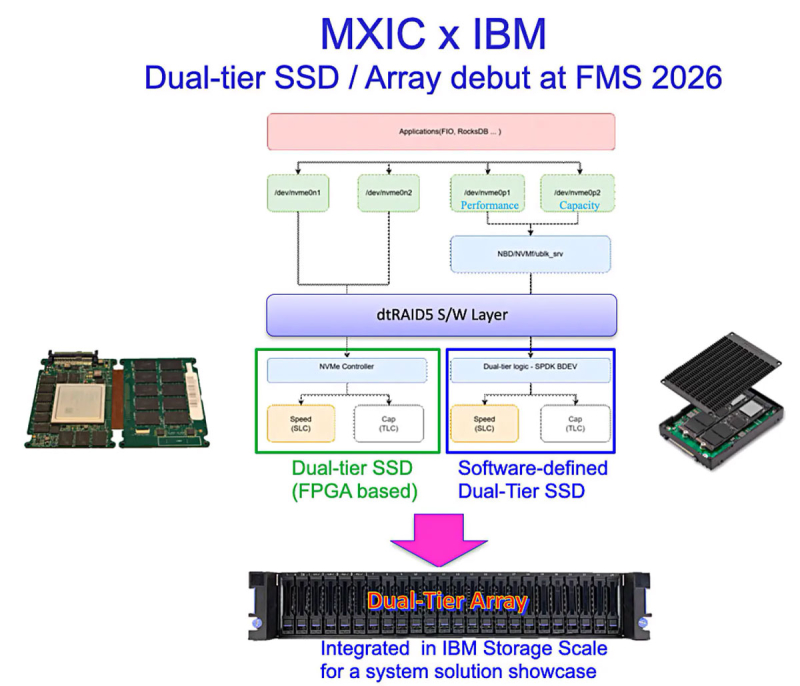
Image source: Blocks and Files
Due to flexible management based on collected current load statistics and analysis, dual-layer SSD achieves the best balance between performance, reliability and longevity of the NAND wafer. Additionally, it is possible to interact with different layers of the drive in parallel.
The possibility of dynamic reallocation of capacity between different storage tiers in dual-layer SSDs is also being considered. In this case, depending on the current load, part of the TLC NAND capacity can be used in pseudo-SLC (pSLC) mode – an approach already used in many drives. This will provide additional flexibility in handling high-load applications such as artificial intelligence and high-performance computing. It is assumed that dual-layer SSD will be able to replace the traditional combination of HDD and SSD in the IBM Storage Scale System storage platform.
source: