


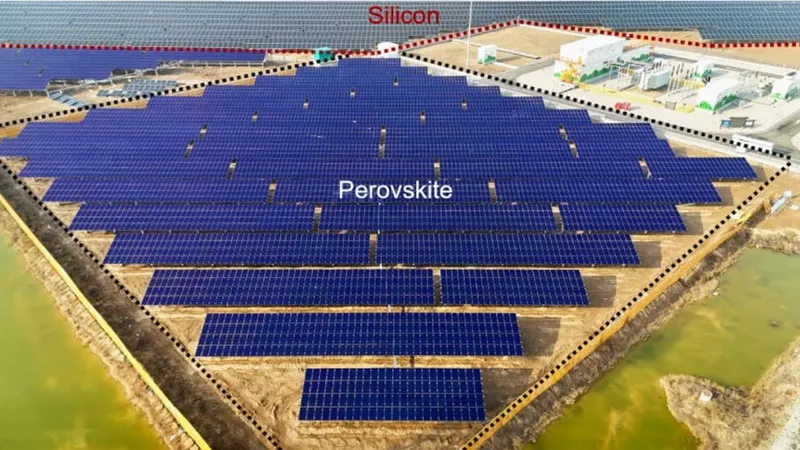
Chinese developers collaborate with Canadian colleagues hold Large-scale field testing of perovskite solar panels, essentially deploying the world’s first solar farm using this type of cell. Tests have shown that perovskite cells are more efficient than silicon cells, not to mention their other advantages of being lightweight and simpler to produce.
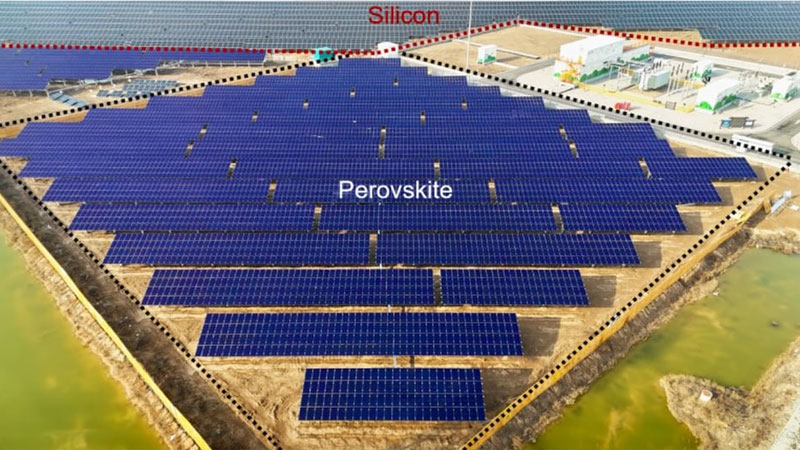
Image source: Nanjing University
Perovskite panels are mainly produced by inkjet printing on thin films. This is much better and cheaper than producing bulky and inflexible silicon panels. The problem with perovskite solar cells has long been that they are unstable to moisture in the air, a problem they have tried to overcome with one type of coating or another. Just as the tests were announced, a new coating was tested, which showed it to be the best when tested outdoors.
The two-component composition overcomes the problem of coating stability and a reduction in the possibility of defects. First, iodized salt is applied to the solar cells to ensure a strong adhesion to the surface, and then a lead compound is applied. The new technology process and its formula were jointly developed by scientists from Nanjing University and Renxin Solar Energy Company.
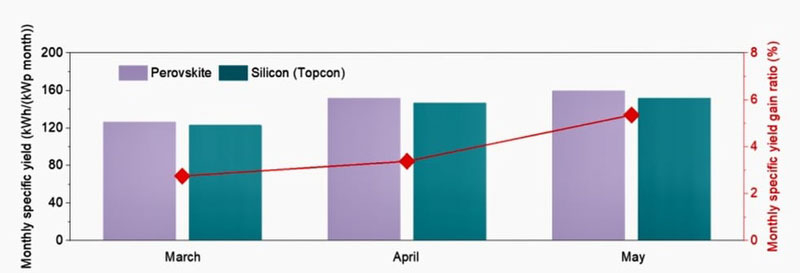
They then deployed a 1 MW solar plant next to a 3.5 MW silicon solar plant and compared their specific output over three months. Based on the same device power, the power generation of the perovskite system increased by 3.42% in March, 3.79% in April, and 5.81% in May. This advantage increases as air temperature and solar radiation intensity increase.
On a single perovskite module with a working area of 810 cm22 Researchers achieved certification efficiency of 24.0%. The open-circuit voltage reaches 53.46 V, the short-circuit current is 0.436 A, and the current-voltage characteristic duty cycle is 83.4%. The technology was then scaled up to the level of small stations: 150 modules with an area of 0.72 m were manufactured2Average power is 144W. The best module has a certified efficiency of 22.0% and a power of 158.4W, continuously producing more than 158W for more than two hours while tracking the maximum power point. According to the authors, this is a record for a perovskite module of this size.
Equally important are the results of durability tests—traditionally one of the weak points of perovskite solar cells. After 1,300 hours of testing at 85°C and 85% humidity, the components with the new coating (passivated) lost only about 2% of their original efficiency, while the conventionally coated samples lost 39% of their efficiency. Overall, the modules have passed a series of IEC 61215 tests, which significantly brings perovskite panels closer to industrial use. It looks like the Chinese will be the world’s first in this area as well, although Japanese researchers also rely on perovskites and have made huge progress in this area.
If you find an error, select it with your mouse and press CTRL+ENTER.