


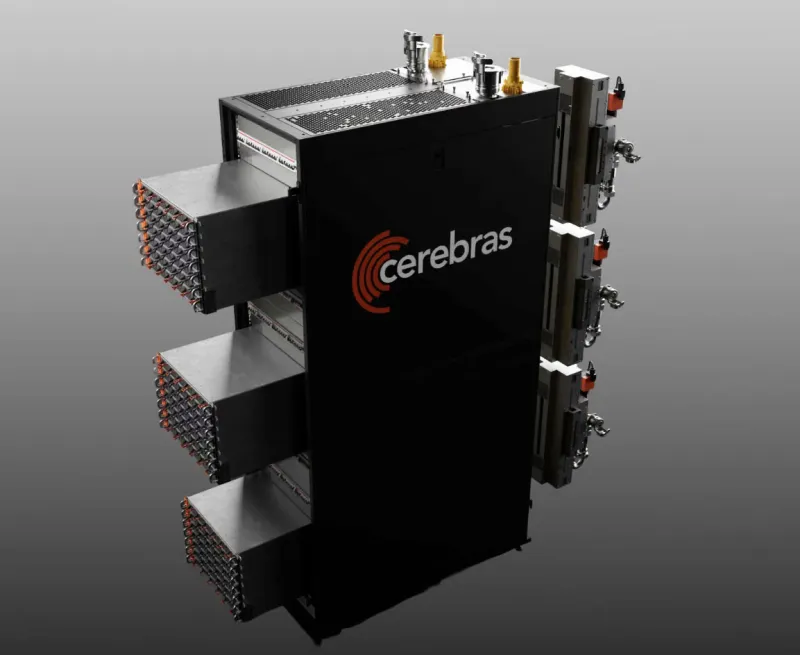
brain systems inc. declare Powerful WSE-3 Turbo AI accelerators and CS-4 rack-mounted systems based on them. The solution is said to improve the performance of inference tasks by up to 30 times compared to modern GPU-based platforms.
Just like the original product WSE-3 (Wafer Scale Engine), the WSE-3 Turbo accelerator contains 4 trillion transistors, 900,000 cores and 44 GB SRAM memory. Production still uses TSMC’s 5nm process technology, and the silicon wafer area remains at 46,225 mm.2. At the same time, the memory bandwidth increased from 21.6 PB/s to 43.2 PB/s, and the I/O subsystem increased from 1.2 Tbit/s to 2.4 Tbit/s.
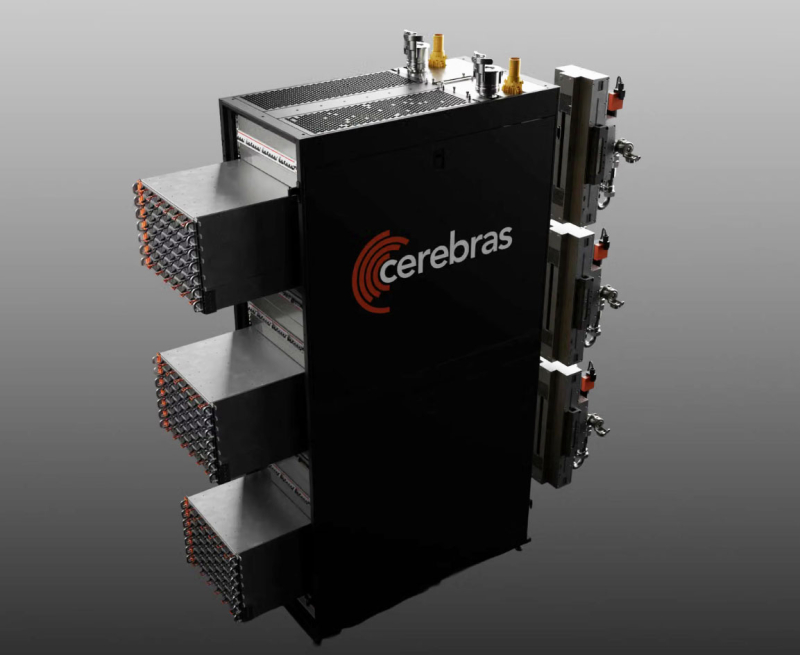
Image source: Cerebras
Performance doubled in sparse FP16 calculations – from 125 Pflops to 250 Pflops; in regular FP16 operations – from 12.5 Pflops to 25 Pflops. The TDP at the wafer level is estimated to be 33 kW, WSE-3 is 15 kW, the node level is 46 kW, WSE-2 is 23 kW, and the entire CS-4 rack level TDP is approximately 120-140 kW. Apparently, the company just increased the operating frequency – approx. From 1.4 GHz to 2.8 GHz.
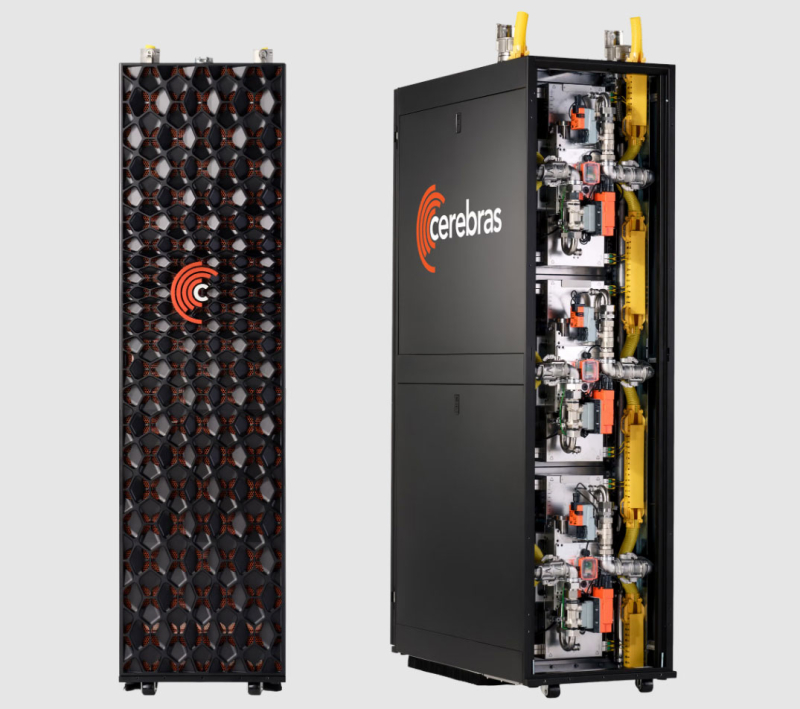
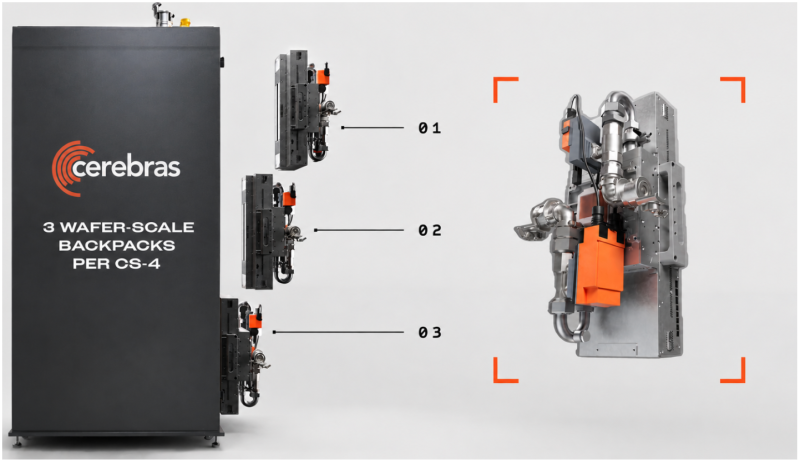
The CS-4 AI rack is based on the Nexus modular architecture. The system is divided into three key modules: Wafer-Scale Backpack computing node, power subsystem and IO subsystem. The architecture simplifies production, deployment, maintenance and upgrades. Notably, Cerebras completely rethinks the concept of artificial intelligence servers. The CS-4 has a total of three wafer-level backpacks, each of which is an independent component containing the accelerator, power converter, direct liquid cooling, high-speed I/O components and control electronics.
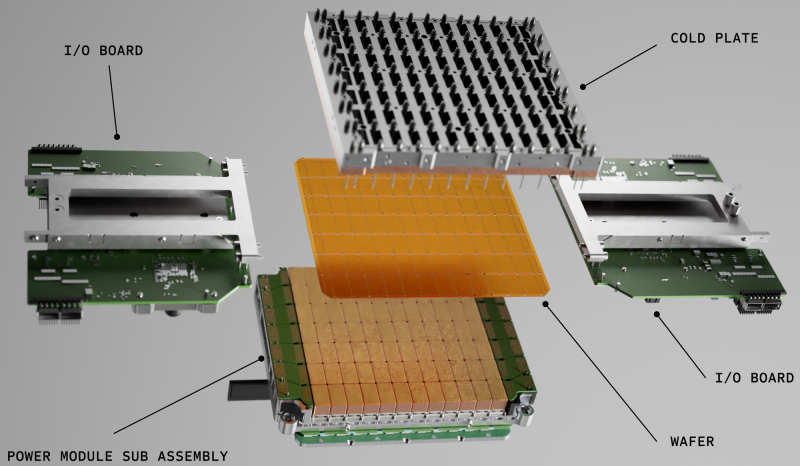
The power supply is powered close to the die (only about 0.5 mm compared to 50 mm on a traditional GPU board), which almost completely eliminates board-level losses and allows more power to be delivered, increasing the frequency and speed of token generation. Special IO modules allow WSE-3 Turbo disks to be connected within and between racks without the need for switches: therefore, the specified data transfer delay between disks is only 2 μs. The overall performance reaches 750 Pflops in sparse FP16 calculations.
Overall, the new product offers maximum performance. For example, tests were conducted on the GPT-OSS-120B model, where the CS-4 system showed over 4400 tokens per consumer per second. In comparison, “the most efficient GPU-based artificial intelligence service to date” showed 350 tokens per second. CS-4 is said to issue more than 1,000 tokens per second on models with parameters exceeding 10 megabytes. The system is scheduled to be delivered this season.
source: