


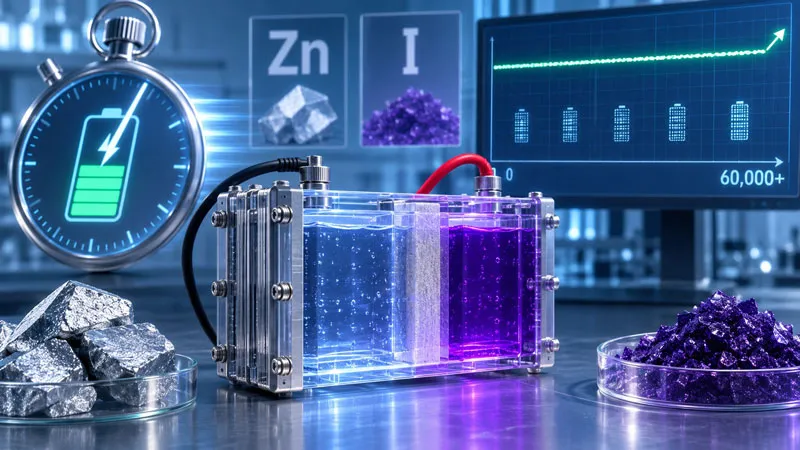
Researchers from Flinders University in Adelaide, Australia developed The water-based zinc-iodine battery can withstand more than 60,000 charge and discharge cycles and can be fully charged in about three minutes. The results of this work, published in the journal Angewandte Chemie, could easily be called a “dream battery” – such is the outstanding properties of this element. However, this is a utility solution and is unlikely to appear in everyday life.
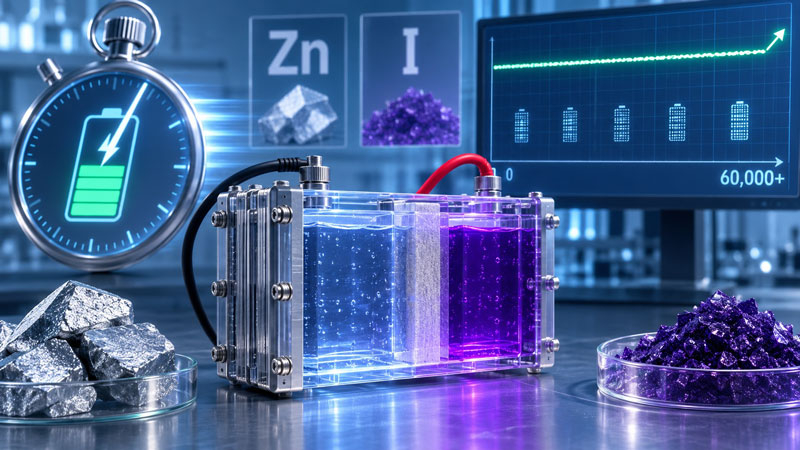
Image source: AI Generation ChatGPT/3DNews
One interesting battery uses an aqueous electrolyte based on potassium iodide with the addition of zinc chloride and ethylene glycol, which simultaneously solves two key problems of such systems: the growth of zinc dendrites and the unnecessary transfer of polyiodides between electrodes. But it’s worth it: after 60,000 cycles at 100% depth of discharge, the battery still retains 83.8% of its original capacity.
The technical essence of this solution is to change the chemical properties of the electrolyte at the molecular level. Ethylene glycol forms a so-called solvation shell around the iodide ions, which greatly reduces the mobility of the iodide ions and prevents their leakage through the separation membrane. The chloride ions are adsorbed on the zinc anode and guide zinc deposition along crystallographic planes that are safe from the perspective of dendrite (needle) growth. This ensures uniform growth of the electrodes without the formation of needle-like structures, which often lead to short circuits. When the current density is 20 mA/cm2 The voltage is as high as 1.3V, it can be fully charged in three minutes, and the specific capacity is 0.45mAh/cm2 1mA/cm2.
Another advantage of this design is that it is simple and fixed, eliminating the need for pumps, reservoirs and complex electrolyte circulation systems typical of flow batteries. This simplifies expansion and reduces storage system costs. The prototype used a 2.1 Ah stacked cell format and showed a coulombic efficiency of 99.7% over 2000 cycles. The battery also features a wide temperature range: ethylene glycol acts as an antifreeze, allowing the device to operate at temperatures from -20°C to 60°C, maintaining 78% capacity at -20°C after 500 cycles.
The developers note that high charging speeds combined with excellent cycle life make the technology promising for stationary energy storage, particularly in networks where solar and wind generation account for a large share. If the results from the lab prototype hold up when scaled up, aqueous zinc-iodine batteries could compete with lithium-ion and vanadium systems in the four- to eight-hour storage arena, where cost per cycle and reaction speed are determining factors.
Australia is particularly interested in this type of battery. Australia’s natural zinc reserves are the largest on earth, accounting for 28% of the world’s total. This is also important from the perspective of not being dependent on Chinese lithium supplies, which will become increasingly problematic in the future. The only drawback of this development is the relatively low density of stored energy – several times lower than the best modern lithium batteries, but taking into account all the other advantages, this is a dream for the creators of industrial-scale energy storage systems.
If you find an error, select it with your mouse and press CTRL+ENTER.