
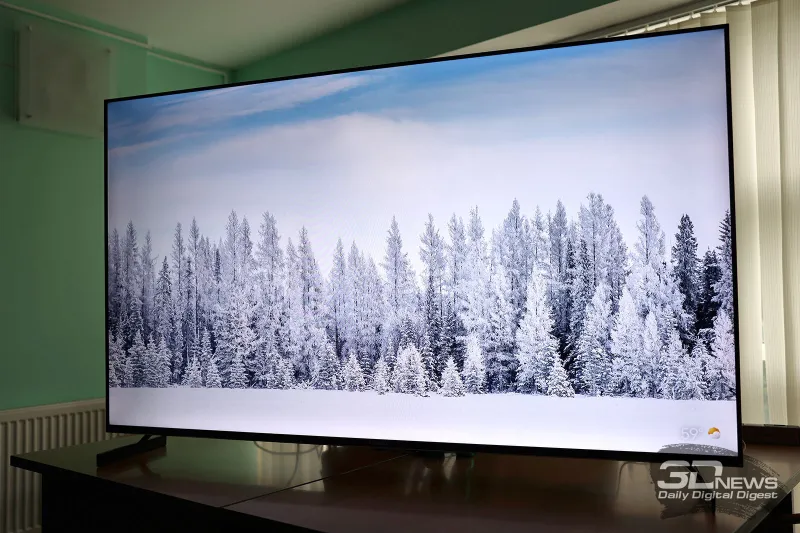
Modern TVs have been known to us for quite some time and have a good reputation; first of all, they have proven themselves to be the best in the low-budget segment. So, getting familiar with the modern 65-inch H-LED65BU7011 is at least not intimidating. Making the idea of a 65-inch 4K TV in 2026 costing about 50,000 rubles seem a bit crazy, one would expect that when analyzing the device in detail various shortcomings will be discovered. Going forward, I would say – no, they won’t happen.
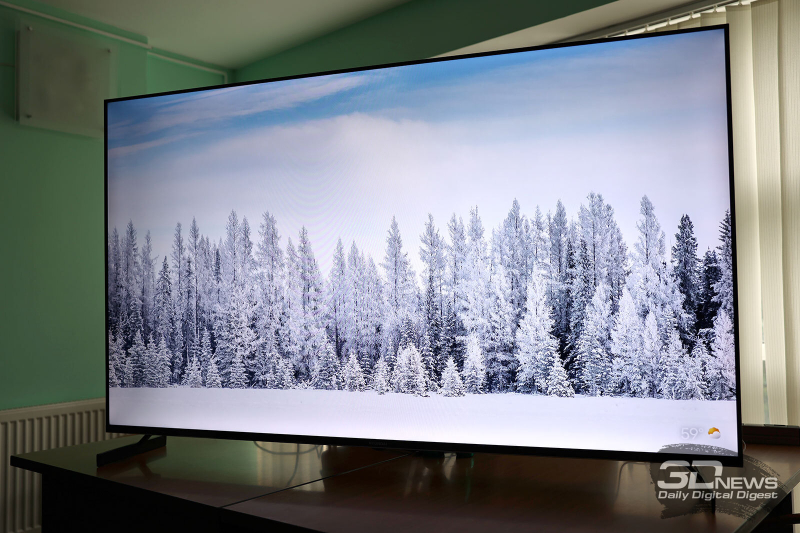
I want to clarify right away that the modern BU7011 series offers a wide range of diagonal options: from 43 inches to an impressive 85 inches. They all have LCD matrix (*VA) and 4K resolution, but come without any hardware or software frills, and come with the GoogleTV operating system pre-installed. But are these pleasures necessary, especially in the world of budget TV?
⇡#feature
| Modern 65″ H-LED65BU7011 | |
| Panel type | LCD, VA, LED backlight |
| panel diagonal | 65 inches (available in 43, 50, 55, 75 and 85 inches) |
| resolution panel | 3840×2160 |
| refresh rate | 60 Hz |
| sound system | 2×10W |
| operating system | Google TV (Android 14) |
| image processor | 4 × ARM Cortex-A55 @ 1.5 GHz + GPU |
| Built-in storage | 16 GB |
| memory | 2GB |
| interface | USB 2.0 × 2, HDMI × 4 (HDMI 2.1), Antenna × 2, S/PDIF × 1, Ethernet × 1, 3.5 mm × 1, CI+ × 1 |
| wireless module | Wi-Fi (2.4/5 minutes) + Bluetooth v5 |
| digital tv | DVB-T/T2/C/S/S2 |
| aspect | 144.5 x 83.2 x 6.4 cm (without stand) |
| weight | 14.3 kg (excluding stand) |
| price | 49,990 rubles |
⇡#design and construction
Televisions, unless they belong to a designer collection with some white frames or try to disguise themselves as pictures on the wall, are purely utilitarian devices in appearance. Big black square. The only differences are the size of the frame around the screen, the thickness of the panel, and the organization of space around the interface.

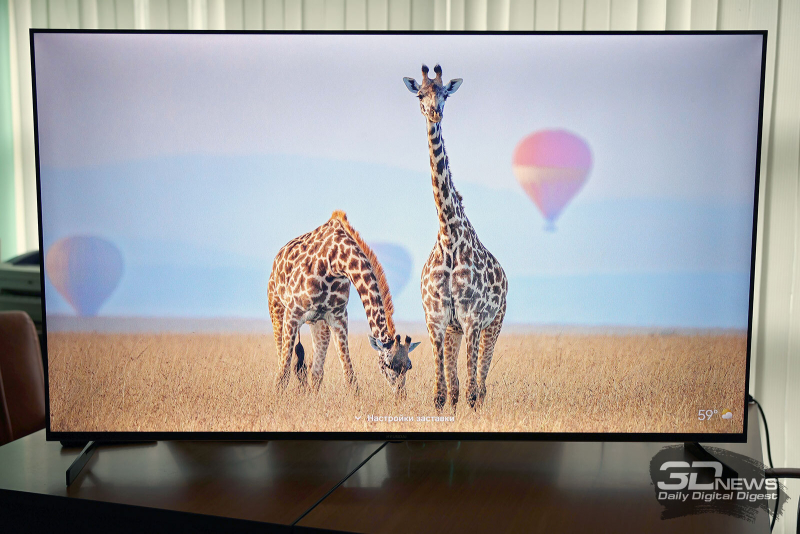
Well, the frame here is surprisingly small. The bottom is slightly larger than the sides and top, but doesn’t create a protruding “chin” effect like on smartphones.
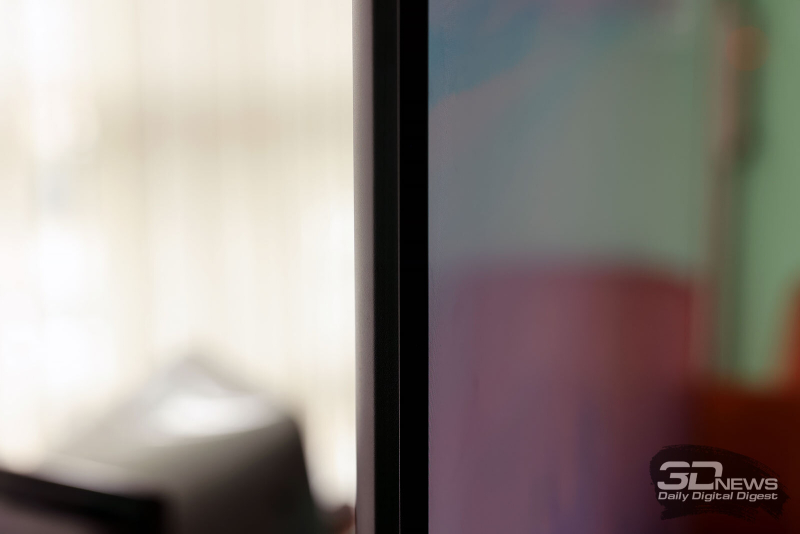
The thickness is quite serious – 64 mm. But that doesn’t stop you from hanging the TV on the wall or placing it on a bedside table—you shouldn’t expect the 65-inch panel to be compact anyway. It weighs 14.6 kilograms and (most likely) requires one’s hands to place it.
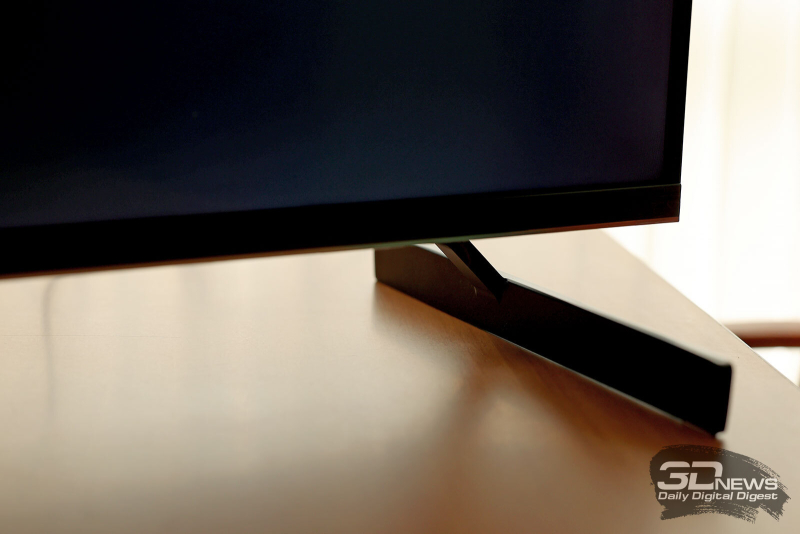
To place it on a nightstand or table, you need to attach two metal legs to the main body. Even for someone who has never held a screwdriver, this won’t cause any problems. Despite its larger size, the modern 65-inch H-LED65BU7011 sits calmly on a table; weight distribution is no problem. The build quality deserves respect.
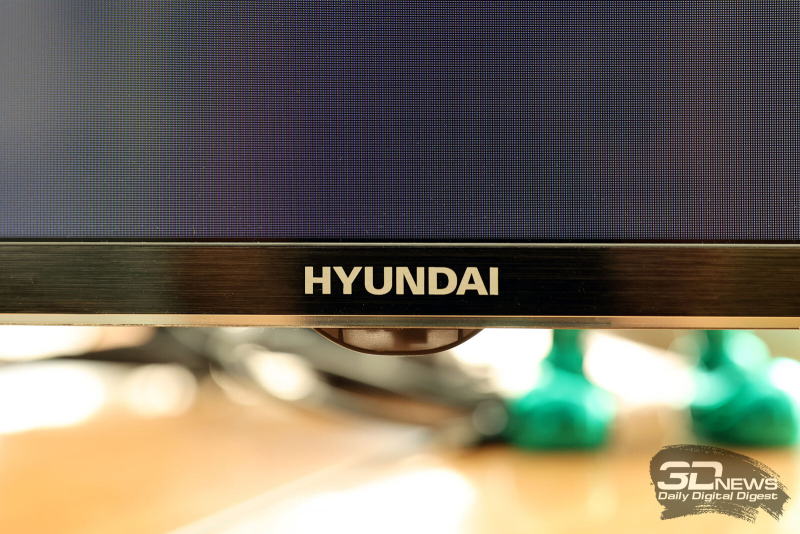
There is an infrared signal receiver below the bottom screen, and there is a physical power button below it.
 |
 |

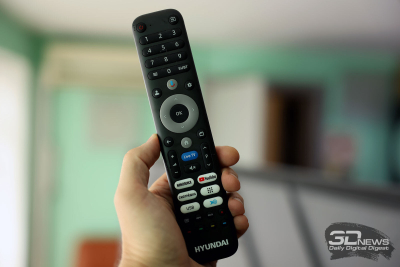
The included remote is universal, features a numeric keypad, an infrared module, and supports Bluetooth connectivity for voice input. Battery included.
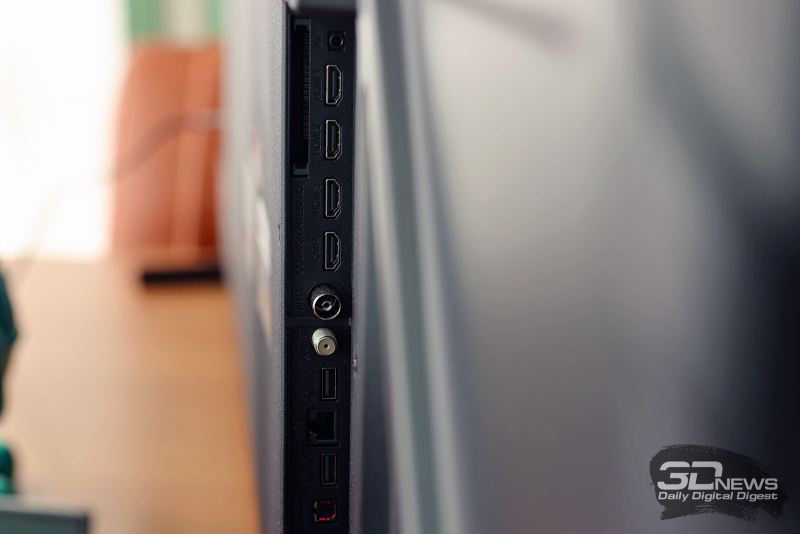
On the back we see the connections – they are on the left and hidden in recesses; there is no problem of excessive bending of the wires when placing the TV on the wall (by the way, the mount is standard, VESA 200×200), the wiring is well thought out. Those same interfaces are abundant here: four HDMI (version 2.1), two USB ports, an optical connector, CI+, a pair of antenna inputs and a minijack for connecting headphones. There is also RJ-45 for connecting to wired networks.
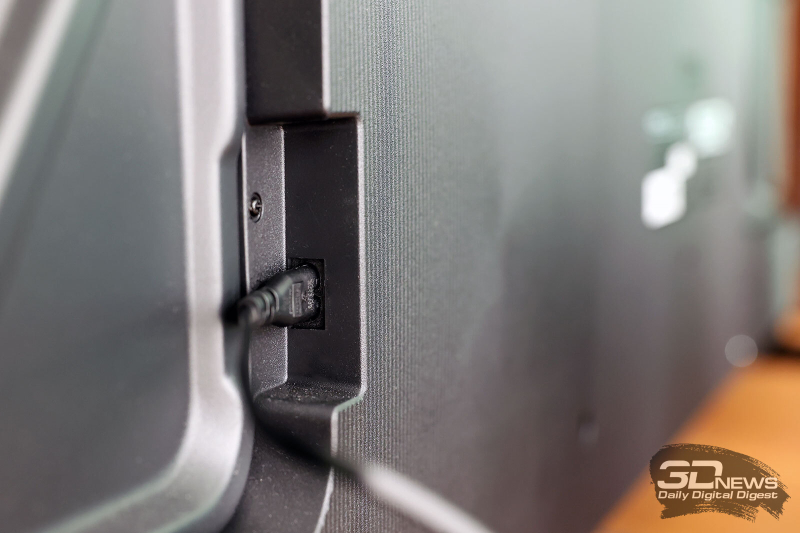
Power is routed to the right – and the supplied cable doesn’t seem long enough; it doesn’t reach every outlet.
⇡#Functional
All TVs on Google TV are functionally similar, almost like twins. The main thing is that the system is properly supported by the hardware – the modern 65″ H-LED65BU7011 does not have any problems in this regard. The hardware platform used consists of four ARM Cortex-A55 cores with a frequency of 1.5 GHz and an ARM Mali-G52 MP2 graphics subsystem. The RAM is only 2 GB, but nothing surprising in our time, but the optimization is impressive – the TV starts up quickly and works very quickly, without lag when navigating the interface (which sometimes happens on more expensive and slower TVs).
The Google TV here is a full-fledged, not stripped-down version of Android 14. During initial setup, you can choose which services will be on your home screen. Applications can be installed from the Play Market, and if they are not available, you can use a flash drive with a recorded apk archive.
Globally, the functionality of modern TVs has remained almost unchanged in recent years – various cloud services and online theaters can be used through the main screen, and in addition, signals can be received from external devices, such as via HDMI. The TV can be connected to the Internet via cable (there are Ethernet modules already mentioned) or using a wireless adapter (Wi-Fi modules operate in the 2.4 and 5 GHz bands). There’s also Bluetooth 5.1 for connecting remote controls and accessories like headphones.
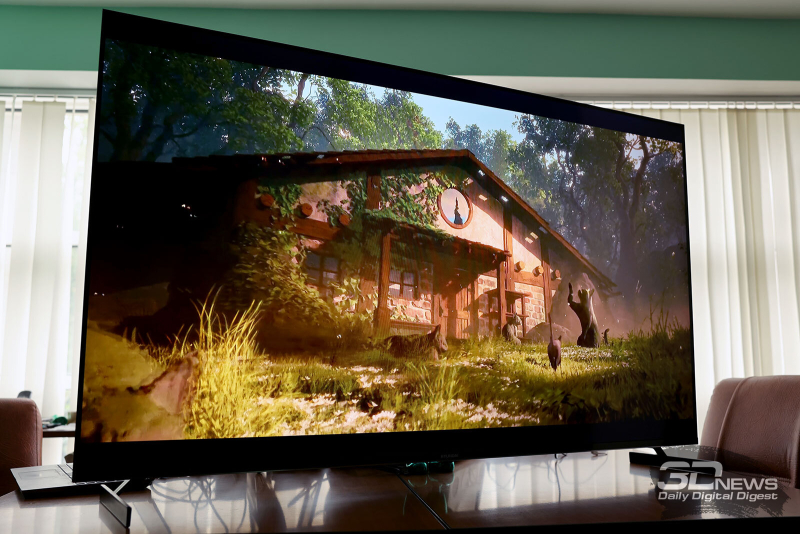
The TV supports playback of files from connected media – these are the basic codecs used by the device: VP9, HEVC/H.265, MPEG1/2, MPEG4, Sorenson H.263, H.263, H.264, VC1, VP8, AV1. You can even transfer some content to it – there’s a built-in 16 GB drive.
⇡#images and sounds
The modern 65-inch H-LED65BU7011 uses a 65-inch diagonal VA matrix LCD panel with a resolution of 3840×2160 and is equipped with a traditional LED backlight. Using direct LED backlight, the lights are distributed across the entire area of the screen substrate, but the number of areas is not indicated.
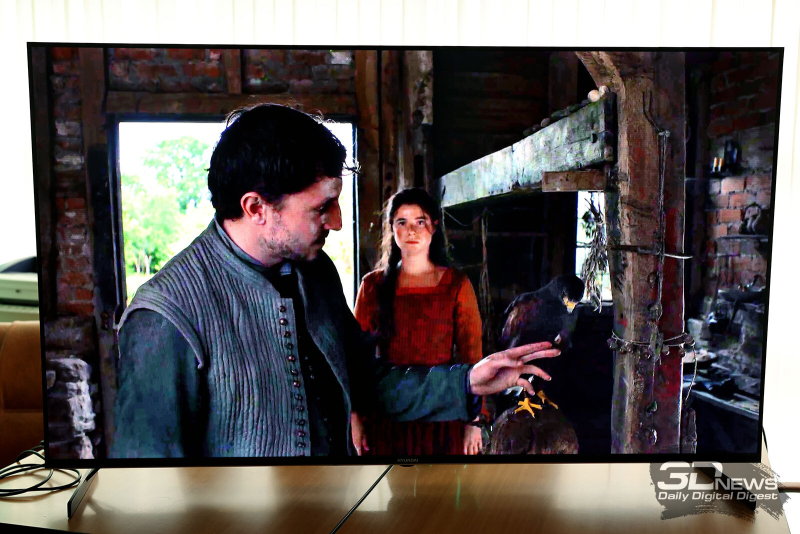
However, I didn’t notice any noticeable flare; the footage was pretty stable.
The measured static contrast ratio is 3946:1 – there’s no need to talk about true blacks in the context of an LCD panel anyway, but this level is pretty good. The manufacturer’s claim of 6000:1 is dynamically quite achievable; I recorded similar figures in non-specific testing.
Measured brightness level is 312 cd/m22 – Even slightly higher than the claimed 300 cd/m2. That’s a good enough indicator for a modern TV that allows you to watch during the day. Of course though the picture only shows in a dark room.
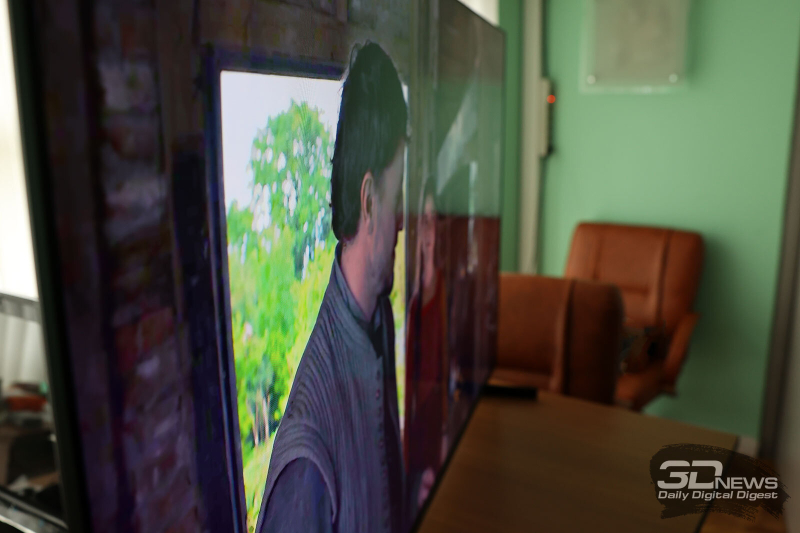
The viewing angle of the TV is marked as 178 degrees. The VA panel does not have such a wide viewing angle by default. However, in fact, even if extreme deviations occur, the picture will hardly be distorted, so this statement has been fully confirmed by practice. This TV claims to be HDR10, HLG and Dolby Vision compliant and we accept this application with conditions – the panel is unable to produce the actual brightness required to be HDR10 compliant.
The actual refresh rate of the panel is 60Hz. Yes, there is 120Hz DLG technology (where the frequency is “doubled” in software by interleaving and duplicating rows), but its use reduces the actual image resolution (in this case to Full HD rather than 4K). You should primarily enable this add-on in-game to keep movies at their original resolution.
Image settings are standard settings for Google TV/Android TV. You can choose a color rendering preset (“Standard”, “Saturated”, “Sports”, “Cinema”, “Game”, “Eco”), or customize it manually by adjusting gamma, contrast, backlight brightness, etc. Custom color temperature and white balance settings are available.
I measured the device’s color rendering in its default settings of “Eco” mode, Standard mode, and “Theater” mode without correcting individual image parameters.

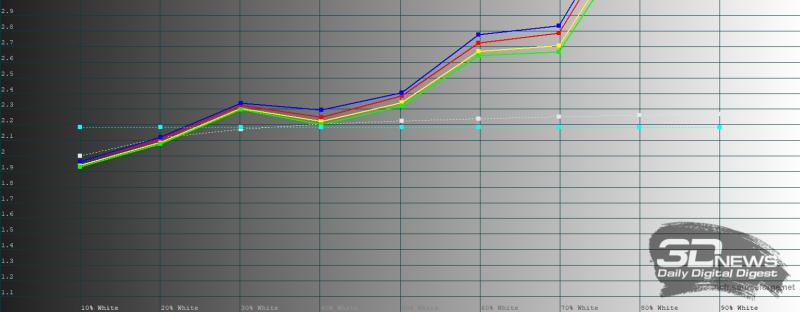
Modern 65″ H-LED65BU7011, gamma in energy saving mode. Yellow line – performance of modern 65″ H-LED65BU7011, dashed line – reference gamma
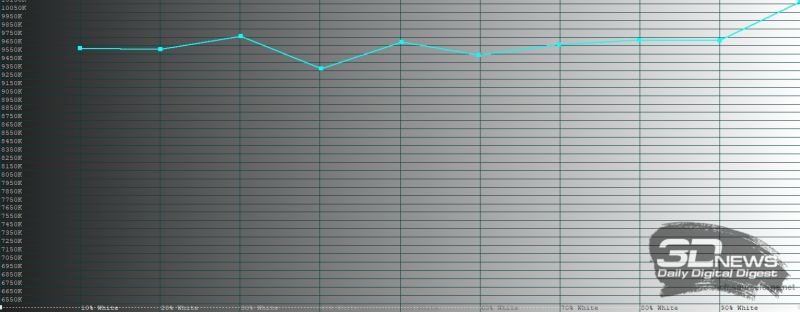
Hyundai 65″ H-LED65BU7011, color temperature in energy saving mode. Blue line – indicator light of Hyundai 65″ H-LED65BU7011, dashed line – reference temperature
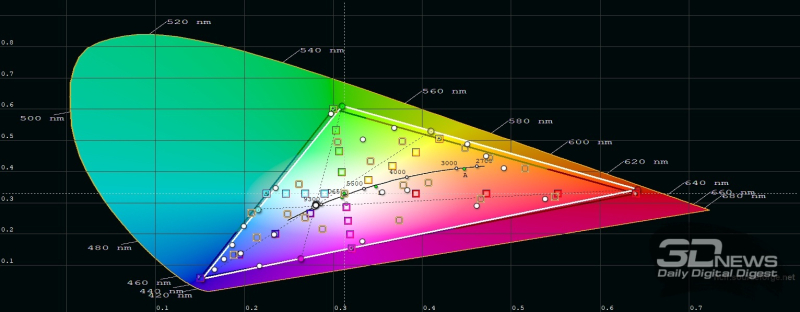
Modern 65″ H-LED65BU7011, color gamut in energy saving mode. Gray triangle – sRGB color gamut, white triangle – Modern 65″ H-LED65BU7011 color gamut
The color gamut of the modern 65-inch H-LED65BU7011 panel remains close to the sRGB standard in any mode; the TV operates in a fairly narrow spectrum. The energy-saving mode that is enabled by default on the device is no exception. Average gamma normal value – 2.18. At the same time, in bright colors, the curves “fly into space”. The temperature rises sharply – up to 9,350-10,000 K at reference values 6,500 K. The Color Checker scale (including grayscale shading and extended color spectrum) has an average DeltaE deviation of 7.93, with a standard of 3.00. In this mode, the image is noticeably cooler and far from normal.
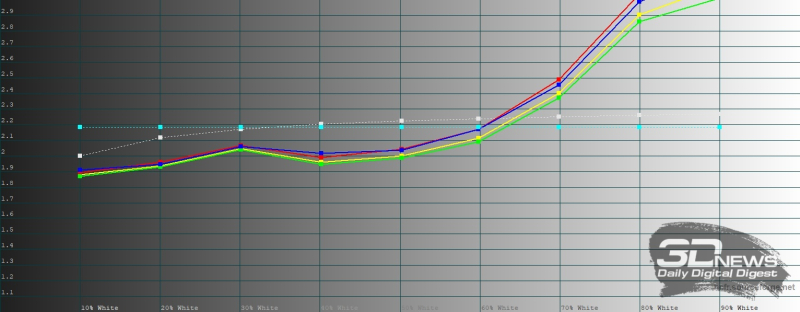
Modern 65″ H-LED65BU7011, gamma in standard mode. Yellow line – indicator for modern 65″ H-LED65BU7011, dashed line – reference gamma
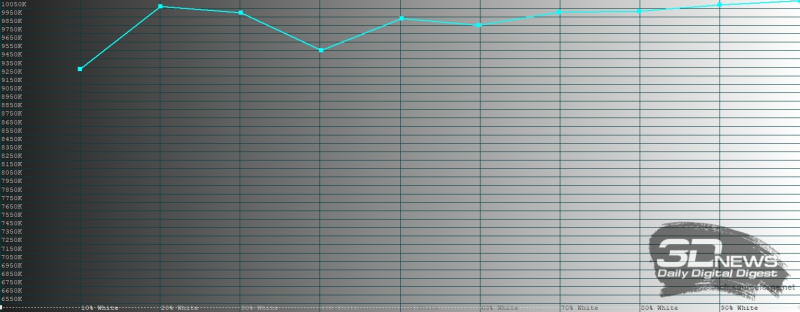
Modern 65″ H-LED65BU7011, color temperature in standard mode. Blue line – Modern 65″ H-LED65BU7011 indicator light, dashed line – reference temperature
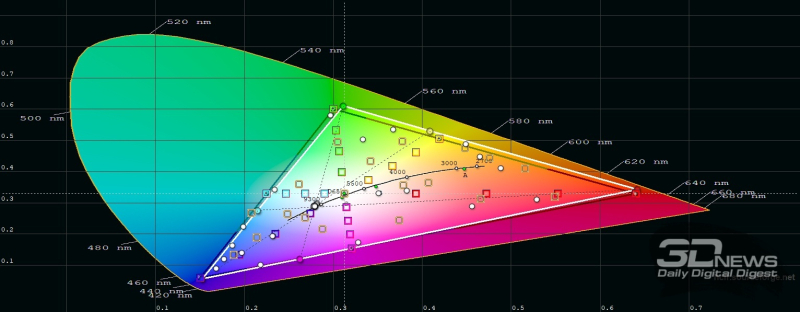
Modern 65″ H-LED65BU7011, color gamut in standard mode. Gray triangle – sRGB color gamut, white triangle – Modern 65″ H-LED65BU7011 color gamut
In standard mode, the characteristics of the image do not actually change. It’s brighter, the gamma isn’t as high, but the coverage, color temperature and DeltaE are about the same. The deviation even increased slightly – to 9.95.
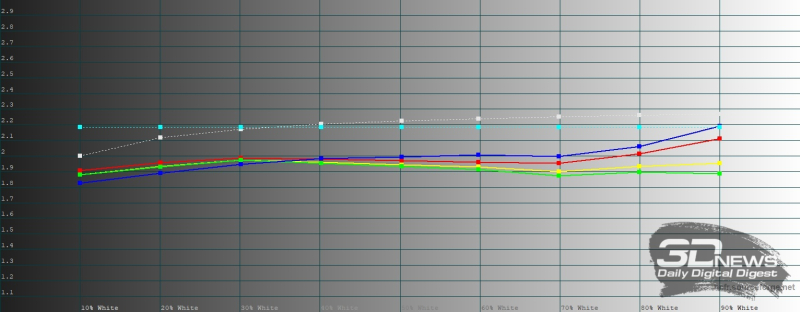
Modern 65″ H-LED65BU7011, gamma values in “Cinema” mode. Yellow line – performance of modern 65″ H-LED65BU7011, dashed line – reference gamma values
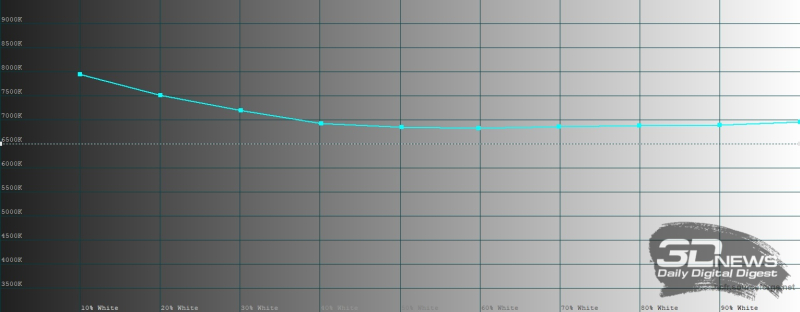
Modern 65″ H-LED65BU7011, color temperature in “Theater” mode. Blue line – Modern 65″ H-LED65BU7011 indicator light, dashed line – reference temperature
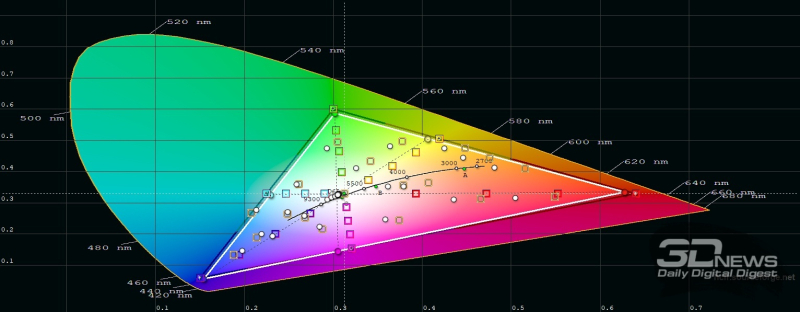
Modern 65-inch H-LED65BU7011, color gamut in “theater” mode. Gray triangle – sRGB color gamut, white triangle – modern 65-inch H-LED65BU7011 color gamut
Yes, in normal mode the color reproduction of the modern 65″ H-LED65BU7011 is not encouraging – in “Bright” and “Game” modes the panel behaves in a similar way, producing images that are bright but at the same time have a narrow coverage and are not very honest. But most importantly, the TV can offer honest lovers in “Cinema” mode a setting closer to the standard for the average case color gamma, and the average deviation of the Color Checker palette DeltaE Already reached a level of 4.19 – curiously, the brightness itself does not drop in this mode; Movie mode does not have to be used exclusively for evening or night shows.
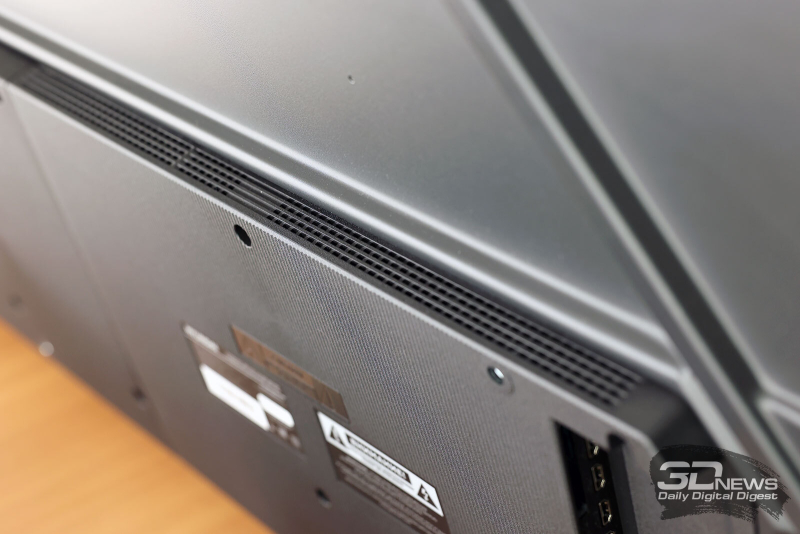
The audio system built into the TV consists of two speakers with a total power of 20 W – which is enough for an average-sized room. At maximum volume, the speakers don’t wheeze, keeping the sound crystal clear.
⇡#in conclusion
The modern 65-inch H-LED65BU7011 does everything a modern TV needs, without trying to offer anything beyond that. But even this is more than enough for a 65-inch panel that costs only 50,000 rubles. This is a completely honest 4K panel, with a 60 Hz matrix, but capable of including software add-ons that increase the frequency. Its specs aren’t great, but the panel at least responds to trying to calibrate it, and by default it delivers good color in movie mode. The TV comes with a high-quality metal body, is relatively thin and has a small frame, which is unexpected even for a budget model – but most importantly, it works well, which is not noticeable with the nominal 2GB of memory.
If you find an error, select it with your mouse and press CTRL+ENTER.