


The Rubytech Group of Companies has completed testing of the Russian Large Language Model (LLM) on a Chinese-made accelerator. The test confirmed that the domestic neural network operates stably as part of the software and hardware complex “Artificial Intelligence Machine Scalar”which opens the way to building an AI infrastructure independent of Western vendors.
For testing, engineers used a modified version of the Scalar AI Machine with eight Chinese GPUs and MWS AI’s third-generation Cotype 3 language model. Results show performance comparable to solutions based on NVIDIA H100: When processing a context of 27,000 tokens, the average wait time for the first token (average TTFT) is approximately 8000 ms and the inter-token latency (TPOT) is 111 ms. These indicators fully meet the scenario requirements of enterprises using artificial intelligence systems.
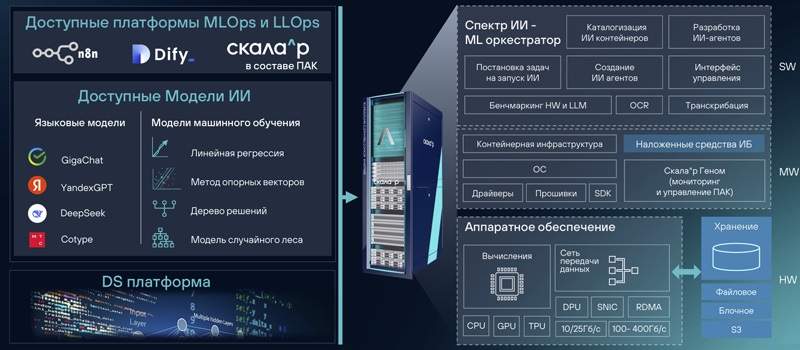
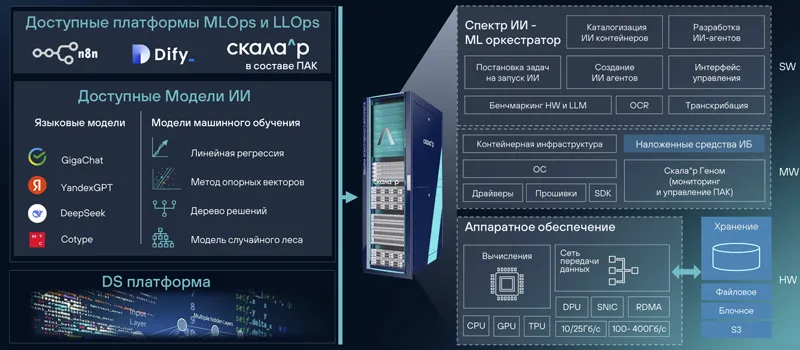
The architecture and components of the “Artificial Intelligence Machine Skala^r” software package (Image source: skala-r.ru)
The company said the ability to use different hardware platforms reduces reliance on a single vendor and provides more freedom when designing artificial intelligence systems. In addition to technological sovereignty, alternative hardware also solves the problem of high computational costs. In many scenarios, the combination of Chinese GPUs, Russian platforms, and domestic models can reduce total cost of ownership (TCO) when expanding services. This makes the solution economically viable for large enterprises and government agencies.
Currently, demand for local infrastructure is generated mainly by the public sector, state-involved companies and critical information infrastructure (CII) operators. It is critical for them to deploy models within their own security loop. Rubytech’s “Scalar” product line is included in the register of the Ministry of Industry and Trade and the Ministry of Digital Development of the Russian Federation and meets the authorization standards for CII objects. The Group’s technology partners include leading Russian banks (Gazprombank, VTB), the Russian Federal Tax Service and the Central Bank of the Russian Federation.
source: