



American startup Hypercubic develops a specialized artificial intelligence agent to translate COBOL code into modern programming languages. declare Conducted a seed round of financing, during which it raised $5.3 million for development. The investment program is led by CIV. Additionally, Y Combinator, Afore Capital, Multimodal Ventures, Pioneer Fund, Epsilon Ventures and Unpopular Ventures, as well as multiple private investors, also provided funding.
COBOL (Common Business Oriented Language) emerged as early as 1959 and remains the foundation for financial infrastructure and applications worldwide. Mainframe: It is estimated that over 95% of card transactions and ATM transactions rely on systems written in this language. There are more than 200 billion lines of COBOL code in the world, but these programs are poorly documented, and qualified experts in the field are difficult to find. The original COBOL developers, if they are still alive, have long since retired, and their successors are approaching retirement age.
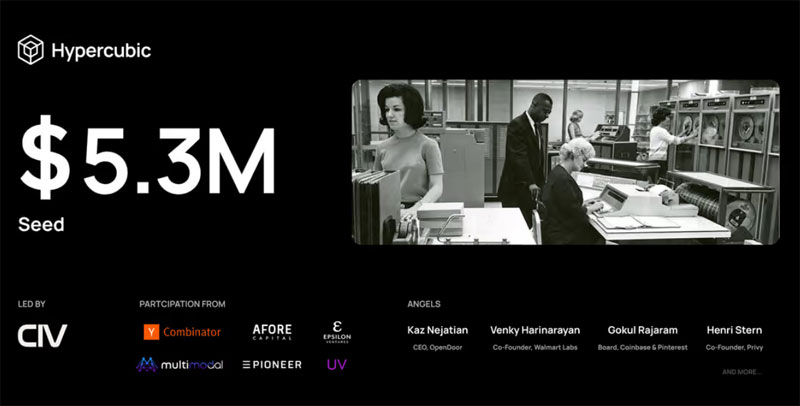
Image source: Hypercube
The process of porting COBOL code to modern programming languages involves significant risks. These applications are often complex monolithic systems, so even small changes can disrupt critical banking and financial services. At the same time, restoring logic developed decades ago requires a huge effort: business rules are often “hardwired” directly into the program code and are not described anywhere. For this reason, many companies put off modernizing: the process takes years, is expensive, and the likelihood of failure is too high.
Startup Hypercubic offers a solution using artificial intelligence agents trained on extensive COBOL code. The system first carefully analyzes the original code, restores the hidden business logic and automatically generates documents. Artificial intelligence then rewrites the application in modern languages while maintaining functionality and compatibility with historical data. This approach is said to reduce modernization time from years to months while improving reliability.
However, Gartnett Prediction failed Using artificial intelligence to automate software transfer from mainframes – By 2030, three-quarters of the providers of such solutions will have closed or relocated. The problem is not just the code (which is just one part of a larger infrastructure complex), but also the data, operating environment, and hardware solutions. IBM continues to develop mainframes that can integrate with modern platforms and deliver new options use.
source: