



Intel launches Crescent Islandis its next accelerator dedicated to artificial intelligence inference, during the Hot Chips 2026 event held at Stanford University Memorial Auditorium (Palo Alto, CA) from August 23 to 25, 2026. The device represents a solution designed for brokering artificial intelligence workloads, where memory capacity, energy efficiency and overall infrastructure cost become particularly important factors.
The heart of the accelerator is New Xe3P architecturethe evolution of third-generation Xe. Crescent Island integrates 32 Xe cores, divided into four computing slices, each with 8 cores, for a total of 256 vector engines and 256 XMX units dedicated to matrix calculations.
Up to 480GB LPDDR5X
One of the most interesting aspects of Crescent Island is the memory subsystem: Intel chooses LPDDR5X instead of HBM Used by NVIDIA and AMD’s highest-end AI accelerators. Capacities top out at 480 GB, but Intel’s reference PCIe card will come with 160 GB. Instead, partners will be able to create solutions with larger configurations, up to the stated 480 GB limit.
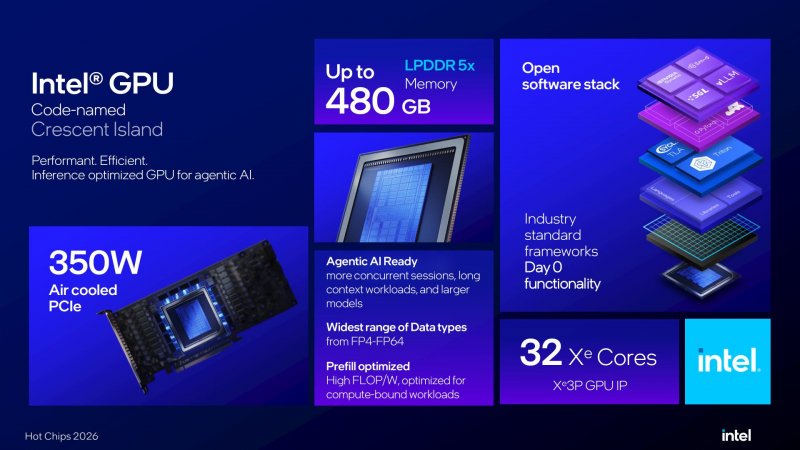
The primary purpose of choosing LPDDR5X is to reduce cost and power consumption. Air-cooled PCIe cards do have TDP is 350 wattsmaking Crescent Island suitable for infrastructure where efficiency per watt and total cost of ownership are prioritized over sheer performance.
Nvidia, GPU prices increase again, RTX 5060 Ti exceeds $800

Every Xe3P core has 8 Vector Engine e 8 XMX Engine. The vector engine supports multiple digital formats, including FP8 and FP4, and provides FP64 functionality. The XMX driver uses a 16-order systolic array to accelerate AI typical matrix loads.
The cache subsystem includes 512KB of L1/SLM per Xe core, for a total of 16MB, and 32MB of unified L2 cache. Crescent Island also does not integrate traditional 3D graphics modules, leaving more space on the chip for resources dedicated to general computing and artificial intelligence.
Intel positions Crescent Island as Inference of AI modelspay special attention to the proxy system. The company cited support for language models, inference models, multimodal systems and diffusion models. Software features include support for vLLM, SGLang, llm-d and NVIDIA Dynamo, as well as KV cache management and agent orchestration systems on heterogeneous infrastructures.
Therefore, our goal is not necessarily to compete with the most powerful solutions equipped with HBM, but rather to compete with approaches based on memory capacity, consumption, and performance. cost per token. Intel specifically targets token-as-a-service providers and data centers that need to handle large amounts of inference.
Crescent Island will initially be available as an air-cooled PCIe accelerator. Intel plans to start shipping samples to customers Second half of 2026and more details on performance should emerge as commercial availability approaches. Therefore, this strategy is different from NVIDIA and AMD’s more powerful AI accelerators: Intel does not just focus on maximum computing power, but hopes to use the larger capacity and lower power consumption of LPDDR5X to provide a more economical inference solution.